
America's Cup Recon: France has short first sail - June 30
by Richard Gladwell, Sail-World NZ 2 Jul 03:25 PDT
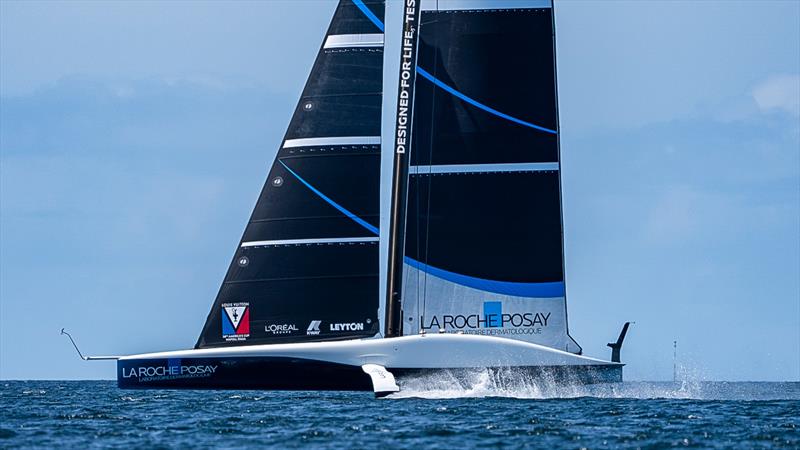
Sailing Day 1 - La Roche-Posay Racing Team (FRA) - June 30, 2026 - Lorient. France © Pierre Bouras / America's Cup
France and Italy both sailed earlier this week. Luna Rossa sailed out of Cagliari on Monday, while La Roche-Possay Racing Team, having completed three days of shore testing, ventured out into the Atlantic, off their base in Lorient, for a first test sail.
For the French, it was their first sail since competing in the 2024 America's Cup regattas in Barcelona; unsurprisingly, according to the Recon team, they didn't complete the full session.
There was no interview posted after the AC75 docked in, so we are none the wiser as to what happened, or if the early finish was planned all along. The indications were from within the team, that there was a lot of work to be done if the team were to sail on June 30. Having passed that milestone, it will be interesting to see if the team takes their foot off the accelerator a little, and adopt a more measured approach. They certainly have plenty of days on their test-sailing-days quota - with 55 days to spend - the most of the teams that participated in Barcelona.
The first two teams to sail AC75s in this 38th America's Cup cycle, have both enjoyed a smooth trajectory to date.
The French did look impressive in the runs shown in their Highlights video, with the Recon team reporting that they had possibly hit 40kts. The Recon Team would know that speed when they were pacing the French.
This was also the first sailing test of the new electrically powered onboard systems. Last time the French sailed this boat, which is the newest AC75 built, they had four cyclors providing the grunt for the hydraulic pressure, now it is push a button, watch and hope.
While the Recon team described the atmosphere ashore as "subdued", only a supreme optimist would have gone for a first sail and expected everything to be tickety-boo.
The highlights video, with great camera work, gives a good insight into some of the onboard systems on the French AC75, and by definition, what is in the Emirates Team New Zealand design package. The French have the same mainsail adjustment system that we have seen on the Kiwi boat, and there's a great piece of video showing it in action.
Recon Report – June 30, 2026
La Roche-Posay Racing Team - Sailing Day 1, June 30, 2026 - Lorient, France
Crew List:
- Starboard Helm: Quentin Delapierre (FRA)
- Port Helm: Diego Botin (ESP)
- Trimmer: Jason Saunders (NZL)
- Trimmer: Timothé Lapauw (FRA)
- Positions 5 & 6: Not named
Wind & Sea Conditions:
Summary: Sunny day with sea breeze building during the day
AM Wind: 290°: 6-7kts
PM Wind: 290°: 14-16kts
Sea State: Flat sea north of the bay. Choppy to the South
Dock Out: 1112hrs
Dock In: 1520hrs
Time sailed: 15 minutes
Recon Report – Sailing Day 1 - June 30, 2026
The Recon Unit was advised that La Roche-Posay Racing Team (LRPRT) intended to sail B1 for the first time on Tuesday 30 June, the boat's first sailing day of the AC38 campaign. From the dock-out brief, the objective was understood to be to validate the sail control systems with one upwind and one downwind at around 75% of maximum load.
The boat rolled out from the shed at approximately 08:15 and was taken to a different crane from that used on D3, where the port and starboard foils and rudder were fitted. The rudder appeared consistent with that seen on D3, though it was raked further aft such that the elevator leading-edge root did not sit against the hull. Orange marks were noted on the outboard wing tips of both foils, together with white marks slightly inboard along the leading edge on the outboard side of each wing tip. The anti-ventilation fences on the foil arm fairings appeared consistent with D2.
Mast stepping followed broadly the same sequence as D2. The forestay was attached and a tensioning sequence carried out, during which the forestay was detached and reattached while the halyard remained under tension on the hydraulic ram, with mast bend monitored throughout. A crew member was hoisted aloft to remove temporary holding ropes before the hydraulic ram was removed. The boat was craned into the water at approximately 09:42 with the bow facing the sea, as previously observed on D3.
Alongside the dock, a crew member was again hoisted up the mast using a halyard driven by a hand drill to remove the crane hooks and the temporary spreader piece. The Cunningham hydraulic rams connected to the orange hydraulic lines were installed, completing the Cunningham system, while the remaining temporary fittings and temporary forestay were removed. An extended dockside validation of the control systems then followed, including mast rotation to both sides, full foil cant cycles, and checks of the mainsheet, traveller, sheeting angle and mast rotation systems, often operated simultaneously from laptops on deck. Both mainsail skins (MN2-1) were loaded, and two jibs, J3-2 and J4-2, were on deck.
From the dock-out brief, the helmsmen were Quentin Delapierre on starboard and Diego Botín on port, with Jason Saunders and Timothé Lapauw also aboard. The boat docked out at approximately 11:12 under a short tow to clear the harbour.
The mainsail was hoisted on both sides before the jib, with a crew member later sent aloft to carry out checks around the jib hook. After a short tow, the boat was released and sailed in displacement mode before taking off at approximately 13:02. It reached up onto the foils and bore away to an estimated true wind angle of around 150° on starboard, working through varying modes of approximately ±10°. Boat speed appeared to be around 30 knots, possibly approaching 40 knots, with a fairly constant ride height and some pitch movement developing towards the end of the run.
A single gybe followed with a pronounced touchdown, after which the boat struggled to return to stable foiling with both foils down and considerable windward heel before recovering. Ride height and pitch remained irregular before briefly stabilising in a bow-down attitude. On a short port segment, raising the windward foil again led to further instability and another touchdown before the windward foil was lowered once more. The boat then stabilised briefly, headed up and stopped at approximately 13:14 after around 15 minutes of sailing. While stopped on the water, noticeable mast bend remained visible under load.
Following the stop, the technical team boarded the boat to carry out checks while the crew completed team photographs.
Once the checks were complete, the technical team disembarked, and the boat appeared ready to resume sailing, likely for an upwind, with the chase boat preparing a bow tow. An apparent interruption then followed, with the technical team boarding the boat again before a prolonged wait on the water. The boat was eventually bow-towed back to base from approximately 14:37 after the mainsail and jib had been lowered following work around the mainsail tack. The reason for the curtailed session could not be confirmed.
The boat docked in at approximately 15:20hrs. Once alongside, the small inspection openings in both inboard foil arm fairings were opened and personnel appeared to inspect the area before applying an unidentified coating or lubricant in several locations. Vibration fairings were also noted on the shrouds and lowers. During end-of-day handling, one foil was seen being pushed down manually rather than through the foil cant system, although whether this related to the earlier interruption or formed part of normal handling could not be determined.
The boat was lifted out at approximately 16:23. Blue markings were noted on the foil wings and beneath the foil bulb. The mast was unstepped and rinsed on the pontoon before the boat returned to the shed at approximately 18:08. Although operations ashore continued normally, the atmosphere appeared slightly subdued following the shortened sailing session, suggesting the interruption had not been entirely routine, though this could not be confirmed.
The Italian team sailed on Monday, and from the video and Recon Unit report turned in another encouraging performance. This is a team that has got away to a good start and has momentum in just six sailing days.
As guessed earlier, they are sailing in their Barcelona mode, and as discussed in another story appear to be bringing together a combination of solid America's Cup sailing and coaching experience from within and without Italy, and combining this with the energy of the Womens and Youth America's Cup champion crews to develop a new AC75 race squad.
Luna Rossa - Day 6, June 29, 2026 - Cagliari, Sardinia.
Crew List:
- Port Helm: Marco Gradoni/Ruggero Tita
- Starboard Helm: Peter Burling (NZL)
- Port Trimmer: Umberto Molineris (ITA)
- Starboard Trimmer: Gigi Ugolini (ITA)
- Positions 5 & 6: Maria Giubilei ( Port) Ruggero Tita (Stbd)
Wind & Sea Conditions:
Summary: .
1230hrs Wind: 180°: 7-9kts
1425hrs Wind: 170°: 10-12kts
1520hrs Wind: 180°: 13-15kts
Sea State: Flat, Light chop increasing to a moderate chop.
Dock Out: 1230hrs
Dock In: 1715hrs
Time sailed: 3.25hrs
Foiling time: 125mins
Recon Report – Sailing Day 6 - 29th June 2026
The Italian team rolled out at 1100. A new go-pro camera case was noted on the starboard outboard wing. New rudder was revealed, initially appearing shorter in length, with a longer chord on the upper sections and a shorter chord on the lower sections. Close-up and measurement shots were taken for better evaluation. The anemometer, now mounted on a differently shaped pole was again fitted at the masthead for the day.
Just outside the harbour, the boat was towed at low speed and low ride height. The helm was observed making sudden, minor course changes. For the first session, the crew consisted of Marco Gradoni (helm), Umberto Molineris (trim), and Maria Giubilei (5th) on port, and Peter Burling (helm), Gigi Ugolini (trim), and Ruggero Tita on starboard. Ruggero swapped with Marco halfway through the training session. The team seemed to struggle hoisting M2-4, requiring assistance from a technician who climbed to the mainsail head. Breeze was 7–9 kts from 180°, with mainsail M2-9 paired with J2-9.
The first session started at 1301 with a light initial tow by the primary chase boat. The boat sailed mostly straight, completing longer upwind boards, particularly on starboard tack, appeared stable in pitch. Minor course changes were executed by the helm for rudder testing. After bearing away in lighter air offshore, several gybes were practiced. Even in the lighter conditions, bulb-to-bulb time were counted approximately six seconds. After JK manoeuvre, the boat stopped and, while the sailors grabbed lunch, hydraulic technicians entered the port hatch below deck carrying toolboxes. In addition, minor damage was noted on the leading edge of the port arm.
After a short break, the boat was towed up and immediately bore away towards Poetto Beach. This second session unfolded in 10–12 kts from 170°, and the team appeared quite happy with J2-9. The sailing routine included some upwind manoeuvring before bearing away and executing a larger number of gybes. This sequence was then repeated on the opposite tack. Foilborne by 14:36, the third session unfolded similarly to the previous one. Gybes looked consistent and well executed, very occasionally a larger spray coming from the rudder during transitions.
Before the fourth session began, J2-9 was lowered and J3-9 was hoisted as stronger breeze was forecast. The unknown device on the starboard outboard wing was unscrewed and removed. Foilborne by 15:15, sailing resumed with additional manoeuvring. After the final round-up, the boat headed towards La Sella del Diavolo, where the team practiced aggressive course changes, ranging from bear-aways to round-ups in increasing breeze of up to 15 kts with moderate chop.
As the breeze increased to 17 kts with significant chop, the team changed from J3 to J4 at 15:55. The fifth session saw the Italian boat pick up pace in stronger air, possibly the strongest conditions they had sailed in so far. Upwind, the boat was sailed with heel to leeward, consistent with the target mode for stronger conditions. Manoeuvres looked steady and mostly dry, apart from the occasional larger wave striking the hull. RU struggled to keep up with the boat to capture dry footage and therefore anticipated the boat's course whenever possible. At 16:50, the Italian boat entered the harbour. The team docked at 17:15, concluding another productive day with approximately 125 minutes of foiling time, 41 tacks, and 46 gybes.
Additional Images: