
The Kings of the Lowriders
by John Curnow, Sail-World.com AUS Editor 16 Jun 01:00 PDT
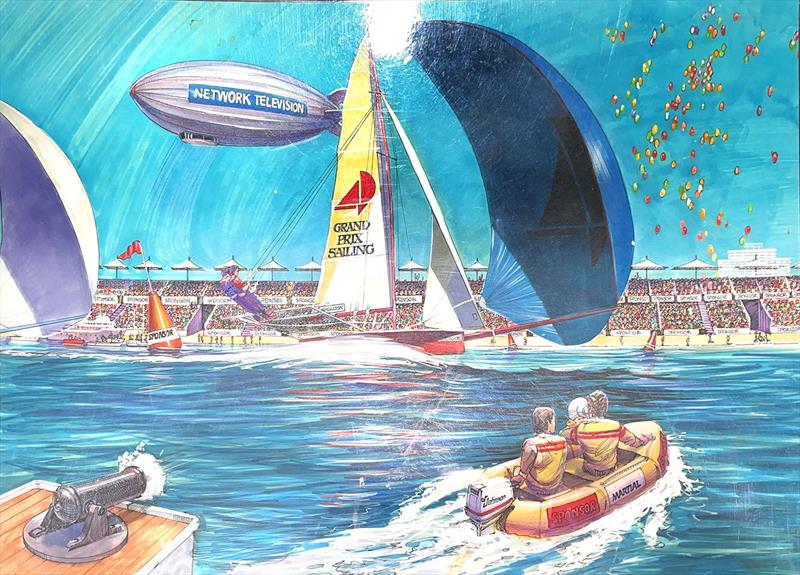
Graphics prepared ahead of the Grand Prix Skiff Sailing on the Swan River in Perth WA to highlight the TV coverage and crowd involvement © Bill Macartney
Rob Brown OAM reached out to me but a few weeks ago. Dangerous thing that, for it got me to thinking. As I pondered this, and reviewed that, I reached out to another great pal in Bill Macartney, to assess what I had been pondering. Namely, that before SailGP, there was Grand Prix 18-Foot Skiff Sailing. Everything has its genesis, and all…
Today, we have this here ditty. Also, I have to immediately say that it was our Managing Editor, Mark Jardine, who coined the phrase that is our headline, but you know, drive it like you stole it!!! So I will.
The sailing world loves innovation. Every generation likes to believe it invented the next great leap forward. Carbon fibre, foils, wing sails, mic’d up sailors, on board cameras, live telemetry, umpiring on the water, stadium racing, corporate hospitality, fan engagement, multi-layered marketing. The list goes on.
Yet the truth is that many of the ideas currently defining elite professional sailing were not born in San Francisco, Bermuda, Valencia, Porto Cervo, Auckland, or even SailGP itself. They were being trialled, refined and commercialised by a group of determined Australians just on four decades ago aboard some of the wildest boats ever created. The were the Kings of the Lowriders all right, and had different rigs for different velocities, flexi tips even, and massive wings of over 20 feet (as in the racks extending from the topsides), which are larger than what is there now, but amazingly much shorter than the 32 feet of Brown’s own Bradmill of 1985.
Long before F50s were carving around short courses in ‘stadium-esque’ locales, and at breathtaking speeds like low 30 knots, the Australian 18 Foot Skiff Grand Prix circuit was already demonstrating what modern sailing could become.
The story is not simply one of fast boats. It is a story of vision, and even more crucially, the passion that had to be applied to make it so. It’s also a story that deserves to be remembered.
Time and a place
The 18 Foot Skiff has always occupied a unique place in sailing. They’re ridiculously overpowered, spectacularly unstable, astonishingly fast, designed to be pushed, and so the class has long lived on the edge of what is possible. As Brown himself says, “The boats demanded absolute commitment.”
If you’re an F1 fan from back in the turbo era, you’ll remember they had qualifying engines. In the case of the #3 rig for when the squirt got to 18 plus knots TWS you had to go out there and use it for the whole race, not a blast for bragging rights. “That was when things became particularly interesting. The skiffs were capable of speeds that left crews simultaneously exhilarated and terrified.”
For spectators, however, there was a problem. How do you convey the experience of sailing one? Better still, how do you bring the audience on board? Those questions sat at the heart of what Bill Macartney and his team were trying to solve during the 1980s. The answer would eventually reshape the very way in which sailing was presented, and in the golden decade from the late 80s to 90s, not one, but three separate networks all ran the 18-footer Grand Prix, including the fabled spot in the lunch break at the cricket.
Nexus
It was before the start of the 88/9 season that the skippers all got together in Dee Why and decided that there would be no arms race for the season due to the impossible economic climate we all found ourselves in. Smart thinking. So apart from repairs and maintenance, a moratorium was placed over the fleet. By and large it sort of stuck. Sort of.
Brown had the tiller of Southern Cross, and along with crew of Dave Slennet up for’ard and Kevin Nixon on the main, they won the JJ’s that year (World Championship of sorts), amongst a lot of other races. No new sails for the year meant the kites especially took a pounding as they went around the headsail each time. The replaced the clew area, but got sent to the room for being more than the 25% that was allowed. It got thrown out.
On appeal it was deemed to be 26% of area that had been replaced, and so Trevor Barnabas, Phil Barnett, and Adam South with a brand new Chesty Bond hull and #3 rig were elevated and named as co-winners. Peculiarly, the trophy got engraved with the latter’s names on top, even though they had finished second, as such…
At any rate, the upshot was that it gave the 18 Foot Grand Prix and real hand up, with most of the sailors coming over to join the league that had been carefully crafting and building its offering over the preceding few years, and was thus ready to really set sail, and boy did they!
So, there had been a larger battle raging. Many within the Grand Prix movement believed they were fighting not merely competitors, but resistance to an entirely new vision for sailing. It should be pointed out that Brown was one of the stars for the show, as well as a two-time winner of the Circuit which visited all of the Australian State capitals and Auckland, NZL. To say nothing of his wins in the America’s Cup, Admiral’s Cup, the famed JJs, along with a vast collection of other gems…
Did someone say Che Guevara?
Well it was all a bit revolutionary. Back then, if there was coverage, it was stills taken at the time, and a report published up to six weeks later in a magazine. Yes, the 18’s had sponsors, but up until this new dawn, it had been a bit rudimentary. Macartney, with his film and TV background saw it differently. Rather than document the past, why not allow them to experience it? There’s an idea…
The objective was simple in concept, but enormously difficult in execution, for it was about getting viewers as close as possible to the action. This in turn meant microphones and cameras on board. Of course, if you were there in the day, you’ll remember that the microphones were almost superfluous, given the tonality, shall we say. Lip reading 101 became everyone’s favourite book in that era…
It also meant chase boats, and innovative television production techniques. Most importantly, it meant treating sailing as entertainment. Today such concepts seem obvious. At the time they were anything but, and many considered it heresy. Probably still do.
The on board camera systems were heavy, awkward and difficult for sailors to use. Helmets carrying cameras and audio equipment frequently snagged on rigging. Technology had to be developed from scratch, no Bluetooth and WiFi back then, after all. Production crews were inventing solutions as problems appeared, and yet the results were extraordinary, even addictive.
For perhaps the first time, television audiences could see the expressions on sailors' faces as boats accelerated into ‘survival mode’. They could hear instructions shouted between crew members. They could witness the intensity rather than merely being told about it. And that experience became visceral. Suddenly, the audience was right there, on board one of these oh-so-often frightening machines.
Even today, Macartney talks both avidly and fondly about how he would be cock-a-hoop in the edit suite when they had managed to capture face on imagery during extreme moments when the emotions were obvious, and language just about the same.
Same, same, but different
Looking back now, it becomes increasingly difficult to ignore the parallels between Grand Prix sailing and the modern professional sailing landscape. Macartney readily acknowledges that the objective was always to create a sporting spectacle that could attract people who might otherwise never engage with sailing.
The challenge was significant. Unlike football, cricket or rugby, sailing lacked deeply embedded tribal loyalties. Fans were not automatically inherited or invested through generations. This meant every spectator experience mattered. Every sponsor mattered. Every guest mattered.The solution became an obsession with delivering value beyond the racing itself.
Corporate hospitality evolved into a sophisticated operation. Guests were not simply transported onto the water and left to watch. They were immersed, with expert commentary added to really draw people in. The atmosphere became part sporting event, part entertainment experience, and part business networking platform.
The approach worked. By the mid-1990s hospitality accounted for approximately 40 percent of revenues and profits. More importantly, it became a powerful pathway for attracting new sponsors. Business leaders experienced the product firsthand and wanted to become involved. The commercial engine fed itself. Eventually the circuit grew into a multi-million-dollar operation.
Indeed, Brown reflects fondly of the camaraderie between crews, sponsors, supporters and the organisation itself. Like many, he’s thrilled to still see it so today.
What’s in a name?
One of the most fascinating threads connecting past and present involves a young Olympic Champion from New Zealand. Sir Russell Coutts KNZM CBE as he is now, first encountered the Grand Prix circuit during the summer of 1986-87.
Fresh from Olympic success, but unfamiliar with the unique demands of 18 Foot Skiffs, he arrived in Australia to compete. The learning curve proved steep. The boats punished mistakes. Equipment broke. Crews finished races exhausted. Yet Coutts refused to surrender.
McCartney remembers seeing a fiercely determined competitor confronting one of sailing's most demanding challenges. A decade later, following America's Cup success, Coutts returned to race the circuit once again. This time he experienced the operation from a very different perspective.
He saw not only the racing, but also the commercial model, the television production, the sponsorship structures, and the hospitality programme. The entire ecosystem. At the conclusion of that final season before Grand Prix sailing changed hands, Coutts reportedly expressed considerable admiration for what had been achieved.
Years later, when SailGP emerged, many familiar elements appeared once more. Nobody is suggesting SailGP is simply a replica. Far from it. Modern technology, enormous budgets and globalisation have utterly transformed what is possible.
Yet the conceptual DNA remains difficult to miss. Namely, the philosophy of bringing fans closer to athletes, making sailing understandable, turning elite racing into compelling entertainment. These ideas were already alive and thriving aboard the 18-Foot skiffs.
What does it all mean?
The boats were and are amazing. It is what allowed Grand Prix Skiff Sailing to be the thin edge of the wedge. The people were pretty damn cool as well. Now we got to experience speed, determination, hanging on for dear life, and all the drama that entails. It wasn’t the moments that were captured that were hitherto unavailable to audiences. It wasn’t the faces contorted by concentration, or other fields of human endeavour, and it certainly wasn’t spray everywhere.
It did translate the rawness of the experience directly onto screen. Even now, decades later, footage from that era retains an immediacy that feels remarkably contemporary. Perhaps, and that is just maybe perhaps, that is because modern sailing has finally caught up with what those pioneers were trying to achieve, and they have even more tools at their disposal to make it so.
You could argue that genuine innovation rarely appears from nowhere. It evolves. It builds. It learns from earlier successes and failures. The current sailing landscape owes much to people prepared to experiment long before commercial success was guaranteed. They treated sailing as entertainment, without diminishing the sport itself. Most importantly, they demonstrated that sailing could be presented in a way that captured the broader public attention.
Today, SailGP fills waterfronts around the world. America's Cup coverage delivers telemetry, on board audio and immersive viewing experiences. Drones chase foiling cats and tris when out at sea. Fans engage with sailors in ways once considered impossible.
Before telemetry. Before foiling. Before SailGP. Before streaming, there was Grand Prix Skiff Sailing, and I would suggest that the future of sailing started there. Next year they are having their 40 year bash. Do hope I get a Guernsey to that little affair. What a hoot…
Thank you for being a crucial part of Sail-World.com
John Curnow
Sail-World.com AUS Editor