
2026 Dutch Water Week - Day 1
by Dutch Water Week 3 Jun 02:15 PDT
30 May - 7 June 2026
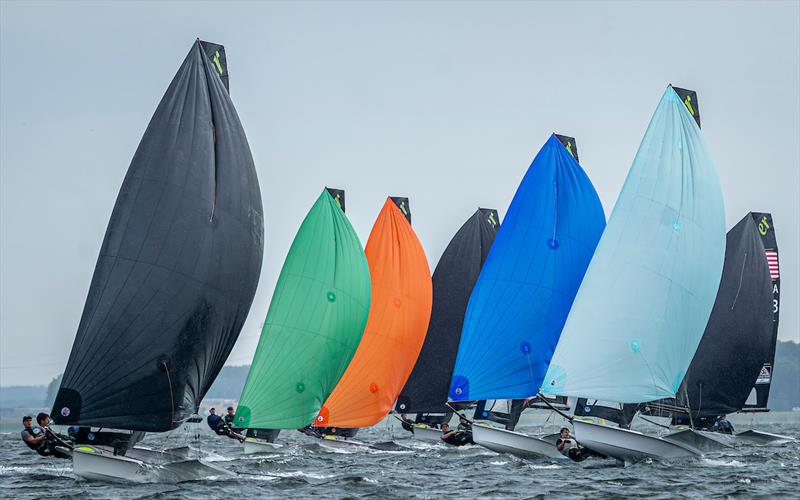
2026 Dutch Water Week - Day 1 - Sailing Grand Slam Almere © Sailing Energy / Dutch Water Week
The opening day was defined by the inherently fickle nature of the Dutch weather. Several showers passed over the racecourse just off the coast of Almere, causing treacherous changes.
The races took place off the coast of Almere on the IJmeer, with the historic fortress island of Pampus serving as a striking beacon in the background. Almere is perfectly situated as a central watersport region in Flevoland. As the youngest province in the Netherlands, surrounded by large open waters such as the Markermeer and IJsselmeer, Flevoland is one of the largest interconnected sailing areas in Europe.
Sailing Grand Slam
The regatta in Almere marks an important milestone on the international calendar. The Sailing Grand Slam is the global World Cup circuit for Olympic classes in the cycle leading up to the Los Angeles 2028 Olympic Games. Following the season openers in Palma de Mallorca (Trofeo Princesa Sofía) and Hyères, France (Semaine Olympique Française), the world's top sailors are competing in the Netherlands this week for coveted ranking points, before the circuit moves on to Kiel and the United States.
Sports on the beach
While the Olympic boats headed out onto the racecourse off the Almere coast, there was also plenty of activity on and around the beach for the youngest generation. Thanks to the presence of 'Optimist on Tour', local primary school children and youth from the surrounding area could get a free introduction to watersports in the sheltered waters. Under the guidance of enthusiastic instructors, they gained their first experiences in an Optimist, canoe, or on a stand-up paddleboard (SUP).
Tactical races on open water
Out on the open water, the weather proved unpredictable today. The wind ranged between 12 and 15 knots, but inside the squalls, it picked up with gusts of up to 25 knots. Due to these heavy gusts and the accompanying wind shifts, the teams immediately had to focus on flawless boat handling and tactical positioning.
Because of the shifting wind directions, the race committee postponed the first starts to wait for more stable conditions. As soon as the wind stabilized, the schedule was efficiently executed, resulting in three completed races on the scoreboard for the 49er fleet by the end of the day.
In the 49er class, Andrew Mollerus and Trevor Bornarth from the United States ended the day as leaders of the standings. At the previous Sailing Grand Slam in Hyères (Semaine Olympique Française de Voile), they finished fifth. "We have this event, then another Grand Slam in Kiel, and then the Europeans. It's only going to get more intense from here, so we're just trying to see what we can learn from this," Mollerus said.
Small ILCA Fleet offers unique medalrace simulation
The size of the ILCA fleet in Almere is notable for being relatively small this week. While sailors typically compete in fleets of sixty boats during major international championship events, they are now racing in a highly compact setting. "It is obviously different, but it actually serves as excellent practice," explained Dutch sailor Willem Wiersma. "Normally, you only encounter such a small fleet at the very end of a regatta during the top-ten medal race. That introduces a very specific dynamic that is almost impossible to replicate in standard training. Here, we can simulate that exact scenario for an entire week and focus entirely on executing our own race."
Key learning moments for Roos Wind
ILCA 6 sailor Roos Wind, who recently secured a silver medal at the U23 World Championships, shared a similar perspective: "You learn completely different skills here," Wind noted. "Because the courses are shorter, the sequence of mark roundings happens much faster. That forces you to prepare your starts and maneuvers with extreme precision."
Wind remained critical yet level-headed regarding her own performance on the opening day: "To be honest, today didn't go very well; I missed the shifts tactically a few times. But that's fine. These regattas are intended precisely for these types of learning moments. We will analyze the data with the coach and adjust our approach for tomorrow."