
New Zealand flagged entry to compete in The Ocean Race Atlantic
by Richard Gladwell 31 May 20:29 PDT
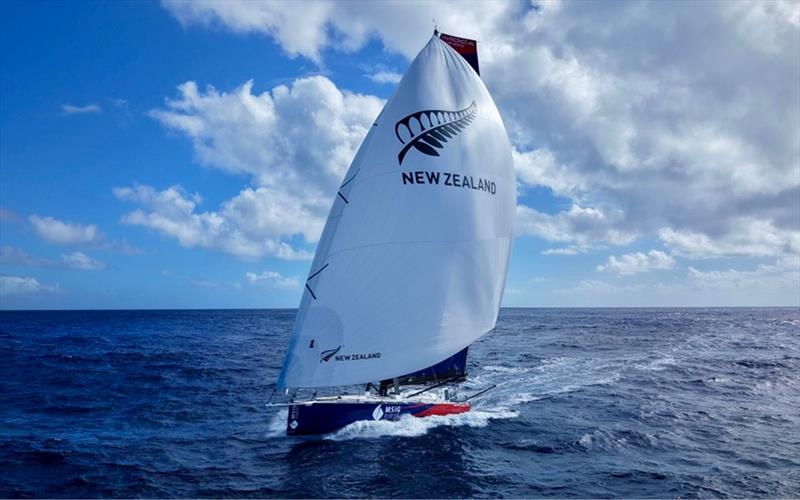
MSIG Europe - Conrad Colman - The Ocean Race Atlantic - April 2026 © Georgia Schofield
In September, Conrad Colman will skipper the New Zealand-flagged MSIG Europe in The Ocean Race Atlantic - a 3,000nm sprint from New York to Lorient in France. The IMOCA60 is one of six entrants in the new event.
Sail-World NZ's editor Richard Gladwell caught up with Aotearoa Ocean Racing's Conrad Colman, during a recent stopover in Auckland.
Colman is New Zealand's pre-eminent short-handed sailor, having completed two Vendee Globe Races and several others in the 60ft IMOCA class used for the Vendee Globe and events organised by The Ocean Race. He is the only sailor to have completed the single-handed Vendee Globe round the world race, without using fossil fuels.
He is now in the sponsorship hunt for his 2027 entry in the fully crewed edition of The Ocean Race.
"At the moment, I'm running around the world trying to find sponsorship to get the New Zealand team into the race, " he told Sail-World.
"We're not there yet, but I am signing some contracts. I've extended with my existing partners, MS Amlin Europe [MSIG Europe, a Franco-Japanese based global corporate insurer and re-insurer.]. So I've got my existing boat and my existing campaign locked down for another 12 months. That gives some solidity on which we can build for the rest. But frankly, we're looking for, for other, other partners, other sponsors, that can join us to help build the team at the level we need for The Ocean Race."
He's got his eyes on a top boat, the Verdier-designed PRB Holcim, which finished second in the last edition of The Ocean Race, and sixth in the 2024-25 Vendee Globe.
"It's often a sort of all or nothing," he says, having seen the sailing sponsorship hunt movie a few times previously. "Everything can change with one stroke of the pen. Or, often when one partner joins, the other one will come as well. I've got lots of balls in the air, and I'm just trying to make something more concrete at this point," he says.
In 2025, Colman competed as a co-skipper in a Swiss entry in the second edition of The Ocean Race Europe, also sailing in fully crewed IMOCA60s.
"It was an excellent experience. But it also showed the pitfalls of coming in very much at the last minute on a small budget. Skipper Alan Roura did a lot of the work. It was fantastic to go out and sail with young, up-and-coming sailors from New Zealand and Switzerland. But we want them on our side of the ledger. That campaign showed me what it looks like to build this kind of team from the inside and gave me valuable experience sailing fully crewed IMOCAs. So now I'm in a much better place, having done that race, to build my own team."
In the 2024 Vendee Globe, Colman competed in a 20-year-old IMOCA60, on a small budget, and finished as the second daggerboarder, behind race veteran Jean le Cam.
"The sponsor and I walked away happy because we'd achieved the goals that we wanted. The Ocean Race is a different kettle of fish because, with a multi-leg or multi-stopover race around the world, you need a homogeneous fleet where everybody is more or less the same speed. That you need to have more or less the same budgets - and obviously we need to be into the latest generation of boats."
"Also, whenever we talk about Kiwis doing the Whitbread or the Volvo OR, and what is now called the Ocean Race, is that anybody who steps up to take the New Zealand flag into the next edition is standing on the shoulders of giants. You've got skippers like Ross Field, Grant Dalton, Mike Sanderson and, of course, Sir Peter Blake. They all won their races. And so that's the level that we're trying to get to when we talk about a New Zealand team in this race."
"We're not just there to make up the numbers, but actually, really compete for the trophy."
The upcoming Ocean Race will be the 15th edition of the crewed Round the World race, which began as an adventure race/cruise around the world in 1973 and quickly became one of the toughest races in the sport.
"The adventure side of the race is always present - particularly when we're doing a 14,500nm leg that goes from Alicante to Auckland - down the North Atlantic, South Atlantic, through the Indian Ocean, and then the Tasman. There's no way that cannot be an adventure."
"We have a field of play that is the most dramatic and most exciting, the most unpredictable in the world," he adds.
"The teams are becoming ever more professional. There really isn't space for enthusiastic amateurs anymore because the level of the sport is so high. The boats are extreme. A foil-assisted IMOCA in the middle of the ocean is no joke. And so you've got to have the people, the experience, and the training time to do the race justice."
He compares life on an IMOCA60 to the 84ft Steinlager II. "It's a much bigger boat, two masts, and then loads of berths down below. And so it almost looks like a cruising boat!"
"You can stand up in comfort. You've had a proper place to cook, sit down, and have a meal. Our boats are designed around solo sailing in the Vendee Globe. And then you adjust things a little bit to shoehorn a couple more people in. And you sail with four sailors, one of whom is female.
"I would like to go to a 50/50, gender mix for the crew, because that's a principle that I believe in.
"You're sailing with two people on watch, two people off watch, and so everything has to work around what you can do with two people. But because these boats are designed with incredibly powerful autopilots, it's the pilot who drives most of the time, even in a fully crewed environment. There are always two people who are there trimming the boat, adjusting the sails, and preparing the next manoeuvre with a much greater frequency and a much greater potential of its overall performance than you can do when you are a solo sailor."
In previous editions of the Whitbread and Volvo Ocean Races, it was a familiar Southern Ocean image to see the crews out in an open cockpit, as massive seas loomed in the background or swept the deck of the boat as they overtook an ocean roller. By contrast, the IMOCA60s are generally completely enclosed, and the crews fully protected.
"I've sailed on Volvo 70s and 65s in quite rowdy conditions - and when you're at risk of having your feet washed out from underneath you at all times, that's not very much fun, frankly."
"For me, sailing is a tactical sport. It's really interesting to try and position the boat within the weather system so that you can best exploit the power of the wind to go in the right way at the right time. "
"For me, that's the interesting part of it."
We kid him that sailing on IMOCA60s is like sailing from inside a bus shelter.
"I put a roof over the top of my last boat (still open aft). The next boat we plan to sail will be of the new generation, which is more or less completely enclosed. As a sailor, it can be quite disorientating, because you don't always have the wind in your face. So you're sailing by numbers - on everything that's coming from the instruments, rather than by feel.
"Sailing on a foil-assisted monohull is also quite disorientating. Plus, the fact that it's enclosed means you're a slave to the numbers, the polar algorithm, and the performance metrics.
As you as the breeze comes on, instead of heeling over the foil digs in and brings you back up to neutral heel. And so you end up just going faster. But then the loads increase, because you're now generating more dynamic righting moment off the foil, and then there's the standard righting moment that was coming from the keel previously. So you really need to change the paradigm you're sailing in. Everything changes."
While the IOMOCA60s will sail at 40kts, Colman explains that ultimately, the sea state is the barrier. T-foils are not allowed on the rudders, so the IMOCA's sail with a very bow-up trim, with the stern just bouncing across the waves.
"The goal at the moment is to create a hull shape that will allow the boat to move as pleasantly as possible over the waves and stabilise the angle of attack of the two foils, or the keel and the foil. So that is ultimately the limiting factor."
Colman has been the leader in proving the viability of being able to sail and race using only renewable energy sources - wind, sunlight and water flow. He was the first sailor to complete a Vendee Globe race without using fossil fuel, and repeated the feat in the 2024 race. On top of the usual power drain for sailing requirements, Colman generated more than enough energy to power his heavy and frequent media commitments.
"I have been an actor in changing the race rules to force the rest of the fleet to adopt renewable energies as well," he says. "I went all the way around the world without any fossil fuels in 2016 and then, sadly, missed the 2020 edition of the Vendée. I did the last one in 2024 using a different mix of technology, but the same ethos and the same result - 30,000 miles of sailing, and used zero drops of diesel.
"I've been actively advocating for this to become a general standard within class. Ultimately, in the Vendée Globe it was the Event that adopted this ethos more than the class itself did. And the point that we've ended up in for the next edition of the Vendée is that sailors are allowed to consume 60 litres of diesel. Previously, they took 300 litres, so the 60-litre limit is below the minimum required to get around the world if you're using purely conventional energy sources. And so that forces everybody to adopt either hydro generators or solar panels, or perhaps some other blend of technology.
"But there is still the allowable component of burning 60 litres, which is what disappoints me, but I'm happy to push the class in this direction. Perhaps they'll go further next time."
"For me, there is zero tension between performance and clean energy. Indeed, I would argue it's the other way around because the gear is lighter.
"Clean energy is an advantage, because the weight of the solar panels, plus the one extra battery that you need to take in order to store some more energy to make the system viable, is lighter than the diesel that you would consume anyway. So you've got a lighter boat. Anybody who's a sailor knows that a lighter boat is better."
"Technologically, it is also more robust. In the Vendée, I had 32 individual solar panel modules on board the boat, and three hydro generators. The idea is to reduce single-point failures. And historically that has been, that has been the engine. So you've got either the starter motor, the alternator, or something mechanical. With the engine itself. They can wipe out your single point of charge, and then your race is cooked. Whereas I had 35 sources of energy on board, if any one of them drops out, I can reconfigure the charging network to operate at 97% instead of 100%, and I'll still get around the world and be safe.
A 14,000nm super-leg from Alicante to Auckland is a feature of the next The Ocean Race - 1,250nm more than the monster leg from Cape Town to Itajaí, Brazil. Perhaps the race organisers are being optimistic, saying this leg will be completed in a month, when the 12,500nm leg took 35days. But whatever the projected time, Colman insists that a 14,000nm leg is viable, and an interim stopover won't be introduced.
"Remember, these are the boats that are designed to do the Vendee Globe - admittedly, 14,000nm is a big chunk of the racecourse. It's half of the Vendee Globe, but you're doing that fully crewed and with boats that are largely either designed for this or have already done it in the previous Vendee Globe. So technically, it's zero challenge. It's a case of managing your resources, managing the team, managing the boat itself, so that you have sufficient reliability to race the boat hard, both down the Atlantic and into the Indian Ocean.
"Something that could be potentially introduced is a scoring gate or some other point of passage relatively close to Cape Town. That means if you have significant breakage and want a technical stopover, you can re-enter the race without a significant delay. Whereas if you leave the routing completely open, then that often takes you way, way south of Cape Town. And that means a technical diversion would be incredibly costly and could put the rest of the participants in the race at risk."
Quite how many boats will contest the next edition of The Ocean Race remains to be seen.
In September, a new event, The Ocean Race Atlantic, will get underway from New York, with the Statue of Liberty as the starting line, to Lorient, France. The 3,000nm event, the first point-to-point event in the history of The Ocean Race, has attracted a fleet of six entries so far and starts in just over 90days.
Conrad Colman will be sailing the New Zealand-flagged MSIG Europe in the race, using his daggerboard IMOCA MS Amlin, a VPLP - Verdier design that he upgraded ahead of sailing in the 2024-25 Vendee Globe.
"The minimum that we'd like to see for The Ocean Race 2027 is six. It'd be nice to get a fleet of eight. It is a bit of a challenge looking around at the current IMOCA fleet and considering who the potential candidates are who could step up and be present for this kind of race. There are several boats that have announced their official entry or candidacy, and others, like my team, are working to get in there.
"There are a lot of individual decisions that will make the collective, but my hope is to have at least eight boats in the fleet."