
America's Cup Recon Diary: April 22 - Kiwis burning through AC75 sailing days quota.
by Richard Gladwell, Sail-World NZ 23 Apr 04:12 PDT
23 April 2026
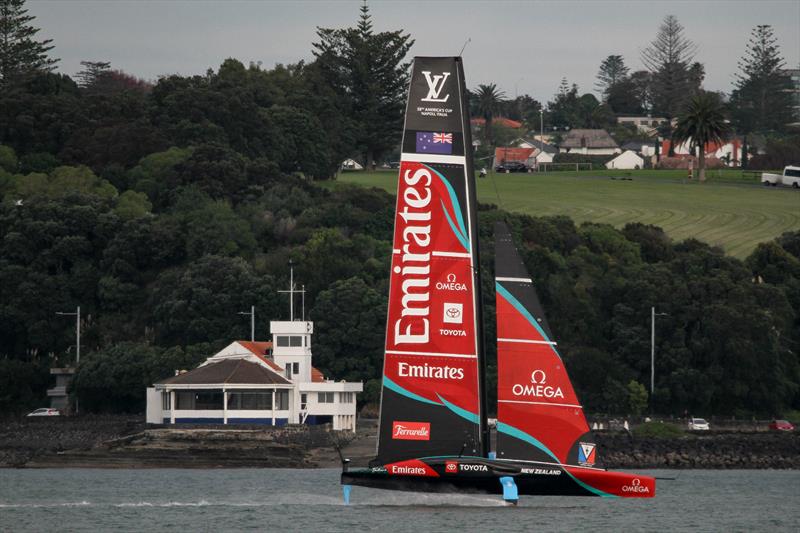
Emirates Team New Zealand - AC75, Day 11 - April 22, 2026 © Richard Gladwell / Sail-World.com/nz
Emirates Team New Zealand continued their second block of testing on Wednesday in a light breeze that grew in the middle of the day into a useful 15kts with a flat sea state.
It was steady as she goes, with the main objective being to find a breeze. In the end, it found them.
The thought was they might have sailed on Tuesday, but with Auckland now in mid-Autumn, the summer seabreezes are no more. And they were fortunate to have found the southerly breeze which grew to 15kts.
Under the new Protocol when every part-sailing day is scored against the team quota, ETNZ have 45 days until early January 2027. They now have 34 sailing days left or have used 25% of their allowed quota. Part-days are expensive, and a higher degree of certainty is now required before triggering, the test sailing sequence. All the teams, except the Kiwis, have extra sailing days in their quota, depending on where they finished in the 2024 America's Cup Regattas.
The Kiwis started by towing the AC75 onto its foils, hoisted the sails, and did a couple of system checks. They headed out of sight up the East Coast Bays and returned before heading deep into the Hauraki Gulf. From the video, we can see the breeze was still very soft, with several touchdowns from which the crew was able to recover.
Later in the session, we saw the rope ladder come out again as one of the support team members crawled out onto the starboard wingfoil for some camera adjustments.
"The foil has eyes, so we were just turning those on, and we're just watching from under the water," was the explanation given by Jake Pye, a man of few words, in the post-session interview with the Recon Team assigned to follow ETNZ.
From the video, it's apparent they found a good strength of breeze out in the Gulf. The breeze proved to be more problematic as they neared the northern side of Waiheke Island - but still provided good testing for the lighter breezes expected in Naples, when racing begins in earnest in just over a year.
They returned and finished up by doing some runs along the northern Shore of Rangitoto Island.
We caught up with them in the Rangitoto Channel, where they stopped for a crew change, followed by a few more runs in flat water and a moderate breeze.
There we saw again the characteristics we had seen before - near-optimal fore-and-aft trim with the bow knuckle very close to the surface, and setting up the endplate effect to seal the hull and rig as close to the surface as possible, to maximise rig efficiency.
Also apparent is the degree of windward heel that the crew can hold, particularly when the breeze is a little lighter, and the weight of the windward foil helps induce heel. But instead of collapsing in a heap, in a breeze that is pushed about several extinct volcanoes, the Kiwis seem to be able to maintain an impressive degree of balance, with the tip of the windward wingfoil only occasionally nicking the surface of the water.
We don't know if they are flying on automated foil control or manually. However, if they are on the automated system, then it is setting a very high bar for the manual flight controllers to emulate in racing.
The session ended with a run into Mission Bay before heading on their final stretch up the harbour under sail. This is the first time we have seen this in the current cycle - and maybe a sign that there is more confidence in the new team. And a good opportunity to show the team to Auckland fans as they headed home from work along the waterfront drive and over the Harbour Bridge.
Testing Session Summary
Crew List:
- Port Helm: Chris Draper (GBR)
- Starboard Helm: Nathan Outteridge (AUS/NZL)
- Port Trimmers: Iain Jensen (AUS); Jake Pye (NZL)
- Starboard Trimmer: Andy Maloney (NZL)
- Oversight: Jo Aleh (NZL) - Starboard
Wind & Sea Conditions:
- AM Wind: 180° 4-8kts
- PM Wind: 180° 5-15kts
- AM Sea State: Very flat
- PM Sea State: Flat
- Dock Out: 1000hrs
- Dock In: 1620hrs
- Time sailed: 4hrs
Recon Unit Report - ETNZ assigned team - 22 April 2026:
Key Points:
- Starboard foil instrumentation (dual sensors: T-section + tip)
- Light air manoeuvre limitations (delayed board timing, hull drops)
- Windward foil down turn ups and foil drops (foil with cameras on)
- Progression into higher-speed two-foil and then one foil manoeuvres (10–15 kts)
The team rolled out early, with a light but chill southerly. A dual-sensor setup was installed on the starboard foil, with one sensor monitoring the T-section and the second at the tip— aimed at sectional flow behaviour on Foil junction and tip dynamics. Sail configuration indicated J3-3 in use, paired with M1-0, with a notable structural attachment point added approximately 1m up on the jib head pennant.
Dock-out and sailing commenced mid-morning, with early conditions in the 5–10 kt range. Initial phases were manoeuvre-focused, particularly gybes and bear-aways, with an emphasis on riding high/foil out through the bear away with windward heel. Noticeably a bow down attitude sailing downwind. At approximately 1104hrs, a rudder loss during a gybe, possibly from debris in the water.
Through 1120hrs–1230hrs, the session shifted into structured light-air manoeuvre work. Repeated gybes and tacks exposed consistent limitations: delayed board-up timing, frequent hull drops, and slow speed rebuilds. Tacks showed reduced pre-roll with a pronounced “catch” required via traveller input, though acceleration was slow. Jib battens were adjusted.
By 1250hrs, repeated starboard bear-aways into port gybes continued to show unstable exits, with hull touchdowns and inconsistent catches. However, incremental improvement was noted with more traveller ease on entry and a higher, cleaner traveller catch on exit developing through the sequence.
A short reset phase included battery swaps (~1300hrs) and cameras activated on the foil package. At approximately 1330hrs, aggressive two-foil down round-ups were tested with the windward foil behaviour recorded. The boat was then towed towards more breeze.
From 1400hrs onwards, the session transitioned into more dynamic testing in 10-16knts breeze. A long reaching leg on starboard included cycling the windward foil (down/up) possibly to assess stability response and attachment testing. As breeze built into the 10–15 knot range (~1430hrs), the team progressed into higher-speed manoeuvres, including two-foil-down transitions and larger one-foil turning circles.
A crew swap at ~1440hrs preceded the final block at North Head (~1515hrs), returning to light-air manoeuvres and focused speed-build / “hop-up” flight input in sub-flight conditions.
The session concluded with pre-start work at ~1550hrs before returning home.
Additional Images: