
Some difficult questions on the first hours and night of the Rolex Sydney Hobart
by Richard Gladwell 25 Dec 2025 15:30 PST
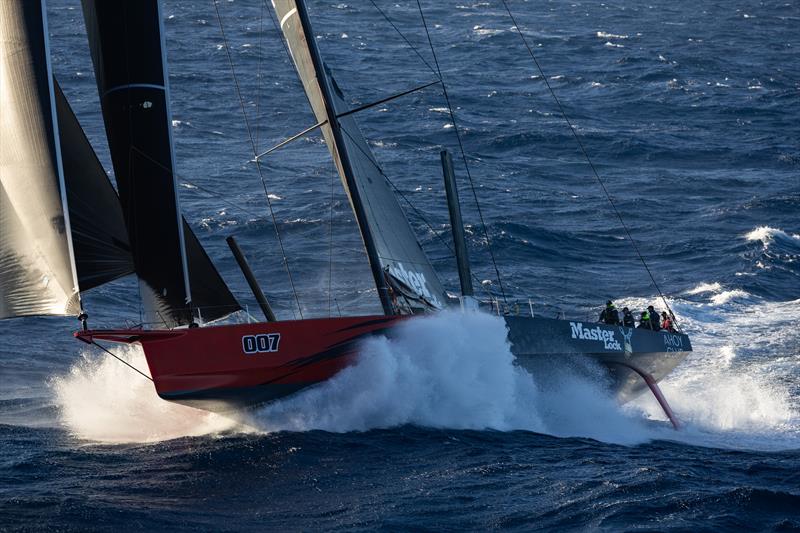
MasterLock Comanche - Rolex Sydney Hobart Race - December 2025 © Andrea Francolini
With fresh southerlies forecast for the start and first day, to the surprise of no-one the race record is not under threat.
According weather routing using PredictWind, and a hypothetical supermaxi's performance polar, the eight weather feeds used/produced by PredictWind, show the race taking 51-54 hours - well outside the record set by LDV Comanche in 2017 of 33.25hrs
The 2025 race is unusual being the first in over 10 years, to have started in a southerly, and to have "enjoyed" similar conditions for the first night at sea.
In the 2014 Rolex Sydney Hobart, which was the first outing in Australia for the 100ft supermaxi, Comanche then under the ownership of tech billionaire Jim Clark (USA) and his wife Kristy Clark (AUS), set a record for being first to Sydney Heads of four minutes and 35 seconds after the starting signal to rounding the first turning mark. That unforgettable record run is likely to be the only mark under threat in this the 80th anniversary of the 628nm offshore classic race.
From there, in 2014, the fleet faced 25kt southerly winds for a tough night, instead being pushed south by the usual north easterly breeze followed by a southerly change.
The PredictWind routing for all eight feeds, shows the boats staying on starboard tack for the first three hours or more, before tacking onto port and heading down the NSW coast. Whether they make this move is one of the first decision points of what will be a very tactical and tough, maybe boat-breaking race.
Looking at the predicted current chart, the northerly set off the lower east coast of Australia is relatively weak, however offshore the direction reverses to become a southerly set and gives the yachts that are positioned in it a push of 1.5kts, but it also likely to create a bigger adverse sea state. There is a small penalty to pay for the boats that elect to cross the northerly set to reach the advantageous current.
Two of PredictWind weather data feeds this year based on generative AI, and they are in broad agreement with weather routing produced by the other six feeds, all of which are manipulated by the PredictWind engine. To date the AI modelling has proven to be exceptionally accurate according to PredictWind. The generative AI takes into account what has happened historically in races which show the same markers as the current event, and then analyses that against the current forecast, to produce recommended routing. The PredictWind routing also takes into account current and sea state. The top boats are expected to encounter as awkward sea state crossing Bass Strait, and PredictWind's easterly routing tries to minimise the effects, as much as possible, on the race leaders.
The challenge for the navigators will come on the second day of racing when they have to make a decision as to how they close the Tasmanian coast, to make the finish in the Derwent River.
In this regard there is a high degree of variation between the course options, with a couple recommending staying well offshore, and making a fast approach to the finish. Others recommend coming in a lot earlier, with the fleet expected to converge off Schouten Island, halfway down the Tasmanian coast.
In the past, with NE winds at the start, navigators have been reluctant to diverge too much from the rhumb line course, and it is likely that a similar pattern will emerge this year.
All routing shows the breeze staying fresh and in the south for the first day, before easing and swinging late on the second night at sea. The change is expected to arrive from 0200hrs until dawn on the morning of December 28.
The breeze is expected to settle in the NE at a light - moderate strength of 8-12kts average asking plenty of questions of the navigators and tacticians as to the best option for their boat.
There is very little VMG sailing in any of the course options, where the boats can point straight at the finish and sail at optimum speed. The distance predicted by the two AI models is 741nm and 750nm over 100nm more than the course length of 628nm. That is an indicator of the trade-offs that have to be made.
Win a PredictWind DataHub
Don't forget to make your entry in the PredictWind competition to win a PredictWind DataHub and a 12 month Professional subscription, with three other prizes of 12 month professional subscriptions. Enter by clicking this link www.sail-world.com/NZ/competition/30