
When 10% earns you 20%
by John Curnow, Global Editor, SailWorldCruising.com 25 Oct 2025 06:00 AEDT
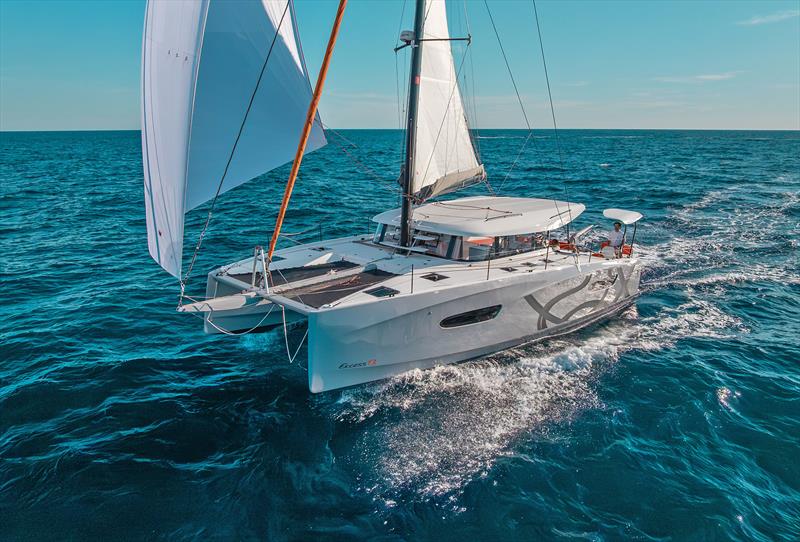
Crack on - Excess 13 with Pulse Line black stick, stanchions, and note the fixed bimini © Yann Riou
It all stemmed from Baby Cats (not kittens). Universally, boats have gotten more expensive relative to their LOA over the last five to seven years, and volume is a key determinant for buyers. Cats are super popular, more so than ever, and it looks like that trend will continue unabated. Nothing does space, low angle of heel, or general stability like a multi, after all.
Now, some sail really well, but there is a visible cost to that, others do a fine job, and are not trying to fly a hull, so you won't be glued to the load sensor, and basically the remainder really are motorsailers, they're just not disguised as fishing smacks.
So, putting it out there, if you are intending to go into this space, then be really clear about exactly what it is you are intending to do, and where you want to go. Now we should also remind you to take this into account with another wee item, 8 up to 11 to 1, for consumption of this material will be the only way to avoid total disappointment.
Just to be super clear, this is not about number of cabins, the GAs (layouts), finishes, and lifestyle features. That comes later; the proverbial icing on the cake, as it were. Get what we are talking about here wrong, and none of that will matter at all, for there will be no joy in the sailing department. Get a powercat if that is where you want to land...
To that end, what follows is really all about answering these core questions.
1. What is the sail area to displacement ratio?
A ratio below 16:1 is not going to offer tremendous performance. Look for boats in the 18-22 range for real sailing ability. And if you are looking for more 'send', then it will be higher than that.
2. Is a taller rig available?
If so, take it. The cost premium is often small compared to the long-term value, but the added usability will be quite immense.
3. What is the standard mainsail configuration?
A fathead main offers significant performance gains over the pinhead variety, so check whether it's an option, and if so, tick the box, swiftly. Remember you can exhaust the square top very swiftly via twist before you need to go for a slab. Just like the big stick, these are appearing on the various manufacturer's options lists more and more often.
4. What are the reefing arrangements?
Well-designed reefing systems make a bigger rig safer and easier to manage. Today's really cool halyard/headboard/car systems also allow for easy stowage in the boom bag.
5. How much reliance does the boat place on additional sails?
If the base rig requires a Code Zero just to move in 8 knots of breeze, that's a red flag. Ponder it. If you are two-sailing there is less hoisting, furling, and sheeting to be done, and no crew have to go for'ard...
6. Who designed the rig?
Was it engineered by a dedicated rig specialist, delivered with an implied safety aspect, or even scaled down simply to save cost?
By being honest with yourself and the vessel of your dreams, you can separate true sailing cats from floating apartments.
So, what does 'Under-Canvassed' really mean?
You know, early on we said it all stemmed from a previous editorial. Well, that's true, because now would be a grand time to introduce Chris Mitchell, who reached out to us after Baby Cats (not kittens). He's a Mechanical Engineer, specialising in rigs. A good bit of name dropping would allow me to list some of his clients, such as David Lambourne, Roger Hill, NZ Rigging, SailGP, Current Marine, McConaghys, and Ron Given. We'll take that as he's qualified on the subject....
"A lot of production catamarans have rigs that are simply too small for their displacement. Some nine-tonne boats need 35 knots of apparent wind just to lift (not fly) a hull. Builders and owners believe that makes them 'safe', but in practice it leaves them unable to sail effectively in light air," said Mitchell.
"So, you end up motoring more than you expect, or then hastily run around investing in layers of additional sails, furlers, and complex gear, just to achieve reasonable performance. Importantly, all of this complexity and expense could have been avoided with a properly sized mast and sail plan in the first place."
There's your mic drop moment, right there.
To demonstrate the thought, Mitchell then describes how a 13m cat with a 7.5m beam, and an air draft of 20m, will have 95m2 of working sails. It will displace 9-12 metric tonnes easily, plus 'gear'. Now, here's the thing, a racing cat will have all of the same metrics, bar its mass, which will be 3 tonnes. Huge difference!!! And yes, it will have very different hull profiles, too...
So, what is with that? The same amount of rag on offer, same equation to be used, and yet oh-so-different outcomes to be calculated.
Stay with us. Don't get scared. It's just maths and physics...
Take our racing cat. "The righting moment (RM) will be approximately 3m half beam to the hull centre x 3t = 9 tonnemetres (a tm is 1000kg on the end of 1m spanner). It will take about 21 knots AWS to fly a hull. That amounts to say 11 knots of TWS in a yacht with an easily driven hull at a speed of about 13 knots.
"At 10 knots TWS or below, this theoretical yacht can't fly a hull using the main and blade, so it might use a zero or screecher, but above 21 AWS the yacht will need to gradually flatten, twist and then reef, because the maximum RM available is only 9tm. Practically speaking this works out perfectly because in a lot of venues 10 knots is a nice breeze for it, and using an extra sail in lighter winds is fine."
"Transplanting the same rig into a 9-tonne cruising cat, and it might look OK, but now we need to pay attention. In 21 knots AWS, it still produces the same overturning moment (OTM), and the hull still resists with same RM of 9tm. The driving force pushing along the yacht is still the same too. The drag of the hulls is higher because they're supporting three times the mass, and consequently we have much higher surface area, and clearly the hulls are not as slender," added Mitchell.
"Now with the same driving force, but much higher drag, the yacht might only travel at say, 7 knots. No real surprise there, as you'd expect it. However, in order to generate the same 21 knots AWS, we probably need 15 TWS to create an OTM of 9tm."
"Several things arise now. Firstly, the yacht is 'sluggish' in under 15 knots TWS, and while a zero or screecher can help that near 15 knots, in under 10 TWS it is basically beyond help, and probably it really isn't that much fun any more. The force the sails produce is proportional to area and AWS^2 (to the power of two, or squared). So, if we halve the AWS then force produced is only 25%, so suddenly we need the iron topsail just to get out of our own way.
"The second issue is that as the wind gets fresher, and the AWS exceeds 21 knots, there really isn't any imperative to flatten/twist, nor reef. The 9t yacht will have an RM of close to 3m x 9t = 27tm, which is obviously three times that of the racing cat. So, we're a long way short of flying a hull, and actually, it is only just starting to become not boring."
"The heeling forces are however increasing rapidly above 21AWS and if we go to 26AWS the overturning moment has gone up by 53%. So now the rig is approximately 53% more costly, approximately 53% heavier, 53% stronger and the mast section is 53% stiffer."
So, does it really need to cost 53% more for only an extra 5 knots AWS? It's just not going to fly, pardon the pun, and hence why you see a lot of cruising cats with rigs that look, well, stumpy. It's a cost thing.
Continuing with our example, and at 26 knots AWS, if the sails are not flattened, twisted, or reefed, then the OTM moment just keeps on increasing, proportional to the AWS^2. If the case study is taken up to 37 AWS without depowering, the OTM could reach 27tm and theoretically the yacht could fly a hull. Now that is just way too scary for words, even for me!!!
The note here is that what has occurred is that you have gone from seriously underpowered to way too much boost, and the wastegate is jammed shut. It is a bit like driving a turbocharged all-wheel-drive car in anger. It will make you look really good, all the way up until it can't any more. Only problem is, that point is way past the average sailor's capacities, and carnage lives at the apex of the next bend...
In short, why build rigs for conditions no one should be entering? You'll save cost in the section itself, and even possibly with standing rigging, even though you're taller, just because you know when you'll have to pull the lever. Sounds like win/win to me.
As a quick aside, monos are different. First slab had to be in before 32 AWS, and as Chris says, "...if you left it until 36AWS the mainsail would already be in flag-mode. Whether the displacement is 6 or 12 tonnes is irrelevant, and the OTM doesn't change just because the vessel is heavier."
This is the big deal!
Now what it does all mean is that if you put a 2m taller rig into the cruising cat to start with (there's your 10%), you could realistically expect a 20% gain in sail area and a good deal in performance in the lower end, just off your fathead main and jib, even if it is self-tacking. Point being, most souls want to operate in 5-15 true, which is kind of ideal for the big rig.
Have your chicken slab ready, and use it, then thereafter you'll be down to partially furled heady, and a couple of slabs at least to ride anything out. Up above that, and it is all preservation mode, anyway, with the commensurate gear aloft (such as a galley cloth), and also be praying you do not have to go into the seaway, for that will be waaaaaaay uncomfortable. Even the extra windage of the bigger rig is not going to phase you.
Keep your coloured sail for when you're at least running well across it, or preferably even deeper. Reason? Deck will be flat and your VMG will be sensational. Giddy up! Don't spare the horses, James.
Now that's passage making.
Saving money on mast height or sail area may cut build costs, but it creates yachts that fall short of their potential. Without consistent input from experienced naval architects and rig engineers, these compromises become the norm, whereas the right rig from the outset saves owners money, actually improves safety, and creates a far more rewarding sailing experience, which is that thing called enjoyment.
So don't just look at the rig as you steam from bay to bay, maybe making 7 knots if you're lucky. Why not really use it, and have a hoot whilst you're at it. Two-sailing may never have been so rewarding.
In all, it might just come down to this. Safety does not come from shrinking rigs. It comes from rigs designed to perform in the conditions sailors actually face. Efficiency in light air, balanced handling, and simplicity in sail management are what make a boat truly safe and enjoyable. It's time to put the rig as prominent in one's decision-making set, as it is proud on the deck.
You take the best mode of transport to get to your holiday house, because it is swift and maximises your downtime. So why not have the best mode of transport on offer when you take your holiday house to its next location?
If you want to see what is happening in the other Hemisphere, go to the top of the SailWorldCruising home page and the drag down menu on the right, select the other half of the globe and, voila, it's all there for you.
Finally, stay safe, and let's see where it all goes now.
John Curnow
Global Editor, SailWorldCruising.com