Debriefing the Atlantic Cup-a Q&A with Pablo Santurde of Tales II
by David Schmidt, Sail-World USA Editor on 2 Jun 2016
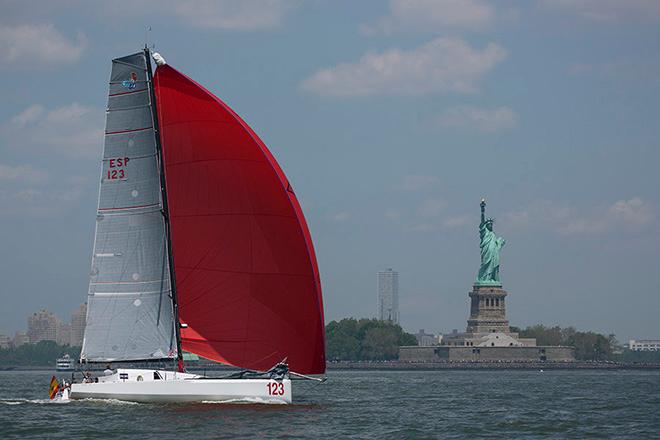
Tales II sailing in the 2016 Atlantic Cup Billy Black
http://www.BillyBlack.com
Shorthanded sailing is typically a European affair with a distinctly French terroir, but there’s a dedicated contingency of American and Canadian sailors who also practice this sometimes-scary art. While North America currently lacks an event with the international gravitas of the fabled Vendee Globe Race or the considerably newer Barcelona World Race, the three-stage Atlantic Cup is one of the premier shorthanded events on this content.
Leg one of the Atlantic Cup began on Saturday, May 28 in Charleston, South Carolina, and took the fleet of nine doublehanded Class 40 raceboats from Charleston, South Carolina to Brooklyn, New York. Leg two, which starts on Saturday, June 4, will take the fleet from the Big Apple to the seaside city of Portland, Maine. There, doublehanded teams will compete on an inshore course for two days (June 10 and 11th) before the winner’s podium is decided.
While leg one of this year’s Atlantic Cup, which is now in its fifth edition, saw an exceedingly slow finish for leg winners Gonzalo Botín and Pablo Santurde, both from Santander, Spain, who were sailing aboard
Tales II, the race had its windy points. Even with the slow finish, Botín and Santurde managed to set a new course record in this carbon-neutral race. I caught up with Santurde to learn more.
Can you tell me about the race from Charleston to New York and the conditions that you experienced?
The start was very good. Sitting in the port of Charleston was good. The weather, there was a good breeze so we managed to have a good start and after going out from Charleston, the breeze started to build up. I think that was the hardest part of the race. Not, it was not the hardest but it was when we had [the most] breeze.
The second day was a very fast day. We sailed to Cape Hatteras in good breeze, so was a straight line, not too [many] options, you know, but I think we sailed very fast in this part of the race. After Cape Hatteras [it] was downwind and there was an important decision when to gybe and approach New York… I think it was an important moment. And after that, the approach to New York was…the hardest part of the race [as the air got light].
How long did it take you to do the last dozen miles in the light air?
Seven hours to do twelve miles.
Seven hours?
To the finishing line, yes. It was very tough.
We were lucky to do the approach during the morning. I can't imagine doing that on night hours with the bay full of [commercial] traffic!
What would you say was the most exciting part of the race?
For sure, [being] the first into New York was the most exciting day. I have imagined that in my mind before, but it was completely different from what I have expected before, you know?
I thought the current was not as strong as it was and I thought that it was very foggy-you didn't see the container ships or the cargo ships you know? So it was stressful, very stressful.
And also when you had a stop in no wind, you always think that the rest of the [fleet of Class 40s] is coming very fast to you, so it was hard, you know?
What were your impressions of the course? Had you sailed the course before?
No, no, no. [This] is my first time sailing into the States, so very interesting and very nice. My father [sailed] a race from New York to Europe a long time ago, but for me was the first time.
What did you think of the course and the Gulf Stream? Was it challenging?
It's a very complete course. Very different conditions.
How competitive is our shorthanded fleet compared to the Class 40s that you race against in Europe?
I think these are good [sailors] here in the States [that are] very competitive. Maybe [the Europeans] have more experience because they, especially [the] French, just [sail] … I think French are one exception, higher than other countries… We are lucky we can sail with them a few times, so we can learn from them, you know?
Stay tuned for more from the Atlantic Cup, as it unfurls.
If you want to link to this article then please use this URL: www.sail-world.com/145212