Shallow Water sailing - Ten vital hints for roving sailors
by Paul Shard on 18 May 2014
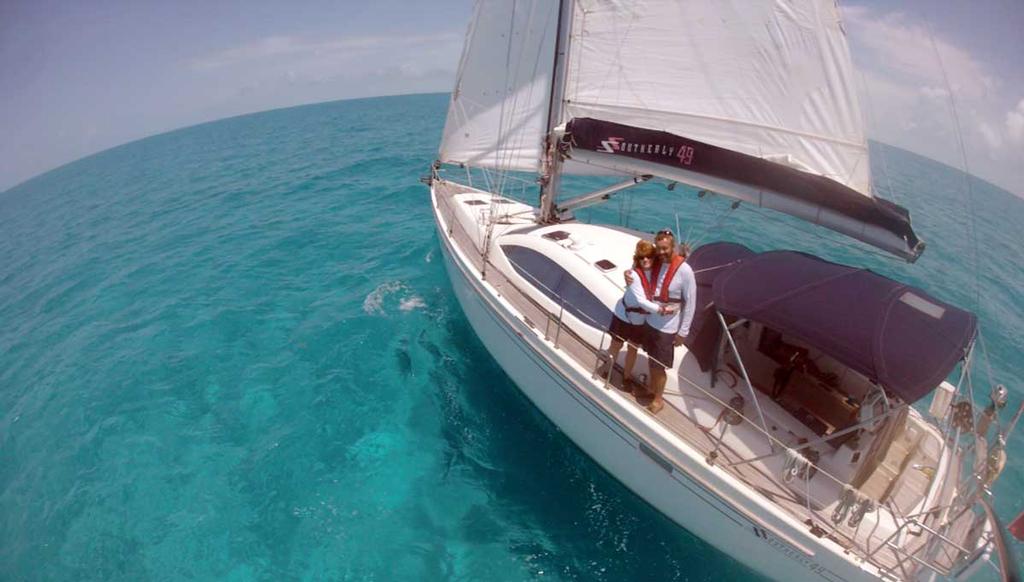
Sheryl and Paul Shard, aboard their Southerly 49 S/V Distant Shores II crossing the Caicos Bank en route to the Bahamas. Paul Shard
Cruising sailor Paul Shard who, with his wife Sheryl, is an award-winning filmmaker, sailing author, and the fun-loving host of the Distant Shores sailing adventure TV, here offers some wise advice on his experiences sailing on their boat, Distant Shores II, in the shallow waters of the Bahamas:
Ahhh the Bahamas. Could this be the most beautiful water in the world? Tough to judge for the whole world, but for many people the Bahamas is best! Definitely for American and Canadian sailors on the East Coast, the Bahamas is the achievable paradise. Yet on any day you will see yachts flying ensigns from countries all around the globe. The secret is out.
But beautiful as they are, the same shallow seas (the name 'Bahamas' comes from the Spanish for shallow seas - baja mar) can be a concern for sailors new to the practice of shallow water piloting.
Sheryl and I have cruised these islands many times, probably a total of fourteen months altogether, over the past twenty-five years exploring the shallow seas of the Bahamas in boats of varying drafts from 6-feet to less than 3-feet. (Our current boat is a Southerly 49 with a variable-draft swing keel giving us a draft from 2-foot 10-inches to 10-feet.)
Navigation has changed here with the advent of pinpoint accurate GPS and plotters but most of the techniques for safely navigating here have not changed. There are few aids to navigation in the Bahamas. Sand bars shift and reef grow.
10 Navigation Tips for Successful Shallow Water Bahamas Piloting
1. Time your passage. It is easiest to judge water depth with the sun over your shoulder. High sun works best – 9:30 or 10:00 a.m until 3:00 or 3:30 p.m. will be best. Try not to come straight into the sun especially when it is lower on the horizon. Do not navigate at night! Rising tide means you can get off again if you get stuck.
2. Do not rely exclusively on waypoints. Cruising Guides have waypoints and they are useful but these are not designed to be used alone. Keep a lookout as well even when running point to point. For new places or routes we haven’t tried, Sheryl and I will check both our charts plus cruising guides for additional information when planning a trip.
3. Know your boat’s draft and tolerance to running aground. Can you afford to run aground? If you have exposed rudders or propellors be sure not to run aground. What is the calibrated offset of your depth sounder? Is the offset calibrated to the bottom of keel or to the water surface?
4. Wear polarized sunglasses. They cut the glare on the surface of the water so that you can see down into the water much better when wearing polarized glasses.
5. Keep a good watch. Height helps - have a lookout standing on the cabin top or other high point. Do not look through windows or cockpit enclosures. Keep a sharp lookout. Post a lookout at the bow. Do not rely completely on Electronics.
6. Slow down or stop when unsure.
7. Learn to judge the depth by the water-colour. Deep sapphire blue to swimming pool blue to pale yellow is all sand. Deep green or gray-black will be deeper water of 3-5 meters over grass or reef. Brown water will be quite shallow water over reef or rock - less than one meter. Judge depth over sand from sandy colour (less than 0.5 meter - two feet) very pale light blue (one meter) to deep blue. (I will go into this in more depth in my next Tech Blog, 'How to Read the Colour of the Water' since it is an important skill for skippers to develop to ensure a safe and happy cruise.).
8. Practice with your depth sounder. Judge the depth ahead (for example, picking a shallower sandy patch) and confirm your estimation as you pass over this patch. Explore ahead in the dinghy and confirm depths with a lead-line.
9.Try out a Lead-Line. On our first trip to the Bahamas in 1989 friends gave us a lead-line neatly designed for our boat (which drew six feet). It was a 20 foot piece of thin cord and had ribbons tied every two feet with a fishing sinker on the end. The ribbons at 2,4 and six feet were red indicating depths we couldn't go. 8,10 and 12 were yellow and 14,16 and 18 indicated we could easily anchor here. Great for scouting in the dinghy or for checking depth off the stern...
10. Be careful in cloudy conditions. The small trade-wind clouds common to the (otherwise) perfect sailing day in the Bahamas can cast a shadow on the water that look just like a black reef patch. The clue is to carefully watch the bearing - if the bearing changes then it’s a cloud. If you are unsure, head around it. When you get closer it’s easier to see if it’s really a reef. Not all clouds pose a problem. Soft clouds or on a high-cloud dull day it is still relatively easy to judge water colour.
We love the Bahamas and enjoy the challenge of piloting in the amazing blue waters here. A little preparation and practice will allow you to safely navigate this wonderful cruising ground.
Paul and Sheryl Shard are the authors of the bestselling book, 'Sail Away! A Guide to Outfitting and Provisioning for Cruising' which is currently being updated to a third edition and are the hosts of the award-winning sailing TV series, 'Distant Shores' which is also available on DVD and downloads. They are currently cruising aboard their Southerly 49 sailboat, Distant Shores II, in the Caribbean and Bahamas. Visit their website.
If you want to link to this article then please use this URL: www.sail-world.com/122236