34th America's Cup - Oracle pumping claims are flawed - Update
by Richard Gladwell, Sail-World.com NZL on 6 Mar 2016
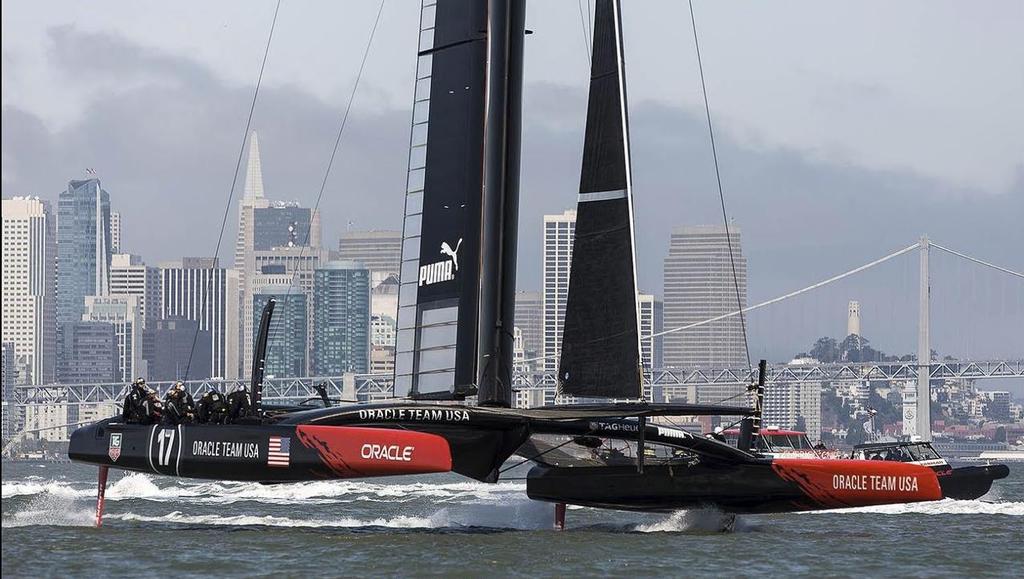
Oracle Team USA - San Francisco - 34th America’s Cup SW
Claims by an American journalist, Bruce Knecht that Oracle Team USA broke the manual propulsion rules in the 2013 America's Cup are seriously flawed.
The newly released book 'The Comeback: How Larry Ellison's Team won the America's Cup' has it that Oracle Team USA used a technique known as 'pumping', whereby the crew reeled in the wing to the against the wind and then let it out again. This was done at the start of each tack to get the boat foiling more quickly.
In the book, Bruce Knecht, a former reporter for The Wall Street Journal, and also a sailor with a trans-Atlantic crossing in his logbook, claims pumping was prohibited under the Racing Rules of Sailing, America's Cup edition.
While an interesting theory, the story dismisses the effect of alteration of the usual rules relating to 'pumping' or Manual Propulsion (RRS42) were substantially modified in the Racing Rules used in the 34th America's Cup.
RRS42 Propulsion did remain in the America's Cup version of the Racing Rules of Sailing, but it consisted of just the three lines of the standard edition rule.
The full rule used in the Olympics and other events, covers over three pages and then has a further schedule of interpretations which again run to several pages.
In fact, the sailing technique of which Knecht opins is identical to that action taken by a windsurfer to pump his or her sail to get the craft moving after a new tack, which is probably from where Oracle Team USA coach Philippe Presti got the idea.
The wording in the Racing Rules covering Windsurfing is very similar to that used in the America's Cup version of the same Racing Rules, and competitors are not breaking the rules when the employ the pumping technique.
In 'The Comeback: How Larry Ellison's Team won the America's Cup' Knecht correctly quotes the Racing Rule used in the America's Cup, but then tacks on the comment
'The permissible adjustments to the wing do not include the repetitive movements that are required for pumping.'
That last sentence is just the author's comment, is not in the rules and does not apply.
Knecht also seems to make the common error made by many sailors, that if a technique is banned it is by definition speed enhancing. That is not always correct. The Propulsion Rules are framed to stop air rowing and use of kinetics in sail racing. Others may achieve the same speeds by using a more subtle, less violent sailing technique.
Trimming permitted
All Oracle Team USA would claim in a potential protest is that they were adjusting the trim of the wing - which is what the rule says is permitted. There is no comment or limitation in the rule as to how many times a crew may trim a sheet, and the only conclusion is they can do it as much as they like - as occurs in other classes when RRS42 is signaled as not applying.
Loads on the mainsheet of the AC72 yachts are not widely quoted, but data from the 33rd America's Cup from Oracle Team USA indicated that the 120ft trimaran had 26tonnes of mainsheet load with their conventional rig and that reduced to 3tonnes on the wingsail rig. The output of an America's Cup grinder is often compared to be similar to that of a domestic sewing machine, and that is only for a short burst before the burn of lactic acid cuts in.
To be effective the sheet must be pulled in rapidly, quickly released, and then sheeted in rapidly. The book says pumping was done by the trimmer releasing and retrieving sheet from a constantly rotating winch drum.
A wingsail mainsheet is quite different from a regular yacht in that it just controls the lateral movement of the wingsail, which it can move in and out. For the pumping to be effective as claimed the entire wingsail would need to be locked to prevent it from just folding around its centre, and Oracle Team USA would also have to be able to reduce the twist in the wingsail to ensure that any energy generated by pumping would not be lost in flex of the wingsail. In other words, to be completely effective the pumping must be on a very rigid sail.
In Olympic and other classes, the practice of pumping is loosely referred to as 'air rowing' and is used to fan a yacht around the course by the crew pulling rhythmically on a sheet, usually the mainsheet - and manually propel their boat in light winds. It is a prohibited practice for that reason in lighter winds.
In all Olympic and other classes, RRS42 is often signalled as not applying in moderate to fresh conditions or when surfing is permitted. In that situation, there are no limitations on a crews' actions regarding trimming, or the other propulsion practice of body pumping, which is used to achieve a similar effect as the rapid trimming, particularly upwind.
Rule change for Cup
In the America's Cup, the racing rules were changed to say the 'crew may adjust the trim of the wing, sails ...' and the exceptions to that practice were removed. Pumping the wingsail against the wind was quite legal if indeed it was physically possible in the conditions that prevailed in San Francisco, and secondly if the action would make much difference to the performance of wingsailed 72ft foiling catamaran.
The inserted comment in the book is symmetrical with the full RRS42 as it relates to dinghy classes and the Olympic regattas. But even in those classes the no-pumping rule would generally be signalled as not applying in fresh winds of the type experienced in San Francisco.
Further, in the 34th America's Cup, the racing was under the control of on the water judges and umpires as well as off the water scrutiny. The umpires' position is to normally follow behind the racing yachts, and any rhythmical adjustment of a sheet manifests itself in the twitching of the trailing edge of the sail or wingsail. It is hard to believe that the on the water judges could have missed seeing the claimed illegal action over the last week of the regatta when Oracle Team USA became dominant. Contrary to later claims by Knecht the action is easily spotted from astern by experienced judges.
If Bruce Knecht's strict interpretation is correct, then a crew would never be able to trim a sheet as under his definition they would be using manual propulsion to pull a sail in against the wind.
Of course, that is a nonsense, as trimming a sail is specifically permitted under the America's Cup version of the Racing Rules of Sailing. There is no mention in the Rules of the frequency of the sail trimming - and that is why Oracle Team USA's action is completely legal under the America's Cup Racing Rules of Sailing.
Legal under standard rules above 12kts
The pumping would also be legal under the usual version of the Racing Rules of Sailing if the Manual Propulsion restrictions were deemed not to apply by race officials as is the case in moderate to fresh winds which blew on all but one day of the 34th America's Cup Match.
As an aside, the length of the America's Cup course in San Francisco was such that the yachts could not complete ther course in winds of less than 10kts - about the normal point for serious consideration of the lifting of propulson rstriction by race officials.
The book claims the technique was conceived by Oracle Team USA coach Philippe Presti and bought into play on a no-race day - Friday, September 13. Significant changes to Oracle Team USA's wingsail were also made on that day says Knecht.
The constant work of Oracle Team USA crew in the grinder positions to generate pressure in the hydraulic systems has always been freely acknowledged by the team. It was necessary to generate the power to drive the team's controversial foil adjustment system and other control systems on the boat which were constantly in use.
Indeed, Emirates Team NZ almost capsized in Race 8 because the team lacked sufficient hydraulic pressure in its control systems. The team was only able to recover because the crew kept turning the grinder handles and generating hydraulic power while the catamaran was poised at a very precarious angle.
'The Comeback: How Larry Ellison's Team won the America's Cup' says the pumping movement was achieved by the trimmer Kyle Langford (24) pulling about a metre of sheet and then easing it and repeating the action. It took five or six pumps to get Oracle Team USA foil-borne on a moderate to fresh breeze - whether that was any more quickly than Emirates Team NZ is not disclosed.
But under the racing rules, they were entitled to 'pump' or turn the grinder handles all race if they wished, or had the energy to do so.
Other insights into Oracle Team USA
Pumping legality issues aside this book is an excellent insight into the 34th America's Cup, and the Knecht seems to have got the inside story from Oracle Team USA.
Interestingly Knecht says that the crucial date and move in the 34th America's Cup for Oracle Team USA was September 10, after the first race of the day, when the Defender elected to call a lay day, and the decision was made by CEO Russell Coutts to ring the changes in the afterguard, substituting Ben Ainslie for John Kostecki.
'We have to unscramble what the hell they are doing' he (Coutts) said, referring to Team New Zealand. 'They are sailing in a completely different mode.'
'The Comeback: How Larry Ellison's Team won the America's Cup' explains how the change-out was made and handled within the team. While it seems that the change of personnel happened on an amicable basis, it does appear that both skipper Jimmy Spithill and General Manager Grant Simmer were against the postponement.
Spithill because being super-competitive he didn't want to appear to be in retreat. Simmer because he thought the time-out should be held in case the AC72 did have a gear breakage later in the regatta, and could use the option at that stage.
The reaction within the Oracle to their imminent defeat by Emirates Team NZ is an ongoing theme throughout the book, with Spithill not being prepared to throw in the towel at any stage and pulling the team through mentally, race by race.
Another point of interest is the close shave for Oracle Team USA 45 minutes before the start of the final race when a control arm bracket broke 30ft up the wingsail - an issue which the book says trimmer Kyle Langford thought was incurable but rather than tell the other sailors that he said just the opposite.
For international readers 'The Comeback: How Larry Ellison's Team won the America's Cup' is available from Amazon.com in Kindle format.
Interviews:
For an interview with Bruce Knecht on RNZ.co.nz click here
For the Newshub report and 3News video click here
For the NewstalkZB report and interview click here
For the Radio Live interview with Bruce Knecht on Friday afternoon (NZT) click here
Richard Gladwell was an ISAF certified Int Judge for 20 years and an Int Umpire for ten years. The legality of the Oracle Team USA action has been confirmed by a member of the International Jury who contacted Sail-World after this story was first published.
If you want to link to this article then please use this URL: www.sail-world.com/142791