Why Boats Sink (and how to keep yours afloat)
by BoatU.S./Sail-World Cruising/Powerboat-World on 3 Mar 2008
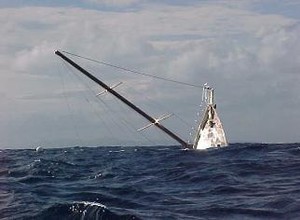
David Vann’s Bird of Paradise sinking off the coast of South America last year SW
Who better than an insurance company to give the answers? So the insurance arm of BoatU.S., the Boat Owners Association of the United States, tells here - statistically from their records - why they sink, and how to to best make sure they stay afloat. Daring skippers will be pleased to know that according to their records, for every boat that sinks underway, four boats sink in their slips.
There are two reasons for this discrepancy.
One reason is whenever a boat leaves the dock, someone is aboard, which leaves open the possibility that the leak will be discovered and the problem corrected before it sinks the boat.
And the second reason is that boats tend to spend a majority of their time at the dock.
Besides having to pay the deductible, the skipper typically loses the use of the boat for several weeks while it is being repaired. The best defense against a dockside sinking?
Visit your boat. And, at least twice a season, inspect any fittings above or below the waterline that could be letting water into the boat. All too often, skippers rely on bilge pumps to bail them out when they can’t visit their boats. The pump fails and the boat sinks. If you can’t visit your boat regularly, consider using a buddy system with other boat owners to watch each other’s boats.
Modern boats sink for a variety of reasons, which is the point of this story.
WHY BOATS SINK UNDERWAY:
Any boat has the potential to sink underway for the same reasons that it could sink at the dock--a hose slips off, a packing gland leaks, etc. Many boats sink because of leaks at thru-hulls, outdrive boots, or the raw water cooling system, all of which are routinely implicated when boats sink at the dock.
There are also many other reasons that boats sink underway, however, which have nothing to do with loose hose clamps or broken fittings. Boats underway can strike floating debris or stray onto a rocky shoal (“Navigation error”). There are careless skippers who forget to install drain plugs. Many boats sink after coming down hard off of waves and splitting open.
Once a boat starts to sink, it will gain momentum as it settles into the water. If a boat has a two-inch hole that is a foot below the waterline, for example, over 78 gallons of water will pour into the boat per minute. When the same hole is three feet below the surface, the flow of water increases to 136 gallons per minute. Keep in mind also, that other thru-hulls that had been above the waterline will be underwater. If any of these fittings are cracked or missing, the flow of water into the boat will accelerate further.
Low Transoms - The single most critical reason boats are flooded on open water has to do with transom
height. Most boats that are swamped are outboard powered, with engine cut-outs that are often only inches above the waves. Motor wells are supposed to be the second line of defense when a wave comes over an outboard's transom but, in some cases, the well is too low, too shallow, and/ or not sealed adequately to the cockpit. Scuppers in the motor well and cockpit may also be slow to drain, especially if they re clogged. And whenever water lingers in the well or cockpit, the chances of another wave coming aboard increases. So too is the risk of being swamped.
Aside from transom height, the other contributing factor when a boat is swamped is typically weight distribution-- too many people at the stern together with scuba tanks, large coolers, bait wells, etc. that reduces buoyancy aft. In most cases, swamping occurs when the boats are stopped or idling.
Prevention: Especially on outboards with low cut outs, be conscious of weight distribution. Avoid storing scuba tanks, heavy coolers, etc. near the transom At slow speeds, keep the boat moving toward the waves. Don't ever anchor from the stern!
Most scuppers are slow to drain anyway, but when they're plugged up with leaves and other boat-gunk the water can linger in cockpits and motor wells a dangerously long time.
Use a dockside hose with a power spray nozzle to flush out debris.
Drain Plugs - It's difficult to understand how a missing drain plug could sink a boat. Wouldn't the skipper realize that the boat was filling up with water? Typically, the water is out of sight in the bilge until hundreds of gallons have come aboard. By then, the boat might be floating well below its lines. In some cases, the source of the leak wasn't discovered until the boat was raised.
Prevention: How can an absent minded skipper remember to install a drain plug? Try leaving a drain plug (you should have at least one spare) with the trailer's winch handle or with the ignition key --anywhere it is sure to be seen before launching the boat.
Cooling System Leaks - A 300-hp engine pumps approximately 30 gallons of water through the cooling system every minute. Depending on which fitting lets go, you could find yourself with the water pouring into the bilge at the same time the engine overheats, which means you're liable to be greeted by clouds of hot steam when you open the engine hatch.
Which fittings are most vulnerable? Any fitting that is loose or corroded can let go. In one case a cooling water pump hadn't been adequately tightened. On other boats, hoses slipped off, a raw water heat exchanger burst (end cap), and a plastic muffler split open when the engine backfired.
Prevention: All of the fittings in the cooling system should be inspected periodically for loose connections and brittle or split hoses. Typically, a break in the cooling system will cause the engine to overheat before much water has been pumped overboard. The hatch is opened, the problem is discovered, and the boat can usually be saved. The exception
is a break in the exhaust or muffler. Backfiring can blow a hole in a plastic muffler, corrosion can eat a hole in a metal muffler, exhaust hoses can split and the engine will continue to pump water--a lot of water--aboard.
Striking an object - Submerged or partially submerged boards, logs, etc., are typically swept into rivers and bays after large rain storms and have been responsible for damaging and even sinking many boats.
Prevention: Slow down whenever you see floating debris. For every log visible on top of the water, there is likely to be two that are bobbing just below the surface. If you do strike something, indicated by an ominous 'klunk' somewhere on the hull, open the engine hatch immediately and make sure the boat isn't taking on water.
WHY BOATS SINK AT THE DOCK
When a boat sinks at the dock, the question most likely to be asked is: “What happened to the bilge pump?”
That’s the wrong question, however. By dutifully emptying the bilge periodically, a bilge pump can actually hide a problem--until the pump clogs or the battery goes dead. Water, not bilge pumps, sinks boats. The correct question should be: Where did the water come from?
In 50% of dockside sinkings, water found its way into the bilge through leaks at underwater fittings. The majority of the leaks are at stuffing boxes, followed by outdrive or shift bellows, failed hoses or hose clamps, sea strainers, and drain plugs.
There were sinkings from air conditioning fittings, gate valves, transducers, mounting bolts, and mufflers.
Boats went to the bottom as a result of a leaking speedometer impeller. It is certainly possible that more than one fitting had been leaking.
It is also interesting to note that the finger was pointed at fittings above the waterline in 9% of the sinking claims.
(Question: How can a fitting that is above the waterline sink a boat? Answer: Fittings that you think are above the waterline aren't always above the waterline.)
Water falling from the sky, either rain, snow, or sleet, accounts for a whopping 32% of sinking claims.
Every
If you want to link to this article then please use this URL: www.sail-world.com/42282