Use the Magic of a Riding Sail at Anchor
by Captain John Jamieson on 12 Sep 2011
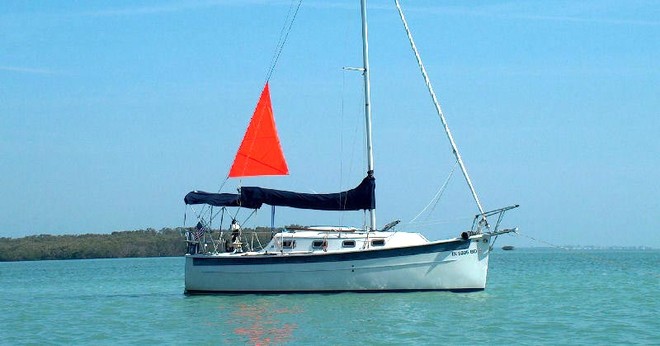
Standard Riding sail in action SW
Does your sailing boat always lie steady as a rock at anchor? Or does she tend to wander back and forth like a restless mare in a corral? There are several ways of overcoming this, the best known being to use an Anchor Buddy or Sentinel (see http://www.sail-world.com/index_d.cfm?nid=38056!story). However, there's another excellent solution, and John Jamieson (Captain John) of skippertips.com shows this little-known technique that will help cure the problem fast and easily!
Some boats behave themselves while on the hook, while others will sway back and forth from side to side. This action--called 'sheering'--can put a lot of side load on the anchor shank. In some conditions, this could cause the sailboat anchor to break free and the boat to drag her anchor! Just the thought of this could cause you a stressful night on the hook--instead of a peaceful, tranquil one.
Three factors can lead to sheering and heavy ground tackle loads...
* Ocean Ground Swell
When ocean swell break on a sand bar, they expend their energy and die a quick death.
But some islands have smooth beaches. Instead of breaking, the swell wraps around the island's windward side and creates a ground swell on the lee side.
This results in an uncomfortable 'rock 'n roll' motion for anchored boats. Look for islands with deep coves on their lee sides for better protection.
* Freeboard and Windage.
Sailboats or power boats with lots of freeboard (the distance from waterline to the deck) present more surface area for the wind. Also, boats with lots of canvas--enclosures, Biminis, and dodgers--create excessive windage. Lower as much canvas as possible to reduce windage.
* Light or Beamy Hulls.
If you cruise or race in a lighter than normal hull, it will tend to sheer from side to side at anchor, even in light winds. The same goes for hulls with extreme beams, like catamarans and trimarans.
Enter the Riding Sail!
The riding sail looks like a pint-sized storm jib and hoists on the backstay. It acts like a weather vane on the roof of a barn to keep your bow pointed up into the wind at anchor. Follow these five steps to get your small cruising boat under control fast with this magic sail:
1. When to Hoist a Riding Sail?
Hoist your riding sail whenever you drop the hook. This becomes more important in windy anchorages. But even in lighter winds, it will help keep your boat's bow into the wind and under control.
2. Pick the Best Sailcloth Weight.
Choose heavy 6 oz. to 8 oz. sailcloth. Ask your sailmaker to hollow (concave) the leech and foot. This keeps flutter down. Veteran cruisers Steve and Linda Dashew recommend full length battens with extra heavy reinforced batten pockets. In high winds, this controls flogging and extends the sail's life.
3. Determine the Size You Need.
Sailboat ketches or yawls should reef the mizzen and use it as their riding sail. For sloops and power cruisers, use the sizes below, recommended by Sailrite. In a pinch, you could hoist a small storm jib on the backstay, as long as it lies within these sail area parameters:
Sailboats up to 35’ = 12.5 sq. ft. riding sail
Sailboats 35’ to 50’ = 20 sq. ft. riding sail
4. Hoist Away on Your Backstay.
Make a pendant that attaches to the deck near the backstay. Have your sailmaker make the pendant from wire rope with eyes in each end, or you can use low-stretch line (Dacron, Spectra) as a pendant. Hoist the riding sail with the mainsail halyard about 1/3 of the way up the backstay. This keeps the riding sail out of the way of crew in the cockpit. If your vessel has a split backstay, hoist on one side of the backstay and sheet the sail flat on that side (see picture).
5. Sheet to One Side.
Lead the sheet through a snatch block or Genoa sheet block on one side of your boat. Sheet the sail almost flat and belay (cleat) the sheet. Sheeting the sail flat reduces flogging (the #1 killer of sails), keeps the bow under control, and helps prevent sheering in shifty winds.
John Jamieson (Captain John) with 25+ years of experience shows you the sailing skills you need for safe short-handed cruising. Sign up for his free sailing tips newsletter at www.skippertips.com Become a member to receive instant access to over 400 sailing articles, sailing videos, sailing topic eBooks, and live discussion forums.
If you want to link to this article then please use this URL: www.sail-world.com/88348