Looking at the Reemerging Catamaran Classes
by Shauna McGee Kinney on 18 Dec 2010
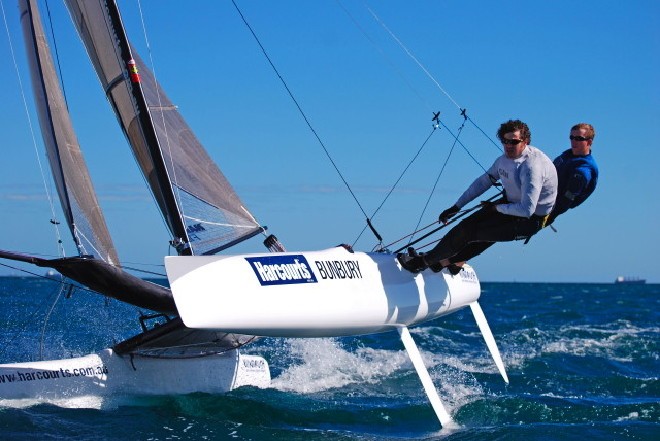
Ryan Duffield helms the NACRA f18 Infusion to victory in Fremantle Ryan Duffield
Ryan Duffield is among the top catamaran athletes in Australia and working his way up among international sailing competitors. He takes a look at his sailing career and the international catamaran classes.
In February 2007, Ryan’s sailing career took off quickly. He crewed for Gary Gornall at the Seawind Formula 18 Worlds in Yeppoon, Queensland - Australia. In combination with entering international competition, Ryan celebrated his 23rd birthday at the Yeppoon event. A month later, Ryan was crewing for Brett Burvill at the SWG Tornado Australian National Championships. After his first day of Tornado racing, Ryan and Brett knew they had an incredible team.
Brett and Ryan actively race internationally in several catamaran classes including the Tornado and the Formula 18 catamaran. As a boat builder and owner of Windrush Yachts in Western Australia, Brett modified and built a Tornado, and a year later a Formula 18, to meet the technical features he wanted while racing.
This past year, Ryan and Brett competed overseas at several European National Championships including the Tornado Worlds and F18 Worlds. In June 2010, their European campaign started out strong with a fifth out of 71 Class 1 cats at the Dutch Texel regatta. They sailed a new Formula 18 - the Windrush EDGE in heavy wind. The new design performed well with good control and speed in the brisk conditions.
Early in July 2010, the wind was light and swell was sizable at the F18 Worlds at Caroual Beach - France venue. This was the first time the team was sailing a major competition with their new F18 - the Windrush EDGE. Ryan admitted the difficulty wasn’t only the boat, their team had never sailed in light-and-lumpy. They found it hard to get the boat going. Later in July at the Tornado Worlds in Travemünde Lübeck, Germany Brett and Ryan placed fourth out of 51 Tornados.
It All Started in Carnarvon
Ryan started sailing at the age of 12 in Carnarvon, Western Australia. Carnarvon is located about halfway up the 'left coast' of Australia where the ocean waters are famous for sea life. His first sailing experience was crewing on a 10 foot Arafura Cadet catamaran. Soon after the Arafura Cadet, he switched to the Windrush 14 class, a popular family-oriented catamaran with over 20 boats racing regularly. Ryan’s childhood sailing memories include 'lots of capsizes' and 'enjoying it', though he seems to remember the Carnarvon water was cold back then (the ocean water temperature can range from 18 - 28 C / 64 - 82 F.)
In addition to overseas and national competition on the spinnaker cats, Ryan continues to race the Windrush 14 in Western Australia in the 'super-sloop' configuration - single-handed with a trapeze and jib. He points out that the Windrush 14 is a great starter boat with the 'sloop-rig' - double-handed with jib and no trapeze, and the 'cat-rig' - single-handed with a trapeze and no jib.
Bigger, Better and Stronger
Ryan admits that catamaran technology has helped promote catamaran sailing as a sport. While the cost of extreme designs like the America’s Cup and ocean record-setting multihulls is too expensive for most sailors, the technology developed at the extreme level is passed down to the more numerous small, sport catamarans.
Ryan noted that the Tornado, the former Olympic-class catamaran, has kept up with technology by changing out the aluminum mast with a carbon mast. The Tornado's carbon masts have proven to be more durable than the aluminum masts. The older masts were prone to folding when overloaded and even breaking in severe pitchpoles. Ryan laughed, 'The carbon masts can take on some pretty ugly shapes when the boat is hit by a gust, but that ugly shape seems to spill off the excess wind - a kind of self-exhausting feature.'
In contrast, the Formula 18 class rule requires an aluminum mast. Technology from the bigger wing sails has been passed down to create a narrower extrusion of aluminum in the masts that is now seen in most competitive F18 boats. The control and understanding of the diamond tension, spreader rake and overall shape of the masts has gotten better thanks to the development high-technology catamarans.
More is Better
As for getting more people into catamaran sailing, a non-sailor might look at all the classes of boats and think there are too many options. The numerous choices have split the competitors into multiple classes. Ryan countered this criticism, with the the fact that there were 160 boats at the Formula 18 Worlds. Likewise, in the Tornado class, sailors find the level of competition rewarding and like the smooth boat performance. Even with these preferences, many of the top catamaran sailors enjoy competing on multiple boats and don't limit themselves to one design.
In getting more athletes sailing catamarans, Ryan points out that some classes of boats are cheaper. For example in the spinnaker classes, the Formula 18 is a little less expensive than the Tornado and has gained dominance by having a larger number of manufacturers competing in the market. The Formula 18 class has also enjoyed a large number of loyal regatta sponsors that help keep the cost of major events down.
For new and experienced teams, there is a lot of value to competing at a regatta with 50 to 60 boats in a start. The mass competition improves sailing skills, even when the sailors aren't yet 'one of the big guys'. The big regattas are a great way for developing sailors to push their skills to the next level.
Being Seen
Spectators are missing from the sport of sailing. While in Europe, Ryan and Brett were part of one of the best spectator events for sailing. The Travemuende Speedsailing (in the Trave River - Germany) was a race held on a narrow waterway. There were food and retail stalls along the river’s edge. Over 40,000 spectators could easily see the boats, the sailors and the action from along the shore. Ryan and Brett enjoyed hearing the crowd cheering for them and could see the spectators faces as their Tornado sped through the river.
Roland Gaebler led the development of the Speedsailing event. The format consisted of three to five minute races. The course was about 400 m / 440 yards long and 80 - 100 m / 87 - 100 yards wide. There were eight boats per heat and two heats. A commentator kept the crowd informed on the progress of the race and the spectators were wowed by the occasional capsize. The top three boats were pulled out of the water for the spectators to admire. (http://www.speedsailing.org/arena-concept/)
In the coming year, Ryan and Brett is eager to see the Extreme 40 and the AC 33 series heat up the competition and stir up more excitement. They are even hoping to develop a similar arena event in Perth near the Barrack Street Jetty.
The Bust is Over, the Boom is On
Ryan is optimistic that the renewed interest in multihulls is benefiting catamaran sailing at all levels. He sees that boat technology and large international spectator events are helping renew interest in the sport, especially after the disappointment and confusion that followed the loss of the Tornado as an Olympic sailing event. Ryan is enthusiastic to see his career grow and to see an increase in the number of competitors joining him on the water both locally in Australia and overseas.
Look for Ryan and Brett on the F18 and Tornado in their 2011 European campaign.
If you want to link to this article then please use this URL: www.sail-world.com/78221