America's Cup - Dan Bernasconi explains the foiling AC75 - Part 2
by Richard Gladwell, Sail-World.com on 26 Nov 2017
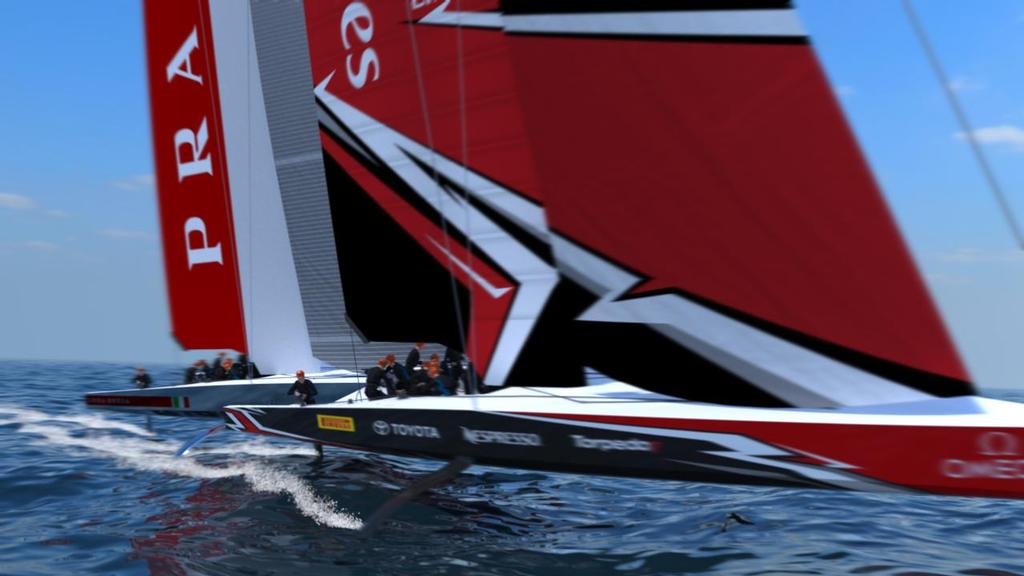
Computer graphic of the foiling monohull to be used in the 36th America’s Cup Emirates Team New Zealand
http://www.etnzblog.com
Earlier this week, Dan Bernasconi, Emirates Team New Zealand’s Technical Director was in the UK, discussing the AC75 concept with teams that have either announced their intention to enter or seriously considering a Challenge.
Bernasconi has met with Land Rover BAR (GBR) and New York Yacht Club who have both announced they will be entering. Also involved is Artemis Racing who gave Emirates Team New Zealand close run in the Louis Vuitton Challenger Final, and would almost certainly have beaten Oracle Team USA had the Swedish team been the Challenger.
While the AC75 appears to be an overwhelming design exercise, perhaps that is because a foiling monohull of this type and size is not in the sailing lexicon.
For an established America’s Cup team, Bernasconi believes there is a lot of crossover from the AC50 wingsailed catamaran to the AC75.
“I think there is a lot of crossover from the AC50”, he told Sail-World from the UK. “I know the boats look completely different. Everything we learned as designers and sailors about foiling about the controllability of foils, controllability of the rig and the huge range of apparent wind speeds the rig has to go through, and how the loading on the boat changes with speed - all those things are very relevant to the AC75.
“What we have done is brought back the element of hull design which disappeared in the last competition,” he adds.
The AC75 is not expected to be foiling until windpeeds of 9kts, while its predecessor, the AC50 could sail at four times the speed of the wind at just 6kts of breeze.
“Although the boats will be foiling most of the time it is going to be incredibly important to have a hull which gets you foiling as quickly as possible”, Bernasconi says. “That's an interesting design problem. That is going to be a big part of the design focus - how do you design a hull that gets you accelerating well and then gets you up on to the foils before your competition?”
The AC75 has just three tonnes of total ballast, spread across two swivelling foils and 1000kg of crew weight. The trade-off is likely to have sufficient beam to achieve maximum righting moment and get foiling as soon as possible. The other side of the beam trade-off is to have a boat that is narrow to reduce drag as much as possible and lift the speed that way. That’s a design conundrum that can only be sorted out in the simulator – provided it is accurately calibrated for the real world.
'The current projections are that the boat will weigh seven tonnes without the crew. The AC75 crew weight will be in the region of another 1,000kgs on top of that,' Bernasconi says.
In comparison, the AC72 catamaran used in the 2013 America’s Cup had a sailing weight (without crew) of 5500kgs (only 1500kgs less than the ballasted AC75). The AC50’s topped the scales at 2440kgs, and the IACC class used for the 1992-2007 period topped the scales at a massive 24000kgs (19,000kgs of ballast) – almost 3.5 times the weight of the similarly dimensioned AC75.
That weight disparity with a conventional keelboat raises issues of stability when the AC75 is at rest. There is the ability to lower both foils to hang clam-shell like below the AC75 to maximise the 5.5metres draft and 3000kg of ballast.
'They are not to be super stable, but they will be stable enough,” says Bernasconi. “It will be easy to work on these boats while they are on the dock. Obviously, you can't have a boat with seven tonnes of lead under it and then expect it to be foiling in a moderate windspeed.”
“We sized the amount of ballast so the boat would be self-righting - which was one of the design criteria, and that determined the weight of ballast,” he adds.
America’s Cup fans have probably seen the last of the cyclors which gave Emirates Team New Zealand an edge in power and sailing weight in Bermuda.
“We probably won't allow cyclors in the rule. There are a number of aspects of the boat we want to connect more with sailing outside of the Cup. Cyclors are obviously not something that most sailors identify with. While that worked really well for us in Bermuda, we probably will require the power to be provided by conventional grinding.”
'They will be doing everything that grinders do on a more traditional monohull - primarily controlling the mainsheet, traveller, jib sheet, hoisting and furling the Code Zero and runners,” he adds.
It has been a decade since America’s Cup yachts used soft sails for the main, jib and gennaker. It’s probably an area where there will be a trickle up as designers adapt knowledge across from existing classes across to the AC75.
“The jibs and Code Zeroes and whatever we do with the mainsail, brings back the sail design element - as of course, they were one design in the AC50,” explains Bernasconi.
“We will be relying massively on the experience of sail designers. It is new territory in a way in that there aren't many foiling boats - particularly foiling at this efficiency, and at these speeds that are powered by anything other than wings.”
“The only class of boat that has been able to sail across this range of conditions on up and downwind courses fully foiling has been the AC45's and AC50's.”
“Achieving that performance with soft sails is definitely new territory. It is going to be an interesting challenge for designers,” he adds.
With apparent wind foilers, one of the unknowns is always what wind angle they can sail at in a given wind strength. The big surprise in Bermuda was the sight of AC50's being unable to make a downwind mark in winds of less than 7kts.
'I think the sailing angles will be similar to those we saw in the AC50. You start off lower at the low-speed wind range and get up to between 40-50degrees higher up the windspeed range - depending on sailing modes and how you chose to sail the boat. It is early days with the AC75 concept, and we haven't got the answers yet.”.
With the concept boat now decided and out in the America’s Cup community the task is now to define the AC75 Class Rule by the end of March 2018.
Those who have been there before believe that four months is a very tight time frame to develop a comprehensive class rule. To date, a lot of the heavy lifting with the concept boat has been done by the Emirates Team New Zealand’s designers.
'The next phase for the design team is to work with Luna Rossa on defining the rule’, explains Bernasconi. “So far we have just got to the point of deciding this is the concept of boat for the Cup. But there are a huge number of details we need to work through to put a rule around them - which will create a fleet of challenging boats, all of this style but with enough openness in the design.”
The expectation is that the AC75 Class Rule will be a box rule, meaning that basic parameters of the boat – length, beam, draft, rig height and weight will be specified, along with specific design and measurement points with the class.
With the AC50 class, for the first time in America’s Cup history there were many one-design parts, and in the case of the wingsail, a specified shape was prescribed. The jibs were permitted to be of three sizes and were supplied from a single sailmaker (North Sails). There were three areas open to free design thinking, being the daggerboards, control systems and cross beam and other fairings.
That situation will change completely with the AC75, and most if not all of the new class will be open design within the confines of the box rule.
“We feel that the America's Cup is about having a strong design race,” says Bernasconi. “Because it is such a new concept, we are not claiming to know everything about the AC75 concept at this stage and can't be too prescriptive in terms of how the boat is going to balance, the size of appendages and how the rig is going to work.
“These are things the team will need to work out, that is what makes it an exciting design and engineering competition.
“We will be working towards the issuance of the class rule towards the end of March 2018. We imagine the teams will be starting to build boats around the second half of 2018 and launching in the second quarter of 2019, for a regatta in those boats through the rest of 2019.”
To see Part 1 of this story click here
If you want to link to this article then please use this URL: www.sail-world.com/159074