America's Cup - Constructed in Country almost wiped in new Protocol
by Richard Gladwell, Sail-World.com on 19 Aug 2015
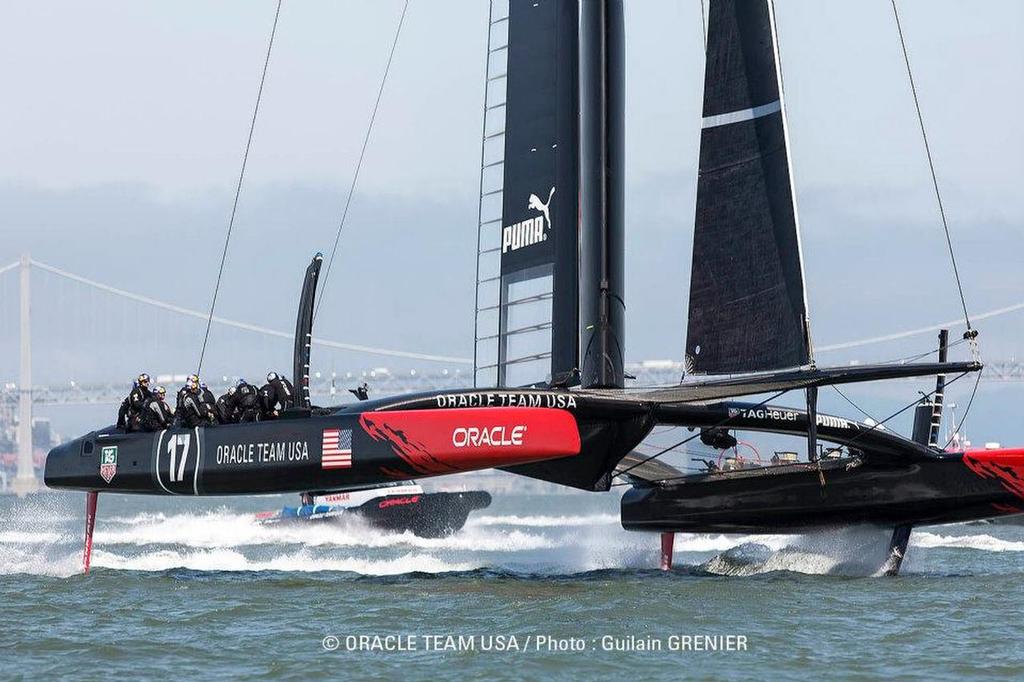
At least the hulls of the AC72’’s had to be built in the Country of the Club, now just a small section of the bow is required. Guilain Grenier Oracle Team USA
http://www.oracleteamusamedia.com/
The latest version of the Protocol for the 35th America’s Cup has been modified to effectively eliminate the fundamental requirement for the yachts to be constructed in the country of the Challenger or Defender.
In the latest edition of the Protocol, a piece of bow section, just a little bigger than Optimist, is all that is now required to be constructed in the country of the yacht club of the competitor.
The new rule requires a 2.7m piece or approximately 18% of the overall length of the 48ft wingsailed catamaran yacht to be built in the country of origin for the yacht to be eligible for the America’s Cup.
Previous versions of the Protocol required the exterior surface of each Hull to be laminated in the country of the yacht club represented by the Competitor.
Constructed in Country is a fundamental of the Deed of Gift, the 19th century document which governs the conduct of the America’s Cup.
It was this rule that the long-time holder of the Cup, the New York Yacht Club, used to ensure that all parts of the yacht were built in the country of Challenger, the yacht was designed in the country of the Challenger, and in the modern era of the Cup 1956-1983 all crew competing in the Match had to be nationals of the Challenger country. The rule was at the centre of the ruckus as to to who was actually the designer of the Australian Challenger Australia II.
That crew nationality requirement is diluted to the point where only one of the sailing crew must be a passport holder of the country of the Challenging/Defending yacht club. Plus a token portion of the exterior surface must be laid up in the country of the Challenger/Defender.
None of the five sailing crew listed for the Defender Oracle Team USA for the first America's Cup World Series were actually born in the USA. A couple of crew meet the passport-holder requirement by virtue of dual passports.
Rule 35.15.of the sixth Version of the America's Cup Protocol reads: Constructed in country: Each Competitor's AC Class Yacht shall satisfy the constructed in country requirements of the Deed of Gift if the exterior surface of the forward section of each Hull is laminated in the country of the yacht club represented by the Competitor. The surface of these forward sections shall be as defined in Rule 7 of the AC Class Rule and shall be no less than 2.7m long measured aft from the Stem plane. The constructed in country requirements of the Deed of Gift shall not apply to any other parts, structure or components of the AC Class Yacht. Each Competitor shall deliver a builder’s certificate in a form acceptable to the Measurement Committee confirming that the Hulls have been constructed in accordance with this Article 35.15.
:
The basic tenet of the Deed if Gift where a competitor had to be able to design, build and sail their yacht using national effort has essentially been taken out of the competition and the event remains true to its founding principles in name alone.
While the now AC50, or to be strictly correct the AC49.2126, (the latest AC class is 15 metres long or 49.2126ft) is a one design in terms of hull shape, cross structure and wingsail profile, the control systems, and foil packages are open, which in a normal America's Cup have required the teams to have their own design teams, and construction teams located at least in their country of club origin.
Now all that is required is for a small building team to fly in with a set of bow moulds, almost as hand-luggage, perform and certify the lay-up ritual in the country of the challenging yacht club. Then they head back to the contracted building facility and turn the bow sections into a finished AC48.
The moves will be touted as being to the benefit of getting smaller and new teams started in the America's Cup.
However almost two years have elapsed since the conclusion of the 34th America's Cup. Despite being told that the original AC62 proposed for this Cup was still too expensive, the organising authority did not change to the smaller AC48, now 50, until nine months after entries had closed, prompting the withdrawal of four time Challenger Luna Rossa. The Italians have been replaced in terms of Cup numbers by the fledgling Softbank Team Japan. There are just six teams entered - two more than the 34th America's Cup.
Two of those teams, Groupama Team France and Emirates Team NZ do not have a vote on changes to the Protocol as they have elected to take a time-payment option in respect of the final tranche of the USD900,000 entry fee, and $1,000,000 Performance Bond - the urgency of the payment timeline being questionable given that without a race being sailed in the ACWS there is $10million sitting in the Regatta Fund.
The changes to the Constructed in Country rules cannot be justified on a cost reduction basis. The cost of an AC yacht is only about 15% of the total budget. Salaries comprise 60% of the AC budgets. From documents filed in US Courts it is known that Oracle Team USA had contracted with one grinder at USD360,000 per year plus a further USD48,000 annualised in accommodation allowances. From a number of sources, the salaries being paid to crew for the Japanese team are said to be eye watering.
Starting Match on negative Points
A further controversial aspect of the 35th America's Cup is that the Defender Oracle Team USA, as well as being allowed to build two AC50's, while the Challengers are limited to just one AC50. That provision remains unchanged, in the latest Protocol as does the right for the Defender to sail in the Qualifier Series along with the Challengers.
The winner of the Qualifier Series was to have taken a one point advantage into the first to seven points America's Cup Match. That could have been the Defender, had they won the Qualifying Round of what is supposed to be the Challenger Series.
Now the Rule has been changed so that if a team which DOES NOT win the Qualifier series, but is the is a competitor - successful Challenger/Defender after the completion of the Play-offs (Semi-Finals and Finals), then the other competitor will start the America's Cup Match with a negative point, ie on a Pointscore of -1.
In other words if the Defender wins the Qualifiers, then the Challenger will start on-1 pt. If neither a Challenger or the Defender wins the Qualifier win the Qualifiers then both will start the Match on zero points. Or if the Challenger wins the Qualifiers and goes through to win the Play-offs, then the Defender will start on a negative point.
It is arguable that the system favours the Defender as the Challengers will be more concerned about making the Play-offs than winning the Qualifier Series. Additionally for the Defender to pick up a negative point start to the Match, the Challenger has to win two series, which the Defender only has to win one.
There is unlikely to be anything other than laudatory comment by the teams on the latest round of changes to the rules governing the Protocol.
The penalty on any Team for making a comment to which America's Cup organisers might take offence is $25,000 for the first infringement, $100,000 for a second and $250,000 for a third and subsequent speaking of one's mind.
If you want to link to this article then please use this URL: www.sail-world.com/137604