A four part course between Quebec and Saint Malo
by Kate Jennings - Expression on 19 Jul 2008
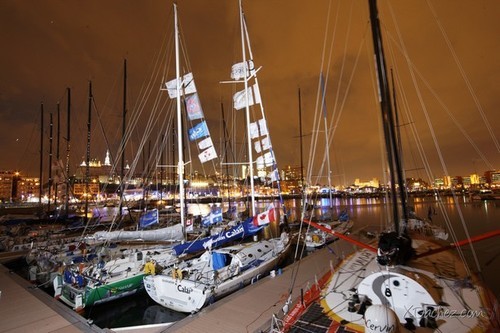
All in readiness for Transat Quebec St Malo. Photo: X Dachez ® Xavier Dachez / VIQ
http://www.xdachez.com
It is an ocean race with a very special profile, which will begin on Sunday in the shade of the Abraham plains and the Frontenac castle in Quebec. A West to East race across the North Atlantic, the Transat Quebec Saint Malo provides the intrepid sailors that attempt it with a vast range of points of sail, wind and sea patterns and marine landscapes, strategic and tactical openings and beyond all that perhaps, some good ground for wonderment and contemplation…
The magical, mysterious, and formidably majestic Saint Lawrence River
An element of bravery is required in this transatlantic, the first phase of a four part waltz, the 353 mile downriver passage between the ramparts of Quebec and the town of Percé, combine a fluvial riot and some unpredictable traps. 353 miles on a direct route, a figure which bears no relation to the reality of beating between the islands, in a wind with a capricious physiognomy, which evolves to the rhythm of the river, from its more or less brutal steep-sidedness and its islands, and its more or less protected islets. 'We had to perform over 80 changes of tack in 2004' recalls Pierre Antoine (Imagine). His high performance 50 foot trimaran with the wind on the tail was forced to hunt down more efficient wind angles, and often saw itself pushed close to the banks where the shallows and currents were being dished up. The latter constituted the main difficulty of this first quarter of the race. At 1100 hours (1500 UT) on Sunday, at the point where the start is given upriver of the Vieux Quebec, the current was to push the yachts at around 3 knots! Later on, as they rounded the famous and pastoral island of Orléans, they kicked up their heels and got 4 knots of boatspeed in current alone vitually! It proved to be a great way to sprint off from the start zone. At that point though, they also had to watch out for the change in the tide. And though the river also owes its majestic nature to the beauty of the countryside it irrigates, the sailors must be careful not to let themselves be sent off to sleep with the backdrop of the beautiful wild landscape. Added to this, the river still carries along a thousand and one objects that it has picked up in the spring with its numerous tributaries. 'To hit an object is the racers’ obsession' admits Jean Edouard Criquioche (Class 40 'Esprit large') 'It is certain that as far as Percé, we won’t be able to get much sleep.'
Time for the islands
The immense Saint Lawrence estuary emerges on the second part of the course, a veritable anti-chamber prior to the open ocean and the Atlantic. After the compulsory passage marks of Rimouski at the edge of the river, 142 miles from Quebec, then the Percé (350 miles), the sailors have to leave the island of Miquelon to port and Saint Pierre to starboard. Situated 690 miles from Quebec, this original and colourful course mark will also influence a route close to Newfoundland, and a possible regrouping of the fleet. The wind will likely kick back in after Percé in a more regular fashion and the foulies will now be part and parcel of life onboard, the racers living in them until they get to the European continental shelf.
Grand banks and grand spaces…
Past the archipelago of Saint Pierre et Miquelon, the legendary route to the Grands Terre Neuvas of the past century, opens out before the racing yachts. Slipping along under Cape Race, at the southern tip of Newfoundland, the crew are in maximum surveillance mode, particularly, as is often the case, if the fog born from the thermal contrast between the continent and the ocean, is in evidence…We then hit the random phase of the race, since the most direct course towards Europe crosses a zone prone to drifting icebergs. Race management is of course particularly vigilant as to the evolution of this field of ice and reserves the possibility of positioning virtual ‘gates’ here, forcing the racers to round to the south of a dangerous zone.
Welcome to the Atlantic
Nearly 2,000 miles of Atlantic Ocean open up before the competitors from Cape Race. The classic conflict of the lows dropping down from Labrador and the Azores High will supply (or not…) the fuel for their sails needed to push the yachts towards the English Channel, Bréhat and then Saint Malo. The power of one or the other of these two phenomena will dictate the comfort and performance of the yachts, whether they receive the wind from the lows astern, or the affects of the zone of high pressure directly on their route.
Final sprint, final dangers
In the past, the Channel has sounded the death knell for the hopes of a number of pretenders to victory in Saint Malo… Marc Guillemot in 2000 and Giovanni Soldini aboard his monohull the same year, both had to swallow the bitter pill of seeing their at times considerable lead melt off the Breton coast, thanks to a final unfortunate tack dissolving any promise of victory. The competitors en route towards the Banchenou Mark just 7 miles from the finish will have to have to have conserved their freshness and lucidity in order to negotiate what is often a lazy English Channel at this time of year.
Qué bec!
The late Paul Vatine, a true Norman if there is such a thing, adored the Transat Quebec Saint Malo which he won in 1988 on Jet Services, prior to racking up two third places in 1992 and 1996. The word 'Québec' had a special significance according to his father: Before the immensity of the estuary, a Norman sailor arriving during the first voyages of exploration of the New World, was heard to exclaim 'Qué bec!' or, in his strong local dialect, 'Quelle Baie!' (What a bay). The word 'Bec' is said to have its roots in the language of the founding Vikings of the Duchy of Normandy and indeed designate a bay (reference to the towns of Caudebec, Bolbec on the banks of the Seine). This version which undoubtedly requires the caution of ad hoc experts, certainly appealed to Paulo (Vatine) in any case, a friend to the inhabitants of Quebec.
[Sorry, this content could not be displayed]
http://www.quebecsaintmalo.com/
If you want to link to this article then please use this URL: www.sail-world.com/46653