In circles over whiting
by Jarrod Day on 20 Jun 2012
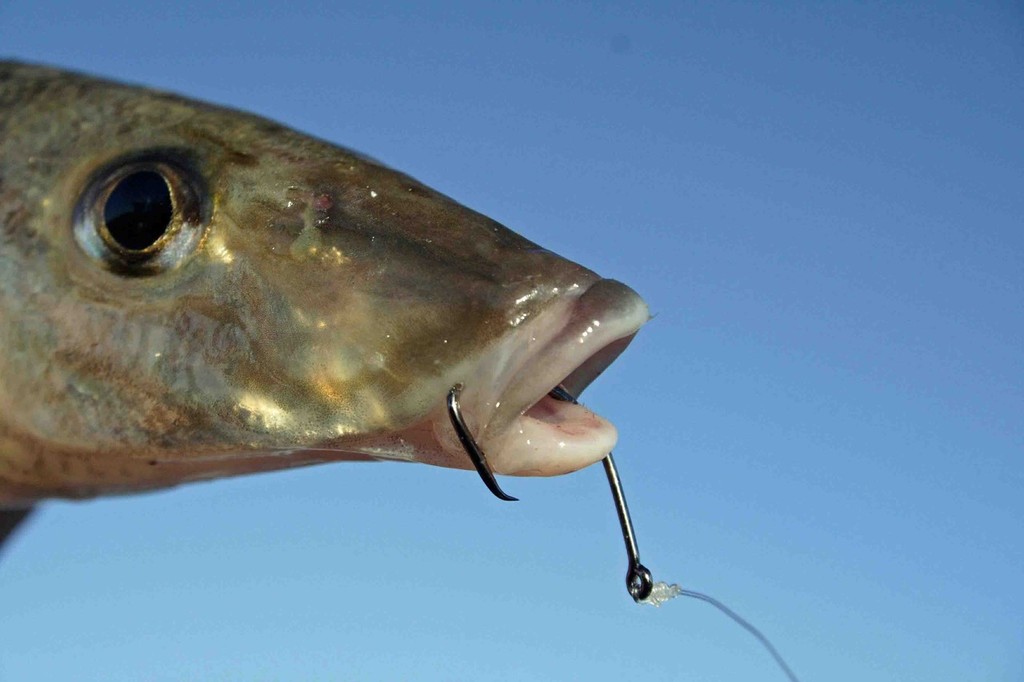
A circle hook in action, the perfect hook set. Jarrod Day
King George whiting are one of the most highly sought after species in Western Port. Known for their delicious tasting flesh and fighting capabilities, whiting can prove difficult to catch.
Traditionally, whiting anglers use small long shank hooks enabling them to strike when the bite is detected aiding in setting the hook. Striking at whiting when using long shank hooks is vital to secure a solid hook-up. Those who use long shanks usually fish for them using nibble tip rods. Nibble tips have an extremely sensitive tip which allows the angler to see the smallest of bites before striking.
Today, technology is always changing, where the long shank hook once inhabited the tackle box is quickly being replaced by the newly redesigned circle hook.
Circle hooks may only be fairly new to the modern angler but in the scheme of things, they have been around for hundreds of years.
Everyday, more anglers are turning to circles because of their success for both hooking and keeping fish on the hook providing they are fished in the correct manner. It is a fact that circle hooks will improve the anglers hook up rate to 98%.
What is a circle hook? A circle hook is a term that has been applied to a range of designs. Circle hook models have a point that mildly turns inward toward the shank, a true circle hook snags nothing at all even if placed in your pocket, this is also the same when entered into a fishes mouth.
Many hook manufactures make some version of a hook resembling a circle. Each has their unique trait that they consider to be the best.
While each angler has their favourite hook brand, I’m fond of Black Magic’s 1/0 KL, Owner’s Mutu Light Circle number six and Gamakatsu’s Shiner number six. These particular models are not too thick in gauge and very small in size making them an ideal whiting hook.
Still, many other manufactures have some sort of circle design but it is these three brands which are leading above all others. Each has their own benefits but it is the chemically sharpened and rust resistant capabilities that are superior above their rivals.
Baiting circles for whiting: Baiting circle hooks can prove a challenging task especially when using harder baits. While most whiting anglers twist on the humble pipi, bass yabbies, pilchard fillets and small crabs can require a little more attention.
When baiting circles with harder baits, take your time to gently thread them on the hook. Bass yabbies are best when used as live baits, so neatly tuck the hook into the tail enabling the hook point to protrude through the top; this also applies to threading on small crabs. Pilchard fillets are much simpler; they can be threaded on with a more weaving method so the fillet is worked right to the eye of the hook. This will keep it on the hook, when a whiting eats it they won’t just suck it off.
Pipi and mussel baits are the easiest to thread on, they can be twisted and wrapped around the entire hook leaving a small amount of hook point exposed for a cleaner hook up.
If you find your pipi or mussel baits are being sucked off, you can always wrap a little Bait Buddy around the bait to keep it attached to the hook.
Spooking the school: Whiting are a schooling fish and for those who religiously use long shanks will agree with this following sentence.
Quite often, you might attract a school of whiting to your location whether your using berley or not. Occasionally you’ll hook a fish only to loose it shortly after the hook-up and after a few minutes find that the fish have gone off the bite. This can be for a few reasons, either the tide has approached the slack tide or more commonly, the dropped fish has swum back to the school and spooked them off. I have found that if you lose a fish mid water, the school stays around but if you loose it within the first few seconds of the hook-up the school is spooked and you have to make a move to find them again. When using circles, once the fish is hooked it has a much less chance of getting free providing you keep a tight line, eliminating all possibility of it swimming back to the school spooking them.
Using circles: Though you wouldn’t think so, circle hooks have a specific way to be used to maximise the hook up rate. Anglers wanting to try circles need to be aware that they are best used in conjunction with braided fishing lines. Monofilament lines have too much stretch, disallowing the hook to be set correctly. If you do use a monofilament line you will need to set a very high drag on the reel to enable the hook to set itself. Still, you will find best success when using braided lines as they have no stretch and enable the hook to be set the instant the bait is completely swallowed.
The fish then turns its head to swim off and the hook is pulled toward the mouth. As it does so, the hook rotates around and the point enters the side of the mouth protruding through the skin. The angler can then see the rod tip quiver and begin to fight the fish to the boat, not giving the fish any slack.
If there is any slack given, the hook can roll out and you’ll lose your fish, but if you battle the fish to the surface with a tight line you’ll soon boat more fish than you’ll loose.
On the other hand, over the past few decades, we have been taught to strike when noticing a bite. Though this might work when using conventional suicide, bait holder or long shank hooks, circles require a combination of braided lines and a set drag to do all the work. I can guarantee that for those who strike at a fish while using circles, will actually pull the hook out of the fish’s mouth 99% of the time. This is because they haven’t let the fish turn enabling the hook to rotate around pinning the fish’s mouth.
Alternative baiting methods: Although the standard method for fishing circles is to thread on a bait, soft plastics are another useful technique.
Soft plastics can be threaded onto the circle hooks and used just like bait. Some anglers might choose to work the softies like you would any other soft plastic lure, though this will still catch a fish, I tend to leave a rod cast into the berley trail set up with a paternoster rig. On each hook I thread on a Berkley Gulp 6' Sandworm, packed with a punch, these softies are deadly on KGW’s.
Other plastics also worth threading on are Storm’s Twitchn’ Nipper or the Squidgy Pro Worm.
Though it may sound a little complicated, the concept of fishing circles is simple, keep a tight line, sit back, relax and watch your rod load.
If you want to link to this article then please use this URL: www.sail-world.com/98753