Nanosail, solar sailing craft, returns to Earth
by Digital Journal/Sail-World Cruising on 3 Dec 2011
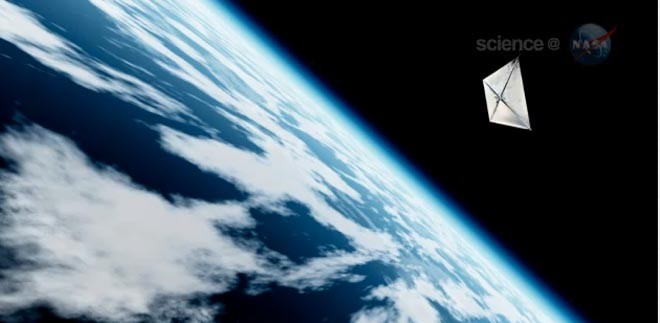
Nanosail in action SW
It was sailing craft that took us beyond our horizons to discover the New World and it's sailing craft that are leading the way into space. NanoSail-D2, the solar sail satellite deployed in low-Earth orbit since November 2010, (see Sail-World Cruising http://www.sail-world.com/Cruising/international/The-little-space-sailing-vessel-that-just-wont-sink./82925!story ) has successfully reentered into the Earth's atmosphere, says NASA.
'The NanoSail-D mission produced a wealth of data that will be useful in understanding how these types of passive deorbit devices react to the upper atmosphere,' said Joe Casas, FASTSAT project scientist at NASA's Marshall Space Flight Center in Huntsville, Ala.
Casas added that the data collected from the mission is being evaluated in relation to data from FASTSAT science experiments which are intended to better understand the drag influences of Earth's upper atmosphere on satellite orbital re-entry.
After analyzing data about its return, NASA has announced that the satellite NanoSail-D2 has reentered the Earth's atmosphere and burned up. Far from being merely the end of its usefulness, NanoSail's reentry was actually the main goal of its mission.
Deorbit and reentry occurred on Sept. 17, six months later than initially predicted, and allowed NASA scientists to observe the behavior of small solar sail in low-Earth orbit and during reentry. Engineers hope to use small solar sail technology to control the future reentry of satellites and space debris.
About the project:
A solar sail is a spacecraft that makes use of sunlight for producing and controlling motion. Although the effect is too small to be observed in daily life, light actually exerts pressure on surfaces. Solar sails consist of a lightweight, reflective material with a high surface-area-to-mass ratio.
As light shines on the surface of the sail, its pressure produces a gentle force that, over time, can accelerate a spacecraft to high velocities. Some engineers have speculated that large sails could even provide efficient means for traveling between planets and even to distant stars.
NanoSail-D2 tests the technology on small scale, and is aimed at providing a means of bringing defunct satellites safely back to Earth. As both light and the wispy traces of the upper atmosphere produced drag on NanoSail's reflective sails, the spacecraft's orbit slowed and gravity slowly pulled it back down towards the Earth.
NanoSail-D2's early days were fraught with trouble. The original NanoSail-D was destroyed when its launch rocket went off-course and crashed into the Pacific Ocean in August of 2008. The replacement satellite NanoSail-D2 was launched on Nov. 19, 2010 as a payload on NASA's FASTSAT, but it too ran into trouble.
Although the satellite made it safely to orbit, it failed to jettison from its parent satellite FASTSAT, aboard which NanoSail-D2 was piggybacking. To controllers' surprise, NanoSail unexpectedly ejected on its own from FASTSAT on Jan. 17, and deployed its sails two days later, allowing the mission to begin.
Because of its broad and highly reflective sail, NanoSail made an interesting target for observers of the nighttime sky. NASA and SpaceWeather.com hosted a joint astrophotography competition, challenging amateurs to capture images of NanoSail-D2 as it flashed in the night sky.
In addition to generating a wider public interest in the mission, the photographs also gave controllers information about NanoSail's behavior while in low-Earth orbit, where interactions with the dynamic atmosphere made its flight somewhat unpredictable. (Winners of the photography contest will be announced next year.)
Studying NanoSail's deorbiting and reentry was a main goal of the mission. Engineers hope that in the future small solar sails may be attached to orbiting satellites in order to bring them back to the Earth's surface in a controlled manner at the end of their mission.
Defunct satellites and other space debris, such as spent rocket stages, provide a collision threat to functioning satellites and manned spacecraft. NanoSail technology could allow controllers to bring old satellites safely down and out of harm's way.
For more interesting news from the digital world, refer to http://www.digitaljournal.com
If you want to link to this article then please use this URL: www.sail-world.com/91415