World-first discovery 'can help save coral reefs'
by ARC Centre of Excellence for Coral Reef Studies on 4 Oct 2011
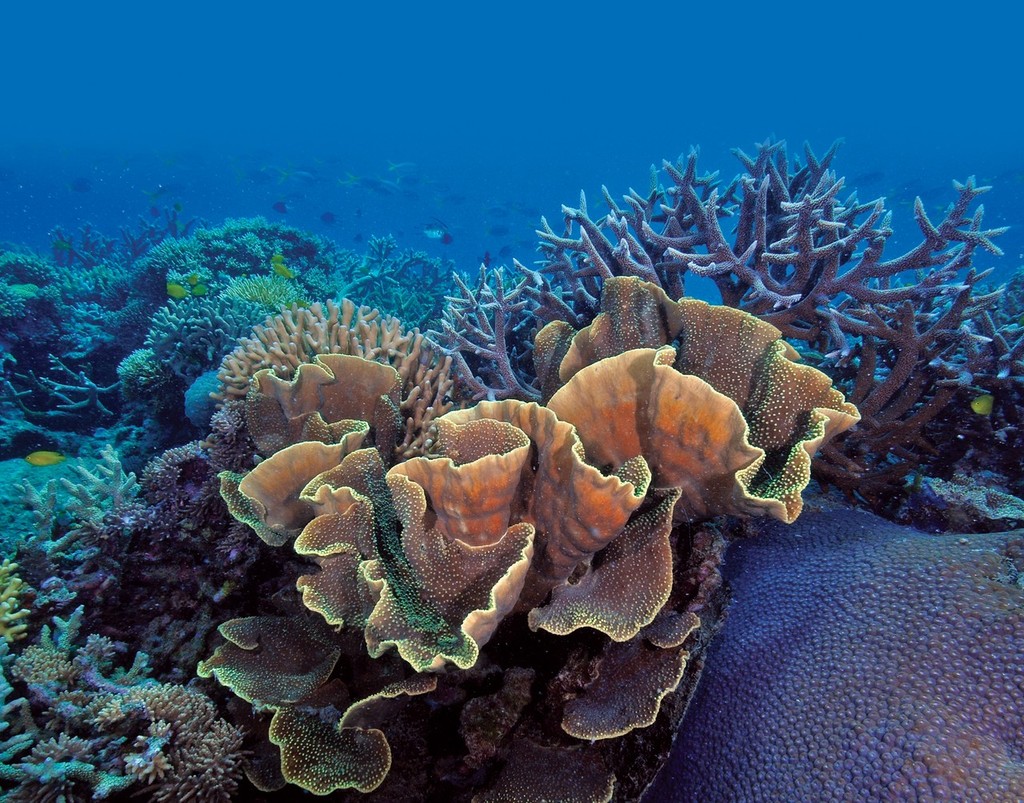
An area of high coral cover on the Far North Great Barrier Reef - Eric G Matson Australian Institute of Marine Science (AIMS)
http://www.aims.gov.au/creefs
An international team of scientists has achieved a major breakthrough in fishing sustainability on coral reefs which could play a vital role in preventing their collapse.
'Fishermen and scientists have long wondered how many fish can be taken off a reef before it collapses, says Dr Nick Graham of the ARC Centre of Excellence (ARC CoE) for Coral Reef Studies and James Cook University.
'The consequences of overfishing can be severe to the ecosystem and may take decades to recover, but hundreds of millions of people depend on reefs for food and livelihoods, so banning fishing altogether isn’t a reality in many nations.'
In a report in today’s issue of the Proceedings of the National Academy of Sciences of the USA (PNAS) the researchers demonstrate how overfishing can generate a predictable sequence of events that lead to the collapse of reef ecosystems.
Their research offers a vital new tool for managing corals reefs and tropical fisheries worldwide, providing clear targets for sustainability that can help reef fisheries support the very resource they depend on.
'Our work shows that as fish biomass – the number and weight of fish living on a reef – declines due to fishing pressure, you cross a succession of thresholds, or tipping points, from which it is increasingly hard to get back,' Dr Graham explains..
'For example, you see patches of weeds replacing coral, you see more sea urchins devouring the coral, you see a general decline in the species richness on the reef, and you see less coral cover.
'The loss of hard corals is actually the last stage in the collapse of the reef system. Though many people take it as a major warning sign, in fact, by the time you see the loss of live coral cover, it may be already too late to save the reef.'
The study shows that in well-protected areas, there are typically 1000-1500 kilos of reef fish of various species per hectare of coral reef.
As the volume is fished down below 1000 kilos, the early warning signs – like increased seaweed growth and urchin activity, begin to show up.
The researchers found that between 300-600 kilos/ha there appeared to be a window of what is known as maximum sustainable yield, but when the fish stock drops below 300 kilos/ha the reef is in real trouble, they say.
Dr Aaron MacNeil from the Australian Institute of Marine Science adds: 'This information is critical to policy makers and reef managers: if fish stocks can be maintained at a certain level, the chances of retaining a sustainable fishery and a healthy reef system are greatly improved.
'It’s a way of understanding the health of the whole system, not just parts of it,' he says. 'It offers managers a tangible target for protecting both the fishery and the reef, and it supports the need for long-term monitoring of fish in places such as the Great Barrier Reef.'
'Of course, having a target is one thing, but achieving it is, well, another kettle of fish' adds Dr Joshua Cinner, also from the ARC CoE. 'So we also assessed how well different reef management schemes did at maintaining reefs within or above this sustainability window.
Reef fisheries with no regulations tended to perform poorly, with some completely collapsed. No-take marine reserves, where fishing was prohibited were the best performers and tended to maintain key ecosystem processes, such as predation.
'But people depend on reefs for their livelihoods, so we can’t prohibit fishing everywhere.' notes Dr. Cinner. 'A key finding from our study was that even easily enforceable regulations that restrict gear or the types of species that can be caught helped maintain biomass. These regulations are often more palatable to fishermen than no-take closures and consequently receive higher levels of support and compliance.'
The researchers point out their work was carried out on Indian Ocean coral reefs, and needs to be confirmed in the Pacific and Great Barrier Reef regions – however they are confident a similar relationship exists between the volume of fish and overall reef health. Similar relationships may also apply in other ecosystems.
Their paper Critical thresholds and tangible targets for ecosystem-based management of coral reef fisheries by Tim R. McClanahan, Nicholas A. J. Graham, M. Aaron MacNeil, Nyawira A. Muthiga, Joshua E. Cinner, J. Henrich Bruggemann and Shaun K. Wilson is published in this week’s online edition of the Proceedings of the National Academy of Sciences of the USA.
ARC Centre of Excellence for Coral Reef Studies
website
If you want to link to this article then please use this URL: www.sail-world.com/89237