Vestas SailRocket 2 unveiled
by SailRocket.com on 9 Mar 2011
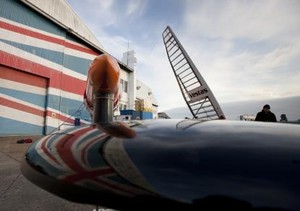
Vestas SailRocket 2 launched in March on the Isle of Wight Vestas Sailrocket - copyright
http://www.sailrocket.com
The SailRocket Team today launched its second-generation speed sailing boat from East Cowes on the Isle of Wight.
Vestas SailRocket 2 is designed to be significantly faster than its predecessor, with the ultimate aim of breaking the ‘Outright World Speed Sailing Record’.
Immediately after the launch the team prepared the new boat for shipping to Walvis Bay, Namibia, where sailing record attempts will begin in April.
Objective:
Since the team started with the first boat in 2002, the record has gone up by almost nine knots or around 20%. We felt that the kite surfers were going to be the ones to watch. They proved us right last October by effectively taking the record beyond the capabilities of all the other contenders. In order to do the 500 meter long record course over 56 knots, you probably need to be hitting peak speeds around 60 knots. It would not be worth trying to build a very expensive and complex boat just to go a little quicker than a simple kite surfer for a year or two. The new boat had to do more than that to justify the all round effort.
Design Criteria:
VSR2 has to be dynamically stable in a number of conditions including a total main foil failure at 60 knots. She must remain stable when encountering either cavitation or ventilation of either foil.
VSR2 was designed to be able to handle sailing loads over 60 knots including a 1G turn with a realistic safety margin.
VSR2 has to be able to operate over 50 knots in winds from 20-30 knots and in much rougher water than the first boat.
VSR2’s wing must be very easily managed and fully depower when the main sheet is eased. It must be able to feather when we tow the boat back up to the top of the course after each run so we don’t have to lower it each time.
VSR2 must be able to carry two people at world record speeds with no reduction of safety margins.
VSR2 must be highly configurable, modular and easily folded to fit in a 40’ container.
VSR2 must have enough structural reserve to be easily upgraded for faster future attempts if necessary.
Facts:
The main fuselage and beam are angled at 20 degrees to the actual direction of travel. This is so it points directly into the direction of the ‘apparent’ wind at high speed to both reduce drag and increase stability.
The entire boat including rigging has the equivalent aerodynamic drag of a 74 cm wide sphere.
The boat should be capable of 3:1 boat speed to wind speed ratios.
Adding a second 80 kg passenger reduces the peak speed by around 2.5 knots... about the same as sailing in 1 knot less wind.
The back of the boat will lift onto the curve of the foil at around 25 knots. The leeward float will begin to fly clear of the water over 50 knots. Only the main foil, the rudder and the ‘step’ of the forward float will be in the water at high speed.
If the main foil fails at high speed, the back of the boat will lift. The result will be that the wind will push down on the beam rather than lifting it like it did on the first boat. It must do this before the boat gets too nose down.
At low speed, the boat will be predominantly steered by moving the beam and wing fore and aft by up to 3 meters. At low speed it is forward to help the boat turn away from the wind. As the boat accelerates the beam is moved aft until it is at 90 degrees to the fuselage.
The curve of the main foil determines how high the boat rides.
The three floats were all designed to have a long waterline with lots of volume at low speed, low drag at high speed as they rise onto their stepped hulls and as low an aerodynamic drag as possible as they will be flying at 20 degrees to the direction of the wind.
The front float has a very strong floor to deal with the pounding it will get at high speed.
More aboout the new VSR2 here http://www.sailrocket.com/node/285
Paul Larsen's March 6th blog:
Yesterday we wheeled Vestas Sailrocket 2 outside and fully rigged her up for the first time. We wanted to do a trial lift with the crane in preparation for the launch. Everything went smoothly in the perfectly calm evening weather. There really wasn't a breath of wind.
We hoisted the 'creature' into the sky and walked around underneath her trying to take it in. Surrounded by nothing but air she looked right at home. I guess she is as much an aircraft as she is a boat. Sailing is all about the two mediums and yet we still consider sailing boats most from the perspective of the water.
This boat is designed and built to do more than break records. She has a purpose and that is to prove a point and show a clear path forward. If she is successful then the records will come with the territory.
The weather is still looking good for Tuesday. Both boats are now rigged in Venture Quays. I have to go and play with the details now.
It will be great to add our own little bit of 'flying boat' history to East Cowes.
The event will be open to the public from 1330 onwards so if you want to come and see both the boats then this is your chance. We will be off to Namibia straight afterwards.
We will be right beside the red funnel terminal in East Cowes on March the 8th.
Cheers, Paul.
htttp://www.sailrocket.com
If you want to link to this article then please use this URL: www.sail-world.com/81160