Quick MOB recovery with new MOBILARM technology
by Tracey Johnstone on 9 May 2008
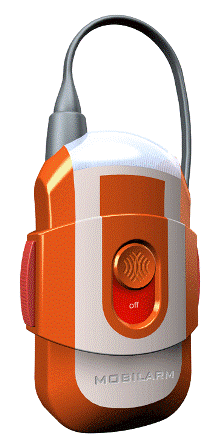
Mobilarm’s new product, the V100 VPIRB MOBILARM .
www.mobilarm.com
Mobilarm has introduced the revolutionary VPIRB which successfully marries existing marine safety technologies to make the recovery of man overboard victims far quicker and more effective.
Mobilarm’s VPIRB is a fully-automated Marine Survivor Locating Device specifically designed for the marine environment. It is small, light-weight, easy to use, competitively priced safe alternative to a personal EPIRB. Its functionality is intuitive through its in-water automatic activation and sending tracking data to all VHF DSC or VHF radio equipped vessels within range including the distressed mariner’s vessel.
Rather than sending emergency distress signals to an onshore location, the Mobilarm V100 VPIRB sends a signal from the device via VHF DSC Channel 70 and VHF Channel 16 to multiple stations - back to the boat the person has fallen from, to other boats in the area of the man overboard incident and to any land-based rescue stations within listening distance of the signal.
The VPIRB uses existing and standard marine technology, but in a new combination. It combines VHF radio transmission and GPS receiver functionality.
When a VPIRB wearer falls overboard the device detects the person has gone into the water. There is a 20 second delay, to counter false alarms, before the system automatically starts to transmit a Mayday message on VHF DSC.
DSC, or Digital Selective Calling, works in a similar way to a paging system. It uses data signals which automate transmission and reception calls between vessels. DSC allows for the transmission of critical information including the MMSI of the caller, the last recorded position of the caller and the priority of the call. Each call is categorised using the DSC’s standard system of prioritised identifiers of which Man Overboard is one.
The device is programmed with a unique identification number which should be registered in much the same way as a personal EPIRB requires registration with search and rescue authorities.
Mobilarm’s marketing manager Lorraine Hammacott explains the reason for using DSC technology is because it is widely used on commercial vessels. However, for the recreational vessels that don’t have DSC, they most likely carry a VHF radio.
'By including the voice synthesized Mayday message on Channel 16 we are making the message able to be received by just about anybody on the water.'
'The Mobilarm V100 VPIRB is a perfect alternative to the personal 406 EPIRB and 121.5 MHz personal locator beacons. If you carry a personal EPIRB, you can easily carry a VPIRB instead. The only time you would choose a personal EPIRB over the VPIRB if you were sailing or power-boating single-handed. Although it does transmit to other boats in the vicinity as well, if there is nobody on your boat to hear your distress signal then obviously sending a signal to an onshore location is preferable because at least you know search and rescue have heard you.'
The VPIRB can send a signal to any VHF receiver in range including onshore stations. 'With more manufacturers producing more cost effective VHF DSC radios for the recreational market, more and more search and rescue authorities on land also have VHF DSC radios.'
The VPIRB signal can be received on land, but that is not its primary objective. The Mobilarm V100 transmits the distress signal to the people who are closest to the man overboard emergency and in the best position to actually effect the rescue, within seconds of the person falling overboard.
The VPIRB has a GPS receiver built into it. When the device is activated it searches for a satellite fix, recording the device’s GPS position. Once it gets a fix the device will broadcast the DSC emergency distress call again with the device’s exact GPS coordinates.
'Once activated the device transmits the initial Mayday Man Overboard distress call and the strobe light starts flashing. Then the moment it has GPS coordinates, it will transmit again. This is all happening automatically. The person in the water does not have to do anything,' says Hammacott.
The voice message with the GPS coordinates is transmitted via VHF DSC on Channel 70 and using a synthesized voice system on emergency Channel 16. 'If there is another vessel in the area and they do not have DSC, they will actually get the same distress call over the VHF radio. It will be an automated computerised voice saying ‘Mayday, Mayday, Mayday’ then the device’s unique identification number, call priority, that is man overboard, and then the person’s longitude and latitude coordinates.'
The VPIRB device transmits the message every five minutes for the first half hour and then every ten minutes thereafter. It is continually repeated with the real time GPS coordinates of the device being updated as the position of the device changes. Message transmission continues until the device is deactivated or low battery power is detected. At this time only the strobe light will continue to operate. The device’s battery can support under normal conditions transmission for up to 18 hours.
Mobilarm’s V100 VPIRB is a development of and compliments the company’s existing marine safety alarm systems which provide automatic, immediate alert and GPS track back data to crew in a man overboard emergency. Mobilarm’s existing MOBi-lert range is an active system providing a close-loop proximity alarm system with tracking equipment installed on the boat through the boat’s GPS or chart plotter and personal pendants worn by everybody on board.
The MOBi-lert system continually monitors the location of the crew through a central console and its wireless network. The signal is broken by, for example, a person falling overboard, with the signal no longer able to transmit once the pendant is immersed in water. An alarm then sounds onboard alerting everyone else on board the vessel that something has happened to one of the crew and a waypoint recorded on the boat’s monitoring equipment.
Unlike the other Mobilarm man overboard systems which actively monitor the crew, the VPIRB is a passive device. Pushing down on the Arming Switch on the front of the device arms the device. The device then doesn’t do anything until a person is in the water. The key to the device is in its water detection capability.
'It has to be submerged in water for five seconds. The odd wave coming over it shouldn’t activate the device. If it is in your pocket and your pocket fills up with water, once it has five seconds of water detection it then goes into a 20 second warning state with an audible beep sounded before emitting the alarm.
'So the user has 20 seconds to deactivate the device which guards against false alarms,' says Hammacott.
The device can be also manually activated while the person is in the water by simultaneously pressing the two side buttons and sliding down the Activation Sleeve at the same time. This manual activation releases the in-built antenna which is designed to increase the effective range of the device’s signal.
The alerting radius for the device can be anywhere between two and ten nautical miles depending on the sea state and the height of the receiving antenna.
To deactivate the device the user presses the two side buttons and slides up the Activation Sleeve, then pushes the central Arming Switch back up which cancels the signal and disarms the device. It simply is a matter then of pushing the Arming Switch back down to arm the device ready for use again.
The VPIRB is a completely stand-alone product. For someone trying to find a person in the water they do not need any specialised equipment such as direction finding equipment. As long as a vessel has a VHF radio on board
If you want to link to this article then please use this URL: www.sail-world.com/44244