Sea Brakes, sea anchors, drogues and broaches
by Colin Patterson on 2 Sep 2007
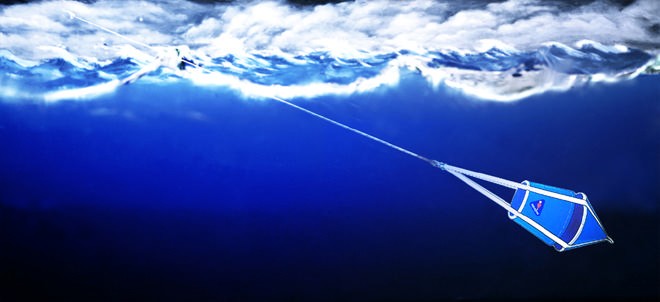
Seabrake Under Water SW
A following sea is generally the most dangerous and has led to many broaches, capsizes and drownings…however boats can be slowed with drogues.
There has always been some confusion in the distinction between sea anchors and drogues, as some look very similar in appearance - however, each have a very different role and if not used accordingly can produce dire results. A sea anchor, as the name suggests is used exclusively from the bow to hold a vessels head up into the wind in depths greater than the length of of line normally attached to a ground anchor - such as in the case of a break down well off to sea.
A drogue, is designed exclusively to be drawn behind a vessel to slow it in hazardous conditions - its restraint must be less than a sea anchor to allow it to be pulled through the water, and it must track well in order not to yaw and hinder or over ride the rudder. Basic drogues prior to the development of Seabrake tracked very erratically, rotated, and broke the surface when loads reached a maximum - right at the point of when it's needed the most.
Much debate has been raised over what is best to use in a dangerous sea when a vessel becomes 'unmanageable' and is at risk of foundering. For those who have drifted backwards on a sea anchor in big seas it is a back breaking experience for all onboard - and possibly for the vessel its self. Hence the reason drogues came into being years ago.
A drogue allows a vessel to travel in her designed aspect - forward. Down wind is always the smoothest ride, for both vessel an occupants, but the danger of broaching prior to Seabrake forced most to STOP on a sea anchor, hang on for grim life - and ready the life raft.
The choice now is unquestionable - endorsed and acknowledged both academically and by all who have used this remarkably simple solution to broaching Seabrake has the best of both worlds with its two stage action - constant restraint at all times and full brakes when required, and it's all automatic just set and forget the boat and the ocean do the regulating - how simple.
The Australian designed Seabrake has twice the drag of conventional sea anchors and drogues and has a whole range of additional applications including emergency steering. Its most unique aspect being its ability to provide 'variable' drag, maximum to prevent a vessel from surfing - and minimum for when the vessel is in a trough and needs to hold speed - a cruise control in effect to keep a boat at a set speed 'slow and constant' no matter how bad the conditions get.
For all of us who have gone to sea in good conditions and have had a home run in bad conditions with a following sea and the vessel 'surfing' down waves, we have all experienced the first stage of this potentially lethal situation without ever knowing we are on the brink of what follows next!
All to often we read of vessels and lives lost through a 'freak wave' that has capsized a boat and the survivors speaking of a wave bigger and coming from nowhere that caught them by surprise.
It is no freak - they are there all the time, just being in the wrong place at the wrong time will bring the best skipper and best boat unstuck - and accounts for a great many boating accidents every year.
Following seas are the most dangerous, and the higher the sea state the higher the risk of being in the wrong place at the wrong time. Panic results in more incidents than bad weather, bad boats or bad seamanship - getting out of the conditions usually results in trying to get home as quickly as possible, taking short cuts and edging up speed to narrow the gap between discomfort and fear, and the calm of home port.
Following seas alone increase a boats speed, increasing the boats speed again through carrying to much sail or to much throttle is pushing the bounds of safe steerage and safe speed - as when the vessel is 'surfing' it's traveling much faster than one realizes.
Even in moderate conditions when a vessel rides the crest of a wave and commences surfing the helm will either become soft or heavy resulting in less control, and once surfing has commenced the boat speed then becomes wave speed in the identical manner as a surfer riding a wave, good control being the difference between success or a wipe out.
A wipe out in boating terms being when the vessel reaches the end of the ride through running into the base of the wave ahead - i.e. 25 knots suddenly becomes a soft brick wall where the bow is buried and the stern is still being pushed at wave speed -resulting in 'capsize' or being swamped when the ridden wave keeps going at 25 knots whilst the boat (in the trough) remains stationary.
The action of a boat surfing down the face of a wave at speed and bottoming out in the manner as described above has been 'broached'- the vessel is not being directed by the helm but instead is finding its own direction which can not be compensated by the rudder.
The speed of water passing over the keel or chine with the vessel in a bow down aspect will cause the vessel to veer off in the direction of least resistance resulting in capsize when her beam takes the brunt upon bottoming out - the exception to this being (mostly yachts) where the vessel noses straight into the wave ahead and the stern is catapulted over the bow which is called 'pitch polling'.
The solution of course is not to get before any wave, but to remain behind them. Remaining slower than wave speed will allow waves to pass - and prevent the vessel from surfing. The classic example of this being when crossing a bar - the rudimentary principle here being to get on the back of a wave and ride that same wave all the way across the bar.
At sea however this is neither practical nor safe - maintaining the slowest speed possible and not exposing the stern to waves to be pushed into surfing will prevent broaching-to however, easier said than done, especially in very dangerous seas or at night. Slowing the vessel therefore is the only safe and practical method of preventing broaching-to.
Since the beginning of time when slow cumbersome vessels first put to sea crude make- shift means of slowing vessels in large following seas have been implemented, varying from bundles of rope dragged astern to drogues of all shapes and sizes, even car tyres and lobster pots strung out on long warps - anything to create drag and the vessels ability to gain speed when being pushed by mountainous seas.
All however had the same inherent unreliability, 'rotation'. Tow anything for a period of time that rotates and the line will twist its self into a tangled mass of knots creating a very unstable tracking device which can be more of a hindrance than a help - until it finally parts.
In 1979 in Australia's notorious Bass Strait in the worst conditions imaginable a solution to this age old problem eventually evolved, John Abernethy was operating as a commercial fisherman come charter boat skipper and stumbled (literally) across an idea that has revolutionized boat safety and stabilization of vessels in following seas through his invention Seabrake - as the word suggests he created the first brake for boats.
Its most unique aspect being its ability to provide 'variable' drag, maximum to prevent a vessel from surfing - and minimum for when the vessel is in a trough and needs to hold speed - a cruise control in effect to keep a boat at a set speed 'slow and constant' no matter how bad the conditions get.
Far from the crude unreliable drogues of a century or two Seabrake is a simple master piece, scientifically trialed and evaluated, and honoured with a number of safety and design awards - its greatest success however is its simplicity of use even by the most novas boater and covering all boats (power and sail) from ten foot tinnies to hundred foot luxury cruisers.
Much has been written and said about this simple yet fool proof
If you want to link to this article then please use this URL: www.sail-world.com/37198