Protest Decision- Measurer 'no longer sure' about Rule 31.6 compliance
by nzeditor@sail-world.com on 29 Jun 2007
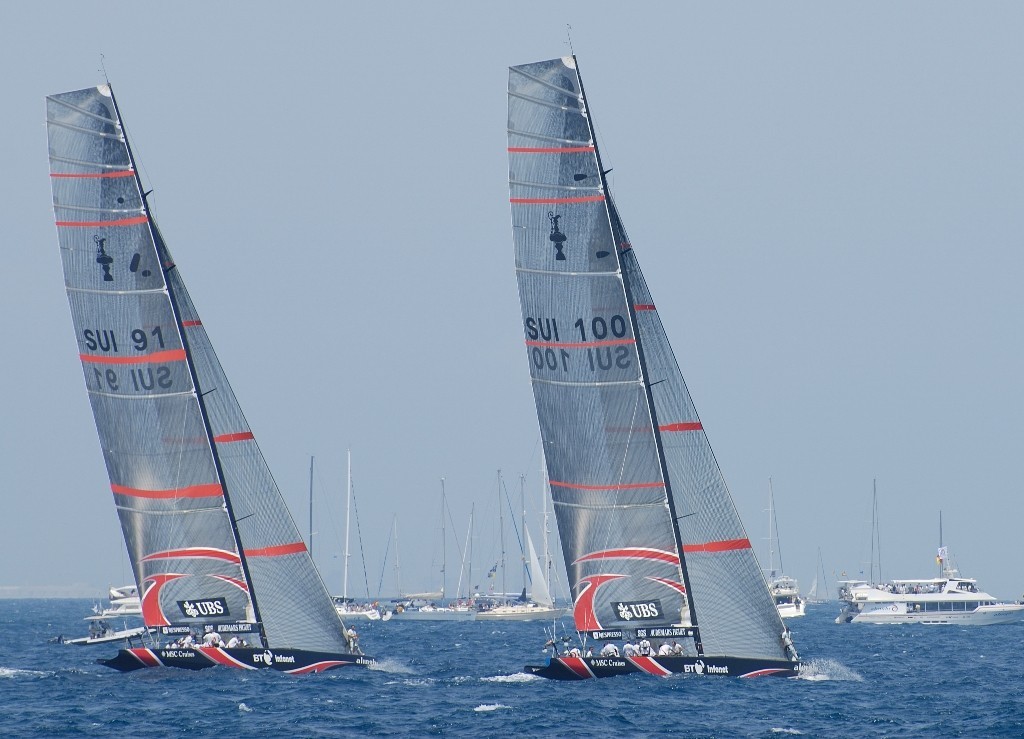
The two Alinghi boats tune up before Race 1 of the 32nd America’s Cup MCC McCamp
The majority decision of the International Jury has been released in the Protest concerning whether Alinghi was in compliance with the ACC Rules governing the use of mainsail locks at the masthead.
In the last paragraphs of the submissions made by various parties, the on-board Measurer, Don Martin, states that he was no longer sure if Alinghi complied with Rule 31.6.
The Decision says in part:
'[24] When the procedure was carried out on the yacht he was satisfied at that time that the procedure complied with ACC Rule 31.6. When he subsequently saw the video of the incident when he came ashore, he was no longer sure that what occurred complied with ACC Rule 31.6. Don Martin stated that the Measurement Committee had not subsequently filed a report with the Race Committee and that the Race Committee had not protested the boat in terms of RRS Rule 78.3.
'[25] Don Martin stated that after viewing the video, he wondered whether the movement of the right foot of the crew member aloft and his gripping of the top of the sail shortly before the release of the mainsail affected its release. He was concerned that from the time the signal was given to release the mainsail it took approximately 15 seconds for the release to occur. He stated that the release of the lock at the head of the mainsail and the kicking of the mainsail occurred virtually simultaneously.'
In its decision the Jury decided that it did have jurisdiction in the matter and stated:
'[32] In proceeding with the protest, the protestor (ETNZ) did not satisfy the Jury that, in the absence of a report by the Measurement Committee or of any protest by the Race Committee, there was sufficient evidence to convince the Jury to refer the matter to the Measurement Committee for determination under Article 20.1 of the Protocol, as to whether the Alinghi yacht complied with ACC Rule 31.6. The protest was therefore dismissed.
'[33] It remains within the discretion of the Measurement Committee after this case to take appropriate steps to be satisfied that, in their opinion, ACC Yachts involved in the Match meet the ACC Rules. '
The full decision is as follows:
AMERICA’S CUP 32
AMERICA’S CUP JURY JURY NOTICE JN085
Protest by Emirates Team New Zealand v. Alinghi concerning compliance of Class Rule regarding lowering of mainsail
Case ACJ035 Jury Decision
29th June 2007
To: Challengers and Defender, ACM, Chief Measurer, Regatta Director
Protest by Royal New Zealand Yacht Squadron represented by Emirates Team New Zealand NZL 92 (“ETNZ”) v. Société Nautique de Genève represented by Team Alinghi SA SUI 100 (“Alinghi”)
Date of Incident: Wednesday 27th June 2007; America’s Cup Match, Race 4
Date of Hearing: Thursday 28th June 2007 at 11h00 in Valencia
ETNZ Protest
[1] ETNZ sent a protest by email to the Jury Secretary and to Hamish Ross of Alinghi at 18h08 on Wednesday 27th June 2007.
[2] The protest by ETNZ was as follows:
“Incident: ETNZ was notified on the “safety radio” following Alinghi finishing race 4 that they were not to lower their mainsail until after the measurers were onboard. ETNZ observed that, after some discussion onboard Alinghi between the measurers and some crew members, a crew member was hoisted to the mast head. The TV coverage showed that crew member pull the halyard out of the top of the mast and lead it over a sheave and attach it to the mainsail. The halyard then took the load and the crew member kicked the mainsail and spread his arms. It did not release at that point. The crew member then shook the upper leach of the main sail at which point the lock released. It was only after all this crew assistance that the mainsail was able to be lowered.
ETNZ submits that this procedure is in breach of ACC Rule 31.6 in that Alinghi have not demonstrated that they can lower their mainsail without sending someone aloft to assist in releasing the head of the mainsail. From the TV coverage it seems that other than sending the man aloft dropping the mainsail would be impossible.
Rule: 31.6 Mainsails shall be able to be lowered to the deck without the necessity of a crew member going aloft.
Notification: ETNZ sent a copy of the protest to Hamish Ross at 1805, within the time limit for Race 4.”
Submissions on Validity of Protest
Alinghi Submissions
[3] Hamish Ross of Alinghi submitted that under the Racing Rules of Sailing (“RRS”) Rule 61.1(a), a boat intending to protest is required to inform the other boat “at the first reasonable opportunity”, to hail “protest” and under RRS Appendix C6.3 to display a red flag. The ETNZ yacht had not met any of these requirements and he submitted that the protest was therefore not valid.
ETNZ Submissions
[4] Jim Farmer QC submitted on behalf of ETNZ that it was difficult to see how a red flag could have been displayed as the incident did not occur until after the race had finished and ENTZ was not in a position to determine whether a protest could be properly made until such time as they had viewed the television footage.
[5] Jim Farmer QC further submitted that the ETNZ racing yacht did not reach the base until a bit after 17h30 and after viewing the televised recording of the race the decision to protest was made at approximately 18h00.
Submissions on Jurisdiction
Alinghi Submissions
[6] Hamish Ross submitted that under Rule 4.3 of the Jury’s Rules of Procedure unless they initially raised the issue of jurisdiction, Alinghi would be deemed to have waived such issue. Alinghi then submitted that under Article 20.1 of the Protocol, the Measurement Committee had exclusive jurisdiction to deal with “all matters relating to the measurement of the ACC Yachts, the interpretation of the ACC Rules, or the determination as to whether a yacht meets the ACC Rules…”
[7] Hamish Ross further submitted that under Article 21.4(a) of the Protocol the Jury did not have jurisdiction where it concerned a matter which is “expressly under the jurisdiction of the Measurement Committee” and therefore the Jury did not have jurisdiction to hear the matter at all.
[8] Hamish Ross submitted that should the Jury decide a matter which does not fall within its jurisdiction pursuant to the Protocol, Alinghi reserved its rights to challenge the decision in New York pursuant to the US Federal Arbitration Act.
ETNZ Submissions
[9] Jim Farmer QC submitted that Article 21.4 of the Protocol did give the Jury power to consider the protest including as to whether it had been demonstrated that Alinghi had complied with the America’s Cup Class (“ACC”) Rule 31.6. He submitted that such power was derived from Article 21.4(a) of the Protocol.
[10] Jim Farmer QC further submitted that the Jury had power to and requested that the Jury direct the Measurement Committee to complete a further test of the Alinghi mainsail release system without a crew member going aloft to ascertain whether Alinghi would comply with ACC Rule 31.6 and that in the meantime the proceedings should be adjourned.
Decision on Validity of the Protest
[11] The protest time limit for Wednesday 27th June was 18h10. The protest was received at 18h09 which was within the time limit for delivering protests. Alinghi was informed by ETNZ of the protest by receipt of the filing of the protest. ETNZ became aware of the circumstances that they considered would justify the lodging of a protest upon reviewing the video after coming ashore. In the circumstances of the matter, the Jury considers this to have been notification to Alinghi at the first reasonable opportunity.
[12] The Jury decided in ACJ032 that a protest may be valid when a boat has not displayed a red flag as soon as possible after the incident in circumstances where it is not reasonably possible to observe the incident whilst racing. Under RRS 61.1(a) a boat is required to display a red flag “until she is no longer racing”. Under RRS Appendix C6.4(b) a boat is required to keep her red flag displayed until she has informed the Umpires after finishing. The Jury determined that the protest concerned an incident which occurred when Alinghi was no longer racing. Therefore a red flag was not required. The requirements of the protest had been met (RRS Rule 63.5) and the protest was therefore valid.
Decision on Jurisdiction
[13] The Jury accepted that this was a fundamental issue. The Jury indicated that it considered the hearing should proceed with the question of jurisdiction being considered later in the case, if required. ETNZ confirmed that it was not raising any question on jurisdiction of the Jury and accepted this approach. Alinghi advised that it was prepared to proceed on the basis that they reserved all their rights in respect of jurisdiction. The case proceeded accordingly.
Evidence and Submissions on whether Alinghi broke ACC Rule 31.6
Opening Statements
[14] Opening statements were given by Jim Farmer QC and Nick Holroyd on behalf of ETNZ. Hamish Ross and Grant Simmer presented opening statements on behalf of Alinghi.
Submissions by ETNZ
[15] ETNZ presented video evidence of the incident. ETNZ submitted that the halyard lock at the top of the mast of Alinghi was not able to be released solely by the trip line and that such release occurred as a result of a deliberate kick to the mainsail by the man aloft on the Alinghi mast.
[16] ETNZ noted that there was no prohibition on a man going aloft to lower the mainsail but rather that ACC Rule 31.6 required that it must be possible to lower the mainsail without relying on a man aloft.
[17] Confidential evidence in the presence of ETNZ representatives, Ken McAlpine the Technical Director and the Jury, was presented to the Jury by ETNZ as to how the halyard lock on the ETNZ yacht operated. The purpose was to assist in understanding how a halyard lock system worked.
Submissions by Alinghi
[18] Grant Simmer submitted that Alinghi complied with ACC Rule 31.6 as it had a system that enabled its mainsail to “be able to be lowered to the deck without the necessity of a crew member going aloft”.
[19] Grant Simmer submitted that they had used the same mainsail system for all 5 masts that had been manufactured under the Version 5 ACC Rule and the system had been used in ten Acts (being from Acts 4 to 13). It was also submitted that on 19th May 2007 the Technical Director, Ken McAlpine, had sailed aboard the Alinghi yacht SUI 91 and they had demonstrated the halyard lock system and tested its release, and that Ken McAlpine had been happy with such system.
[20] Grant Simmer stated that it was standard procedure of Alinghi for a man to go up the mast to fit a halyard to the mainsail prior to its release. This was to ensure that in releasing the mainsail, damage or injury could not occur to the sail, the boat or the people as a result of the mainsail suddenly falling down which was quite unpredictable especially in rough seas like that after Race 4. Video evidence was presented of the Technical Director, Ken McAlpine, being interviewed by the Media about the incident at the Alinghi base during the course of the post-race measurement on 27th June, whereby he stated that the Measurement Committee was satisfied with Alinghi having complied with the ACC Rules. Grant Simmer stated that after he became aware that there was going to be a protest, he was advised by 3 members of the Measurement Committee that they were satisfied with the Alinghi halyard trip system and the test.
Murray Jones
[21] The Jury allowed the evidence of Murray Jones, the person who is in charge of Alinghi’s rigging, to be given confidentially in the presence of ETNZ representatives and the Technical Director Ken McAlpine. Murray Jones produced an Alinghi halyard release system as well as its technical drawing and explained its operation. He said that it worked in conformity with the ACC Rule 31.6 requirements and that it had always worked. It had been approved by the Measurement Committee and had never been changed since. He stated that in his view depending on the position of the mainsail battens, if it was released without a halyard attached it was possible for damage to occur to the runners or battens, or damage to the helm wheels as a result of the boom suddenly coming down.
Josh Belsky
[22] Josh Belsky gave evidence that he worked in the pit area of Alinghi and that it was his responsibility to manage the halyards. He stated that after a member of the Measurement Committee (Don Martin) came aboard, with Don Martin’s approval a man was sent aloft in order to fit a halyard to the mainsail and Josh Belsky held the tail loosely in his hand without applying any pressure at the time the mainsail trip was released. He stated that Don Martin was happy with this procedure. He stated that a member of the crew, Curtis Blewett, pulled the trip line which was below deck.
Pieter Van Nieuwenhuyzen
[23] Pieter Van Nieuwenhuyzen stated that he was hoisted up the mast to clip the halyard to the mainsail. He stated that it was standard Alinghi procedure prior to dropping the mainsail for a halyard to be fitted in order to avoid its sudden falling down. He stated that he did not assist the release of the mainsail lock, that due to the rough nature of the sea there was very substantial movement at the top of the mast (7 to 8 metres) and that he did not kick the mainsail lock system off. The apparent kicks (there were several of them before and after the release) were due to the mast movement especially when his hands were not holding the mast which he did in order to show that he was not helping the release process. He stated that the trip mechanism fully released itself in the normal way and without assistance. He said that, through the radio system with which he was connected, he could hear but not talk and that therefore he had to communicate by hand signals that he had completed fitting the halyard.
Don Martin
[24] Don Martin gave evidence that he is a member of the Measurement Committee and went aboard the Alinghi yacht SUI 100 shortly after Race 4 had been completed to conduct post race checks. He stated that following a request by Alinghi he specifically agreed that for safety reasons a member of the Alinghi crew be sent up the mast to fit a halyard to the mainsail prior to the release mechanism being tripped. When the procedure was carried out on the yacht he was satisfied at that time that the procedure complied with ACC Rule 31.6. When he subsequently saw the video of the incident when he came ashore, he was no longer sure that what occurred complied with ACC Rule 31.6. Don Martin stated that the Measurement Committee had not subsequently filed a report with the Race Committee and that the Race Committee had not protested the boat in terms of RRS Rule 78.3.
[25] Don Martin stated that after viewing the video, he wondered whether the movement of the right foot of the crew member aloft and his gripping of the top of the sail shortly before the release of the mainsail affected its release. He was concerned that from the time the signal was given to release the mainsail it took approximately 15 seconds for the release to occur. He stated that the release of the lock at the head of the mainsail and the kicking of the mainsail occurred virtually simultaneously.
Decision
[26] The decision of the Jury was by majority.
[27] In reaching its decision the Jury did not address Alinghi’s submission that the Jury should not hear the case since it lacks any jurisdiction to do so in view of the nature of the issue. The decision is without prejudice to such issue.
[28] The Jury notes that under Article 20.1 of the Protocol, all matters relating to “the determination as to whether a yacht meets the ACC Rules” are for the Measurement Committee.
[29] The Jury considers that it is within its jurisdiction to decide whether there is sufficient evidence to convince the Jury to refer the case to the Measurement Committee in order for the Measurement Committee to further assess compliance of the boat with the ACC Rules.
[30] The Jury considers that the request by ETNZ that the case be adjourned and the matter be referred back to the Measurement Committee for a further test to be carried out would then not assist with determining whether the Alinghi yacht complied with the ACC Rule 31.6 at the time the test was carried out immediately after Race 4.
[31] The Jury noted that although the member of the Measurement Committee who gave evidence had initially been satisfied that ACC Rule 31.6 had been complied with, when subsequently viewing the video evidence he was then undecided. In terms of RRS 78.3 the Measurement Committee had not decided that the Alinghi yacht “does not comply with the class rules” and that, as a consequence, they had not reported the matter in writing to the Race Committee which would have obliged them to then protest the boat in terms of RRS 78.3.
[32] In proceeding with the protest, the protestor (ETNZ) did not satisfy the Jury that, in the absence of a report by the Measurement Committee or of any protest by the Race Committee, there was sufficient evidence to convince the Jury to refer the matter to the Measurement Committee for determination under Article 20.1 of the Protocol, as to whether the Alinghi yacht complied with ACC Rule 31.6. The protest was therefore dismissed.
[33] It remains within the discretion of the Measurement Committee after this case to take appropriate steps to be satisfied that, in their opinion, ACC Yachts involved in the Match meet the ACC Rules.
Costs
[34] In terms of the Jury Guidelines on the Award of Costs, no order of costs was made.
Bryan Willis
America’s Cup Jury:
Graham McKenzie, Henry Menin, Henry Peter, David Tillett, Bryan Willis (Chairman)
If you want to link to this article then please use this URL: www.sail-world.com/35200