Maxi Yacht Rolex Cup - Meeting of the grand designs
by KPMS on 25 Jul 2014
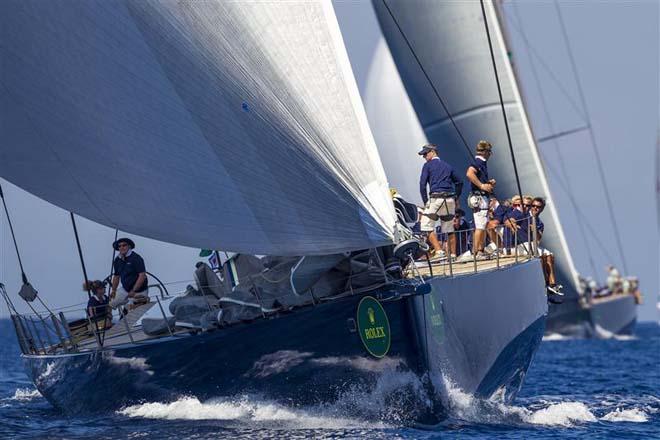
MAGIC CARPET 3 chased by HAMILTON during the first day of racing last year. Rolex / Carlo Borlenghi
http://www.carloborlenghi.net
Maxi Yacht Rolex Cup 2014 - Owned and helmed by individuals accustomed to success outside of sport, sailed by outstanding professional talent and designed by architectural visionaries, the world’s most impressive monohull yachts - known in the sailing community as Maxis - are admired for their speed, power and elegance.
The ultimate testing ground and showcase for Maxis, their owners, sailors and designers is the Maxi Yacht Rolex Cup, held annually in Porto Cervo, Sardinia and open only to yachts over 18.29m (60-ft) in length. With a fierce level of competition, challenging and complex racecourses, the event provides a stern examination of a Maxi yacht’s capabilities.
The 2014 edition of the competition will take place from 31 August - 6 September. Like spring’s Baselworld for the watch industry, the Maxi Yacht Rolex Cup is an unmissable rendezvous for those captivated by, and at the forefront of, the most cutting-edge developments in their industry.
Established in 1980, the Maxi Yacht Rolex Cup was born of a desire to provide the large, powerful yachts with an opportunity to engage in a direct competition, in a suitably challenging environment. Organized by Yacht Club Costa Smeralda, the event has been the jewel of Rolex’s international yachting portfolio since 1985. The near thirty-year partnership between the event, yacht club and Title Sponsor is one of the longest and most significant relationships in the world of sailing. Its enduring nature reflects shared values and the common pursuit of excellence and advancing innovation.
In the 1980s hulls were made of glass fibre, aluminium, sometimes even wood. Masts and rigging were constructed using metal; lines controlling sails were made of wire. Heavy and not particularly fast, loads were high, manoeuvres ponderous and safety margins slim. A far cry from the sleek, carbon fibre-built designs of today that benefit from aerospace technology, making them fast and agile. In the right hands some appear to be sailed like dinghies.
'Initially, Maxis were heavy displacement, fixed keel boats with a fairly shallow draft,' explains Jim Pugh of the San Diego-based Reichel/Pugh studio, the visionary behind several of the world’s great Maxi yachts from Wild Oats XI to Esimit Europa 2. The Maxis now racing in Porto Cervo are unrecognisable from their predecessors – rules, materials and knowledge have all changed over the intervening years expanding the opportunities considerably. 'Some of the Maxi boats now weigh 26 metric tonnes whereas 30 years ago they weighed 75 tonnes – a huge difference. The rigs are probably twice the size and due to a much longer waterline, they are more powerful, probably going three times the speed they did thirty years ago.'
Rolf Vrolijk of German studio Judel/Vrolijk, inspiration behind all-conquering Mini Maxis such as Niklas Zennström’s Rán 2 (and Zennstrom’s latest Rán launched earlier this year and now poised for its first Porto Cervo appearance) and Hap Fauth’s Bella Mente points to a number of factors affecting why and how design has evolved: 'A lot of the changes have been influenced by rating rules which have determined how boats are built.' Other developments have occurred following improvements in a different area, for example 'sail development in terms of cloth and design has occurred parallel to improvements in mast design.'
Continued research into the possibilities offered by the latest construction materials has enabled different sizes and types of boat to emerge. The landscape has broadened immensely: from all-out racing Mini Maxis between 60 and 72 feet to imperious Supermaxis measuring in excess of 165 ft (50m); from boats designed to both race and cruise to those with speed as their single purpose. All reflect a continuing desire to break boundaries in terms of power and elegance. The differences between an all out racing Mini Maxi (Bella Mente) and a Supermaxi (defending Class champion Nilaya), designed primarily to cruise, are outlined in an accompanying infographic.
With the range of concepts and solutions on display, it is little surprise that many projects are born at or inspired by the Maxi Yacht Rolex Cup. 'Coming to an event like this you see so many different styles of boat,' explains Pugh. 'It is definitely very stimulating in terms of creativity.'
Pugh confirms that the design process is categorized by several key steps starting with the owner’s brief: 'You will discuss what the owner wants to do, how he wants the boat to perform, gaining an idea about where the boat has to sail, where it has to have its strong points to meet his vision.'
Some briefs can be truly specific, as designer Mark Mills reveals for the recently launched 72-ft Mini Maxi Alegre: 'More than a perfect testing ground, the Maxi Yacht Rolex Cup is the boat’s raison d'être. The boat’s design, everything about it, is about coming here and doing our best. It is the template around which Alegre was designed.'
Once commissioned, an exhaustive research and development (R&D) process begins. 'So much of this sort of boat design is driven by R&D,' explains Mills. 'The first thing you do is set up a weather model, agree on the right conditions and let 80 or 90 hull shapes run through that model. The hull shape and parameters of the boat come out of R&D work. To that end it is the child of the research process.'
'Sometimes we will tank test, other times we will test computationally,' explains Pugh. 'Then we will develop a number of other designs that are slightly different, varying parameters of the baseline such as beam and displacement and different styles of hull shapes so we can run those computationally. It is a fairly long process, taking somewhere between four to seven months.'
Once the design concept and testing is finalised, the complex build process is set in motion, a collaboration involving composite structural engineers, together with sail and mast makers, and specialists in almost every conceivable aspect of a sailing boat.
Once constructed the crew begin a further testing process through extensive sea trials and then sailing the boat at competitive events. It can take a while for a new launch to reach her full potential. 'Everyone hopes to be right on target out of the blocks,' explains Mills, 'but the size of these boats and level of complexity involved, including a crew of around 22, means it usually takes a year to get a boat fully working.' This is the position Alegre now finds herself in. She is aiming to better last year’s second place and claim her first Mini Maxi Rolex World Championship.
Technology enables crews to crunch an amazing amount of data from cameras recording sail shape to sensors noting backstay and forestay tension. Of course, the data is nothing without skilled human interpretation. The sailors at the Maxi Yacht Rolex Cup are a who’s who in this regard, nearly all with a skill beyond simply knowing how to sail.
Development is not confined to pure race boats. The Wally Cento is one of the latest concepts in dual purpose yachts required to both cruise and perform on the racecourse. Hamilton was the first iteration, launched in 2012, and Reichel/Pugh delivered the second in Magic Carpet 3 in early 2013. The response to another owner taking advantage of evolution in stronger, lighter materials to improve speed. 'It is a very exciting project,' continues Pugh, 'It is not an absolute race design and has to reach the class rules of considerable accommodation. This is an even bigger challenge than doing a stripped out racing boat.'
Magic Carpet 3’s owner, Sir Lindsay Owen Jones, explains his concern throughout the process was whether his new yacht would be fast. The answer he says emphatically is yes: 'It’s much faster. It is much more fun, much more exciting. Paradoxically, it is a much better cruising boat because of its extra width, which gives people air and space and makes it a very stable cruising platform. When you feel it accelerating it really is an exciting feeling. It feels like a racing boat and that’s what we wanted.'
What can we expect to see over the coming years in terms of Maxi yacht design? 'There are parameters that limit you so you are not going to see a revolution in design,' warns Pugh. 'But you may see a continuing evolution in hull design in terms of performance, sail plans and in rigs.'
'The possibilities are always there,' adds Vrolijk 'and a desire to push the boundaries of speed will always be prevalent. For every generation of boats, the new ones have to be faster.'
Just like the Maxi world with which it has been closely associated with for nearly thirty years, Rolex has championed innovation in its field from the very beginning, adapting to dynamic, changing lifestyles and pioneering the development of the wristwatch as early as 1905. The brand is at the origin of numerous major watchmaking innovations, such as the Oyster, the first waterproof wristwatch, launched in 1926, and the Perpetual rotor self-winding mechanism introduced in 1931. Rolex has registered over 400 patents in the course of its history. The parallels with the continued developments in the Maxi world are clear: the desire to create something which is enduring and aesthetically spectacular; precise and innovative; robust and functional; admired and recognised for its excellence.
The developments witnessed each year at the Maxi Yacht Rolex Cup are significant for many reasons: they push the design envelope at the pinnacle end of the sport; the demand for, and availability of, high-tech material filters down to all aspects of sailing; Maxi yacht owners make a substantial investment to push the perceived boundaries of speed; and the desire for increased comfort onboard propels the sport’s continued evolution. Among the innovations anticipated for the future are consequential changes to the underwater profile and foils to increase speed.
As certain as Maxis will continue to break boundaries, the Maxi Yacht Rolex Cup will forever be the proving ground for the world’s greatest and fastest yachts. 2014 promises to be no exception.
If you want to link to this article then please use this URL: www.sail-world.com/124848