Targeting deep water whiting
by Jarrod Day on 16 Jan 2013
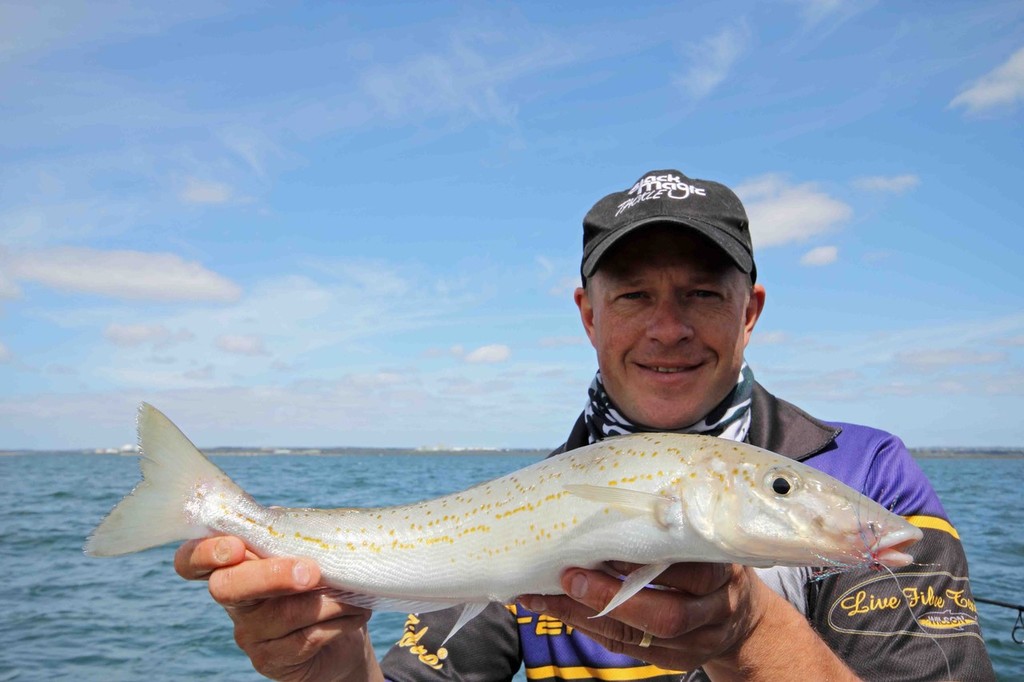
The author with a cracking whiting which measured 48.5cm. Jarrod Day
Those that regularly target whiting know that they are traditionally caught in shallower water where they feed over the shallow sand flats and weed beds. Whiting are one species that predominantly feed over the shallows in depths ranging two meters to five meters of water where they have easy access to small worms and other crustaceans. In Western Port, Victoria, vast areas of shallow mud and sand flats become over crowded with keen anglers in season and while there is an abundance of fish available, the majority range from 27cm to 40cm.
While fish over the 40cm mark are caught, it is within depths of 10 meters plus where fish over the 45cm mark are regularly caught. While many anglers aspire to catching fish of this size regularly, they will have to venture to the deep if they wish to do so consistently.
Deep water locations:
Western Port’s maze of mud banks and deep channels are the perfect location for anglers to target whiting but for the larger versions, fishing the deep is mandatory.
When it comes to fishing for whiting in the shallows, anglers tend to find weeded banks with sand patches where whiting will forage. In the deep water however, finding this type of ground is almost impossible unless you know what to look for.
It is vital in this situation that anglers have, understand and know exactly how to read their depths sounders. Without a sounder, finding potential grounds will be impossible meaning you’ll most likely catch unwanted species including sting rays, yellow tail, salmon, trevally and the like.
When looking for deep water locations, I like to focus on the deep edges of the shallow banks. This usually see’s me looking in anything from 10 to 15 meters of water where normally anglers would be fishing for snapper.
The bottom however tends to be more reefy more so than sand and or weed and is also where the current runs far harder than on the flats.
While there are plenty of deeper water areas to search, I do however concentrate heavily in the North Arm, southern side of Tortoise Head Bank, Sandy Point and off Lysaghts.
Gearing up for deep water whiting:
Most whiting fishing is undertaken with a 2-4 kilo nibble tip or 7’ light boat rod whereby a light sinker weight of 2-3 ounces can be used. In the deep, this is not the case as such a light weighted sinker wouldn’t even make it to the bottom. In this case, most of the sinker weights used are six or eight ounce leads. Due to this, the chosen rods need to be able to support this without overloading the rod on the cast or when it is in the rod holder. Ideally, a 7’ 4-6kg model will suit; personally I use a Wilson Texalium 4-8kg rod which although sounds heavy, has a very fast taper to fold away quickly to indicate a bite, yet still has the power to fish such heavy weights with.
Reel wise, I use a Shimano Sustain 2500 loaded with 6lb YGK braid. The purpose of using the YGK is due to its diameter compared to other braids of its class, it is one of the thinnest on the market. Having such a fine diameter braid will aid in eliminating the waters pressure bestowed on the line compared to thicker lines. This will also aid in bite detection as the line will have less of a bow in it when the bait and sinker is in the water.
Baits of choice:
While whiting tend to feast happily on pipi’s, mussel, bass yabbies and sand worms being the more common baits used, fishing the deep water with fast currents can cause these baits to fall from the hook. While I do use pipi’s the majority of the time, it is hard to go past thin slithers of freshly caught calamari. Calamari can be gathered quite easily before hitting the whiting and one calamari can be quite enough bait for one session. If you are heading out to the deep, arm yourself with some pipi’s and calamari and your well on your way to finding some quality fish.
Berley:
Whiting in the deep don’t tend to group together in large schools as they do in the shallows. A good session maybe 20 odd fish, but you won’t have consistent out of control action for your session. Most of the fish will come every two or so minutes but the key to this is using berley. A berley pot with large holes is recommended with a half block of pilchards mashed up by your hands placed into it. If you mash the pilchards too much, the berley will flow straight from the pot and dissipate in minutes. If you gently squish it up leaving the pillies in big chunks, they will stay in the pot and emit the odour which attracts the fish. It is imperative that the pot has enough weight to get to and sit on the bottom.
Deep water rigs:
Fishing the deep can have many different species take a bait, especially when using calamari. Pinkie snapper, stingray’s, gummy sharks, salmon, trevally and the like are all common catches and tend to bust up light rigs in seconds. While I still prefer to land one of these species than too bust off, I fish a little heavier leaders in this case. Most of the time, I use the pre-tied Black Magic Whiting Snatcher rigs which are tied from 15lb fluorocarbon leader and feature two droppers each containing a Black Magic 1/0 KL hook. If I tie a rig myself, I also use the same leader and hook in which the 15lb leader is substantial to hold up to most species without having you bust off only to tie a new rig when the fishing could be going nuts.
Watch for the dive:
One of the most important things to watch out for when catching whiting is their run. During the battle whiting are known for two distinct characteristics when they take a bait. Firstly it is on the initial hook up when the rod tip quivers to indicate they have the bait then the last run at the boat for freedom. It is at this point when most fish are lost as anglers tend to relax a little thinking they have it in the bag. Most of the time the angler continues to wind but when the fish goes for one last run, the rod buckles and the line breaks. Anglers should always use their arm as the rods extension and when the fish runs, move their arm forward as if it is the rod allowing the fish to run that last time before bringing it to the surface.
Deep water whiting are something else and if you’re on the lookout for a real challenge, venture out a little deeper and get amongst some real kidney slappers.
If you want to link to this article then please use this URL: www.sail-world.com/105606