
Keeping It Real
by Mark Jardine 25 Nov 08:00 PST
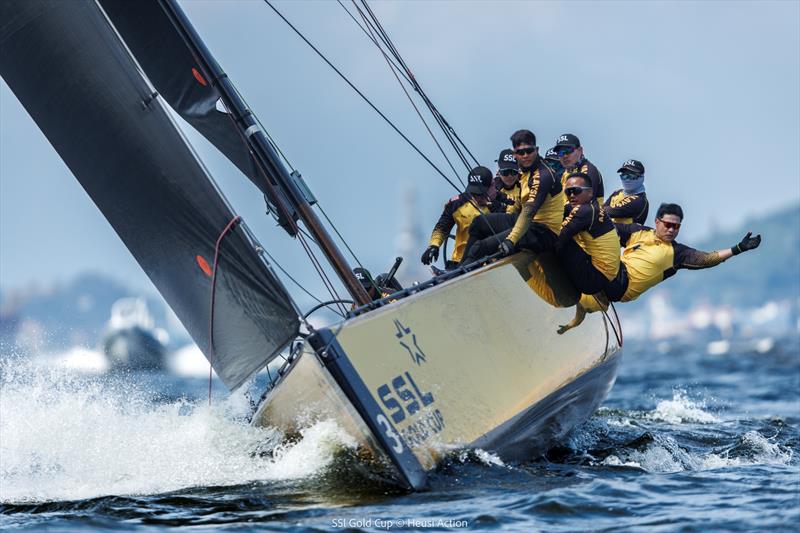
SSL Gold Cup 1/32 Finals Golden Sunday © Heusi Action
For the regular sailing season, November is usually a bit of an off month, and a time to reset, while also attending the incredible Metstrade show to catch up with a fraction of the marine industry over three days of back to back meetings.
This year though I'm out in Rio covering the second edition of the SSL Gold Cup, and everything has stepped up markedly from the inaugural event and - with it being Rio - it's billed as the 'Copa do Mundo da Vela'.
I'm a big fan of the concept. Nation versus nation, four-boat groups in a knockout format where the higher seeded teams enter the competition at the later stages. While some see it as an advantage to not have to go through the early rounds, those who do progress from the early part of the event are practiced, know the race area better, and generally have a well-drilled crew. Being one of the top-ranked teams can be both a blessing and a curse.
When you look at sailing marquee events outside of the Olympics, you have to think of both SailGP and the America's Cup. Both are now firmly down the foiling route and bear little resemblance to what you and I do on the water. Even Moth, Switch, Waszp, Kitefoil, Wing Foil and foiling windsurf sailors have to go through a thorough training program to understand how the extraordinary F50, AC40 and AC75 yachts actually work.
The America's Cup doesn't have a 'physical' aspect to it whatsoever any more, with the cyclors replaced by batteries.
It's now a push-button game.
The problem here is relatability. For sure seeing these machines fly around at 50+ knots at times is spectacular, and it is drawing the attention of people from outside sailing, but for sailors themselves SailGP and the America's Cup are something to look on inquisitively rather than connecting directly with how the boats are actually sailed.
This is where the SSL Gold Cup excels.
The national team concept has novel aspects, borrowing a lot from the Football World Cup with the jerseys, the national anthems, and the knockout structure, and purposefully so. It's of course hard to compare the two in terms of audience, but the SSL Gold Cup is reaching audiences in countries that elite sailing competition often ignores.
In total 66 nations are part of the event, with qualifying whittling it down to 40 at the finals in Rio, and it has brought teams and countries to elite yacht racing competition where otherwise it simply wouldn't be possible.
Earlier in the year at Grandson, Switzerland, during the African and Oceanian Qualifier on Lake Neuchâtel it was a pleasure to chat to the sailors from teams like Mozambique, they have nearly 2,500 kilometres of coastline, much of which I'm told is stunning. These are the places that sailing can grow, and the audiences with them.
The SSL47 yachts are fast, powerful monohulls. Powered up in around 7 knots of breeze with the crew fully hiking, they reward good sailing and punish mistakes both tactically and from crewwork errors. The ten sailors on board need to work together, and when they do the sight is magnificent.
Sailors from each nation come together from many different backgrounds, many from Olympic dinghies, some from keelboat experience, and even offshore sailors. The great thing as an 'ordinary' sailor, is that all the crew positions are relatable.
The bow team work to ensure the spinnaker and jib hoists and drops are smooth, the pit controls the myriad of halyards, trying to avoid jams and releasing them at the right time, the trimmers work the kite and set the jib, working in tandem with the mainsheet trimmer so the two work perfectly together, the grinders provide the explosive power during manoeuvres and more gently during sail trimming, and then at the back of the boat the helm and tactician work together, the former keeping the boat moving at best speed while the later is seen turning continuously to monitor the wind, current and opposition to plan their course.
These are all roles that we as regular sailors understand and can identify with, which makes it all the more enjoyable to watch. While I am writing and recording videos almost continuously while at the event, I find myself cheering my favourites and exclaiming phrases like "look at that" when a team pulls off a great move. It's exciting stuff and the majority of the races so far have been gripping.
There are so many elements within the project to further connect sailors, and the wider public, and it's having a real impact in Rio and beyond.
Right now the SSL Snipe Challenge has 32 dinghy teams competing in Guanabara Bay, some from the national teams competing in the main event, and a fleet of DF95 radio controlled yachts are being used by the sailors, the public, and - I have to admit - by myself and a few of the team for a couple of hours on Monday afternoon. It's great stuff and it's bringing everyone together in a way that is hugely enjoyable.
Curious members of the public are coming to the marina to see what's going on, first admiring the boats and looking at the sailors walking around in their jerseys, then seeing the COBI models of the yachts - made of bricks compatible with Lego, or 'Flego' as those familiar with the bricks call them - and then engaging with all the other activities which have been laid on, or just watching the sailing live or the replays on the huge screen.
The public is engaging with the event. Sailors are identifying with the event. It's an opportunity for the sport the likes of which we simply haven't seen before.
Today I'm recording the voiceovers for episodes of the SSL Sailing School. A series of short explainer videos which describe the basics of sailing with neat animations and actual sailing footage. There are so many side projects happening, and they're all helping sailing be more relatable. This is real sailing, made accessible in new, innovative ways.
I'm hoping later today to publish the first of a new 'The Debrief' video series from the event. This is where we look at incidents during the racing with sailors, the race team and umpires, together with live commentator and pro sailor Robbie McCutcheon. It's all about helping people understand how and why moves were made so that all those watching can make sense of a situation. The first looks at the four-boat OCS we saw during the 1/32 Finals. Should it have been a General Recall or was the Individual Recall made at the time the right call? It was fascinating to be part of the conversation and I hope you enjoy it too.
Sailing can be a complex sport, so if we can simplify aspects of it, and make it clearer as to what is happening on the water, then the coverage will be all the better for it, and more people will be able to engage with it, and then hopefully take part themselves.
I still made it to Metstrade and had my chats with the industry, and was buoyed to find that many were already following the SSL Gold Cup, and I think my enthusiasm for the event persuaded many more to take a look. I highly encourage you all to look at the livestreams, highlights and read the reports.
The Copa do Munda da Vela is keeping it real. Yes, they're grand prix carbon yachts, but it's the kind of sailing we can relate to, and it's bringing in sailors from more countries than we've ever seen before in the sport.
That's the kind of innovative event that I'm overjoyed to be a part of.
Mark Jardine
Sail-World.com and YachtsandYachting.com Managing Editor