
After a high-caliber IMOCA podium: lessons drawn from the Route du Rhum-Destination Guadeloupe
by IMOCA 13 Nov 00:05 PST
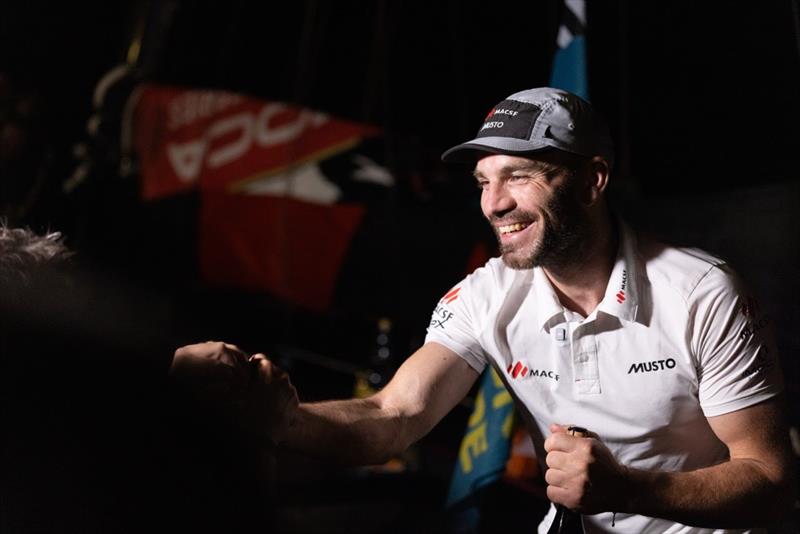
Corentin Horeau after winning the Route du Rhum - Destination Guadeloupe 2026 © Vincent Olivaud / FACTSTORY
Following the victory of Corentin Horeau (MACSF), with Boris Herrmann (Malizia 4) and Elodie Bonafous (Association Petits Princes-Quéguiner) rounding out the podium, IMOCA finishers have been arriving in Guadeloupe at a steady pace.
Once the emotions, the champagne, and the media fervour have all settled, it is a good time to look at what proved to be fast, where the technical gains seemed to be and what worked.
An unbeatable pace
"It was, in a way, the perfect course. Even in my wildest dreams, I couldn't have imagined it," said winner Corentin Horeau as he setting foot in Pointe-à-Pitre. By smashing the race record—improving upon it by 2 days, 24 minutes, and 16 seconds—and finishing 27 hours ahead of the runner-up Boris Herrmann "Coco" made a big statement with his first major IMOCA victory. Beyond the sporting achievement, the figures from this edition are revealing. Corentin maintained a very high speed, partly because the atypical weather conditions offered him a lot of downwind sailing. In fact, the leaders' tracks almost followed the direct, great-circle course. And so Corentin Horeau sailed 290 nautical miles less than Thomas Ruyant, who won the 2022 edition aboard LinkedOut.
But MACSF actually maintained an average speed of 17.47 knots (over the ground), compared to 15.5 knots for Ruyant’s winning route in 2022. While weather conditions certainly play a role, the ability to push the IMOCA to its full potential—along with advancements in foil handling, sail designs and use, and a host of other technical nuances—undoubtedly accounts for this step up in perfornance. And of the actual pace he set Corentin Horeau remarked with a smile: "The boat took a bit of a beating—I’ll need to check the bulkheads, too, because I think I really slammed it into the waves..."
An inspired winner and a unique podium
This edition of the Route du Rhum was unusual in that its outcome was effectively sealed on the second day, as the fleet approached the trough separating the high-pressure system centered over the British Isles from one in the west of the Atlantic near Bermuda. The winner recalls what he saw: "Ambrogio (Beccaria) and Sam (Goodchild) were slightly ahead of me. They decided to gybe right in front of me—I didn’t understand why. I went back to my computer and told myself, 'I want to cross this front as quickly as possible.' I caught a glimpse of them on the AIS, and after that, I never saw them again." Horeau made a brilliant choice: he was the only skipper to break into a favorable north –south orientated corridor of northerly wind. Blocked by light winds to their west his rivals were successively forced to peel off to go to the south east.
In just 10 gybes he built up a lead of 234 miles in under twelve hours—a feat virtually unprecedented in a transatlantic race. Typically maybe one or two competitors might fall victim to this kind of shut out—certainly not an entire fleet of pursuers. Even so, the remainder of the race was no walk in the park for him and he pushed relentlessly; Horeau for instance, had to deal with his fore deck cover being torn off—which he patched back on using Sikaflex—after first bailing out a compartment that had filled with water.
Behind him, Boris Herrmann proved once again that he remains a serious contender, even on this, his first solo outing on his Koch-designed boat, following two previous transatlantic passage, both including The Ocean Race Atlantic were sailed with a crew. This marks his third podium finish in a solo transatlantic race, following his second-place results in the 2024 Transat CIC behind Yoann Richomme and the New York–Vendée–Les Sables d’Olonne behind Charlie Dalin.
One of the major highlights of this Route du Rhum is Elodie Bonafous’s third-place finish. She is the first woman since Ellen MacArthur to reach the podium in an IMOCA Grade 1 or 2 race. Thrilled with her performance, Elodie remarked at the finish line: "Yes, I’m incredibly proud, because Ellen was my idol when I was a little girl. I hope that taking this spot myself will inspire many young girls. And to finish just ahead of Sam Goodchild in Guadeloupe—it’s just incredible! I had never crossed the Atlantic solo before, and I had never beaten him."
Bonafous is the woman to have a new boat built for the new Vendée Globe quadrennial, her Verdier-designed boat is a sister-ship to MACIF Santé Prévoyance. In the past, top performances by sailors like Justine Mettraux or Sam Davies—who secured top-10 finishes—were achieved aboard older-generation vessels. Their achievements have likely helped pave the way for other women today, providing them with the resources to pursue their own ambitions. Francesca Clapcich is among them. Before breaking her bowsprit, she had been contending within the top 5 of this Route du Rhum.
New designs make their mark
Alongside the impressive second place performance of Boris Herrmann aboard Malizia 4, Sébastien Simon’s showing also deserves recognition. Sailing a new Verdier-designed boat, the skipper from the Vendée region staged a spectacular comeback—climbing from 18th place on November 5th to finish 5th in Pointe-à-Pitre. Clearly, his IMCOA built in England at Carrington Boats is comfortable when sailing downwind in a breeze. However, to date there has been a lack of close-quarters racing to truly gauge the exact potential of these two boats.
In the meantime, the 2022–2024 generation remains the benchmark for the IMOCA class as the season draws to a close. It is worth noting, however, that these IMOCA yachts have undergone an exceptionally rapid development process—one was launched in July, the other in September!—which speaks volumes about the current level of expertise among naval architects, boatyards, and teams, all of whom have made significant progress. This is a point that Boris Herrmann was quick to highlight upon arriving at the dock in Pointe-à-Pitre: "I’m really happy—especially happy with my team. With the experience of 'Pifou' [Pierre-François Dargnies] in particular—these guys have so much experience. Everyone runs into minor issues from time to time, even the big teams, but I haven’t had a single problem; the boat is absolutely perfect."
Five races, four different winners
Corentin Horeau’s performance in this Route du Rhum marks the emergence of a fourth winner in the 2026 IMOCA Globe Series—distinct from the three other skippers who claimed victory across the season’s five races. This encouraging diversity speaks to the high caliber of the fleet, with designs from various generations all proving capable of taking the win.
In addition to MACSF, the five races on the calendar saw victories for MACIF Santé Prévoyance (Sam Goodchild), United by The Ocean (formerly Paul Meilhat’s Biotherm), and Ambrogio Beccaria’s Allagrande Mapei. Despite a strong start, the latter—much like Jérémie Beyou on Charal—suffered an accident during this Route du Rhum-Destination Guadeloupe, a result of the impacts that occur when sailing at such high speeds.
Although a helmet is now a mandatory piece of required equipment, the nature of these injuries is a cause for concern—a point highlighted by Antoine Mermod, president of the IMOCA class: "From a sporting and technical perspective, this Route du Rhum—and indeed the entire season—has been exceptional. However, the injuries sustained by the skippers represent a real dark spot for the IMOCA class during this transatlantic race. We need to examine this issue very seriously, sitting down with the skippers to find solutions together. The safety of the sailors must always remain the primary concern."