
Is offshore racing undervaluing its most engaged sailors?
by Rory Maher 29 Oct 12:15 PDT
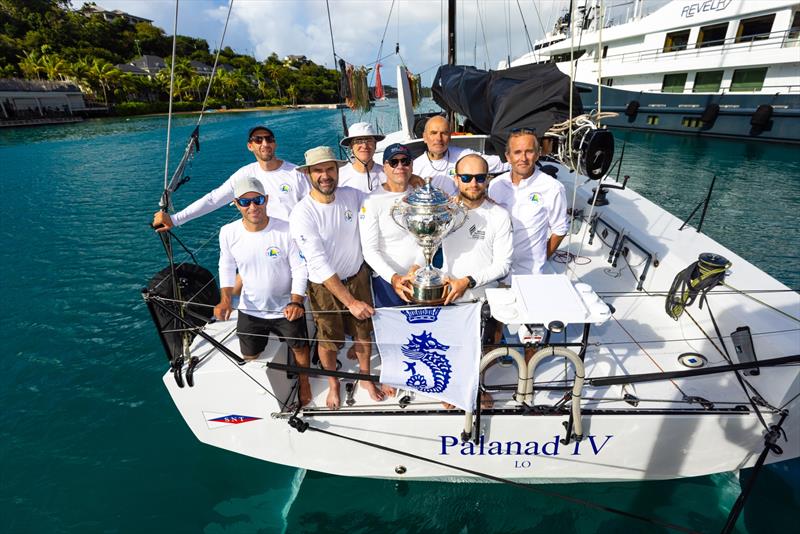
Team Palanad 4 with RORC Transatlantic Race Director Chris Jackson (back right) © Arthur Daniel / RORC
RORC's 2026 roll of honour is led by a family-run Mach 50 and a two-handed Sun Fast 3600. Their success raises a commercial question offshore racing has rarely tested: are the owners who fund and fill its fleets an audience the marine industry is underserving?
The most telling sentence in offshore racing this autumn came from a man who wasn't sure he belonged. Antoine Magré skippers Palanad 4, the Mach 50 owned by his father Olivier, and the boat has just been named RORC Yacht of the Year. Joining the Somerset Memorial Trophy's roll of honour, he admitted, prompted "slight imposter syndrome." "As an amateur, you don't necessarily feel you belong there," he said. "For us, this is the main prize in offshore racing."
He belongs. So do Rob Craigie and RORC Commodore Deb Fish, who won the RORC Season's Points Championship for a fourth consecutive year aboard Bellino, their Sun Fast 3600. Neither boat is a sponsored professional programme. Both are owner-run campaigns that finished at the very top of the results.
That raises a question the sport rarely asks out loud. Not whether owner-drivers are replacing professional teams, because they aren't. The question is whether offshore racing's media and commercial world gives enough weight to its most engaged participants: the people who buy the boats, the sails, the electronics and the entry fees, and who fill most of the start line.
Who fills the offshore racing start line
The participation numbers are not in doubt. The RORC Season's Points Championship, the world's largest offshore racing series, drew 341 boats in 2026, a year without a Fastnet, racing across eight major bodies of water from the Mediterranean to the Baltic. More than 300 of them raced under IRC. The 2025 Rolex Fastnet Race set a record when 444 boats, carrying more than 2,900 sailors, started from Cowes. Earlier in the entry process, RORC had reported a record 407 IRC entries, although that figure preceded the final starting fleet. Race organisers note that the bulk of the Fastnet fleet sits in the IRC classes, alongside the professional Ultim, IMOCA and Class40 entries.
One recent analysis of RORC's own figures put the 2023 Fastnet season at 729 offshore-certified boats and 9,223 sailors, and described the traditional model plainly: owners supplied the boats and paid most of the bills.
Those figures establish scale. On their own, they don't establish commercial value. But they describe a market that is large, committed and, by any measure, spending money.
Father, son and a boat built for friends
Palanad 4 shows what that commitment looks like up close. Olivier and Antoine Magré raced Class40s together for years before Olivier commissioned the Mach 50 from designer Sam Manuard. His brief, according to the company that installed the boat's electrical and keel systems, was a high-performance boat he could sail with friends, with real berths and a usable cockpit. The team is rooted in family and friendship, and Manuard and the boat's builder both sail aboard.
In January, Palanad 4 won the RORC Transatlantic Race overall on IRC. "To win the RORC Transatlantic Race with my son is the greatest result I could imagine in sailing," Olivier said, adding that on the boat, Antoine is the boss. The boat went on to win IRC Zero in the RORC Caribbean 600, where Antoine said it proved it was "not just a downwind speed machine," before the RORC Main Committee voted it the Somerset Memorial Trophy for outstanding racing achievement.
Four in a row, prepared at home
Bellino's story is quieter but just as striking. The fourth championship came with the Jazz Trophy and the IRC Three and IRC Two-Handed titles, topping the IRC standings in a 341-boat series. Craigie and Fish do much of the work on the boat themselves. "We do the preparation ourselves, so that's a big saving every year," Craigie said. For the Round Britain and Ireland Race, they sailed four-up, bringing Nicole Hemeryck and Joe Griffiths aboard.
Professional campaigns sell the sport. The owner-driver fleet may be the people buying from it.
A campaign that became a championship
The Class40 Mediterranean Trophy produced the season's most unlikely champions. Omar Naas, preparing for a round-the-world project, brought Louis Torreilles aboard Stella Nova to help him get ready. The pair did not set out to win the trophy. They were fourth after the trophy's first race. In May they led the 1,000-mile CIC Med Channel Race until the final night and finished second by about 10 minutes. In October they won the Class40 division of the Rolex Middle Sea Race, the season's final event, to take the title. "Louis taught me how to get the most out of a Class40," Naas said. A preparation programme became a championship campaign along the way.
How marine brands reach the fleet today
Some marine brands already market directly to this fleet. North Sails Apparel is RORC's official clothing supplier, providing members' insignia, crew kit and race merchandise, with a discount for RORC members, and it has supplied full race kit to 10 youth crews on the club's Griffin Project. That is a brand investing in relationships with owners and crews where they race.
Other partnerships show how fragile that support can be. Sevenstar Yacht Transport was title sponsor of the RORC Round Britain and Ireland Race from 2006. RORC says the partnership "has run its course," and the club went into the race's 50th anniversary edition in 2026 inviting new sponsors and partners. One title sponsor leaving an event proves nothing on its own. But it is a reminder that even a classic race full of committed owners has to find its backers.
Professional racing still delivers
None of this means professional racing has stopped mattering. Rolex has been title sponsor of the Fastnet since 2001, and the professional classes bring the images and headlines that carry the sport beyond its own audience. One sponsorship platform estimates that the 2020-21 Vendée Globe generated 269 million euros in advertising equivalent value in France, and reports that more than 130 companies supported the 33 skippers in the 2024 edition. The same company, which sells sponsorship and so has an interest, puts the cost of a new IMOCA at six to seven million euros.
The professional end and the owner-driver fleet are different markets. One delivers visibility. The other may be a customer base.
The commercial case, and what we don't know
The business argument is easy to state. Sailmakers, equipment manufacturers, marine electronics companies and safety-gear brands sell directly to the owners who race offshore. Those owners replace sails and gear that offshore miles wear out, travel to events and keep upgrading their boats. Survey evidence points the same way. In a 2024 study of 819 boaters in the northeastern United States by Padin & Estabrook for McMichael Yacht Yards & Brokers, 77 percent said they expected to spend more on boating in 2025, and the researchers concluded that respondents were willing to spend what it takes to maintain or enhance their boats. The authors note the results aren't projectable nationally, and the survey covers boaters in general, not offshore racers.
What nobody has published is the evidence that would settle the question: how offshore sponsorship money is split between professional teams and owner-run campaigns, what the owner-driver fleet actually buys and from whom, and whether a brand gets a better return from reaching hundreds of active owners than from a logo on a professional boat. Race organisers hold the entry data. Class associations know their fleets. Brands like North Sails know what their club partnerships return. That information exists. It just hasn't been put side by side.
The question worth asking
The sport has built good structures for its owner-drivers. The Griffin Project brings young sailors through. The Season's Points Championship rewards a whole season rather than one result. The 2026 Offshore Double Handed World Championship in Marseille put 17 teams from 13 nations in supplied Sun Fast 30 One Design boats, placing the emphasis firmly on crew performance rather than equipment advantages. France's Thomas André and Colombe Julia claimed the title.
What hasn't caught up is the commercial thinking. Professional campaigns show the sport to the world. The fleet behind them, father-and-son crews, Commodores who prepare their own boats and Class40 sailors who win titles they never set out to chase, may be the most valuable customers the marine industry has. If that's true, the brands that work it out first will have an advantage. If it isn't, someone should be able to show the numbers. Either way, it's time somebody looked.
Find out more: clearairmag.com/offshore-racing-undervaluing-most-engaged-sailors