
Class40 in the Route du Rhum: The biggest class has sailors with ambitions at every level
by La Route du Rhum-Destination Guadeloupe 26 Oct 10:34 PDT
1 November 2026
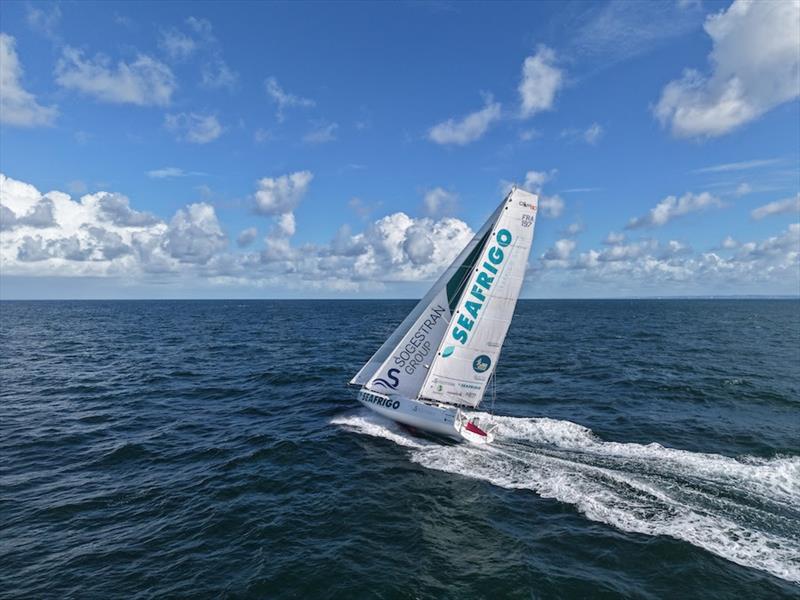
Sogestran – Seafrigo © WaterandTechnologyFactory
With 49 solo skippers set to line up Sunday off Saint-Malo, Class40s make up the biggest fleet in the Route du Rhum - Destination Guadeloupe 2026. It is a highly competitive field, bringing together favorites, underdogs, and newcomers—all with vastly different ambitions and resources.
On paper, two sailors stand out: Corentin Douguet (SNSM, Faites un don!) and Guillaume Pirouelle (Sogestran - Seafrigo). But there are many other contenders—including those whom top skipper Alexis Loison (Groupe RÉEL) calls "troublemakers." The term, for those who could spring a surprise perfectly captures this edition. It is set to b an open-ended battle where the final pecking order across the Atlantic remains open, and could well do so until the final miles into Guadeloupe.
Douguet et Pirouelle: The men to beat
It is impossible to make predictions without starting with this duo. For the past two seasons, Corentin Douguet (SNSM, Faites un don!) and Guillaume Pirouelle (Sogestran - Seafrigo) have only left crumbs for their rivals to feed on. Douguet enjoyed a stellar 2025, securing three victories then a second-place finish in the TRANSAT CAFE L'OR behind Pirouelle and co-skipper Cedric Chateau.
Douguet has kept up the pace this season, adding another win to his record while Pirouelle has repeated that success twice in recent months. He also served as a crew member on Sodebo Ultim 3, the current holder of the Jules Verne Trophy.
"We've put in the work, built a fantastic boat, and it's well-prepared. Now, the expectation is for us to deliver," says Corentin Douguet, who finished third in this race in 2022 and has three solo transatlantic crossings under his belt.
They have a wealth of experience compared to competitors who are less seasoned in long-distance solo ocean racing. Pirouelle is already well-acquainted with the joys of spending time alone with his own thoughts.
"On paper, I'm in a very good position. I've built up a great deal of confidence, and the whole team has made progress. But you also have to know how to reinvent yourself once you start winning—and never forget that you can never truly master everything."
Pirouelle, from Le Havre, knows he will need to adjust his pace for a duration of solo effort that is unusual for him. "Back in the Figaro class, you can push things to the absolute limit for five or six days. Here, I'll need to pace myself. Managing fatigue and maintaining a clear head will be just as important as looking after the equipment." Yet, he has no intention of abandoning his aggressive, competitive nature. "I enjoy pushing my own boundaries, going as far as I possibly can. When conditions get tough, I remind myself that it's just as hard for everyone else. It's precisely in those moments that you can make the difference."
A pack with a killer instinct
Behind this duo, there's a whole posse of good solo sailors waiting for any sign of weakness. Fabien Delahaye (Legallais), Axel Tréhin (Exalt), Italy's Luca Rosetti (Maccaferri Futura), Ian Lipinski (Crédit Mutuel), William Mathelin-Moreaux (Patapain - Les Invincibles), Quentin Le Nabour (Bleu Blanc Planète Location), Thimoté Polet (Team ZEISS), Pierre Leboucher (Institut Imagine), the Czech Republic's Milan Kolácek has a brand new boat launched in July (Ocean Calling), Barcelona's French based Pep Costa (VSF Sports), Mikael Mergui (Hirsch-Centrakor), Achille Nebout (Amarris), and Alexis Thomas (Afterdata - Elcia)—who was recently crowned French Elite Offshore Racing Champion—make for a formidable lineup, and this list is by no means exhaustive.
Loison (Groupe RÉEL) is a dark horse contender capable of upsetting the odds. The Cherbourg native, who won the 2025 Solitaire du Figaro, claimed victory in the 40' Malouine - La Trinquette in his very first competitive outing aboard his Lift V3, which was launched in July. It was a notable debut, though he is careful not to read too much into it. "There are, in fact, two sailors who have won just about everything over the last two years. Behind them, there's a whole pack of troublemakers—and I count myself among them. I enjoy shaking up the established order!"
For his first solo transatlantic race, he can draw on nineteen years of experience in the Figaro Bénéteau class, even if he is still fine-tuning the handling of his new boat. "The Route du Rhum is a sprint—but a sprint that lasts for fifteen days. You have to find the right balance, sail cleanly, and avoid making mistakes by trying to go too fast. Besides, solo racing levels the playing field; things aren't as predictable as they might look on paper, which opens up new opportunities."
"That works for me!" French 2012 Olympian Pierre Leboucher shares this assessment. Aboard Institut Imagine—a boat which is slightly older than the latest generation—he will have to find ways to compete with rivals whose boats are inherently faster. "The new Lift V3 models have a real advantage. But the weather could well reshuffle the deck. And when sailing solo, it's difficult to push your boat to 100% at all times; there's a greater risk of breakage or making mistakes." This suggests that the balance of power may be less set in stone than the technical specifications would imply....of the monohulls.
Fifteen days to make the difference
The roughly 3,500 nautical miles separating Saint-Malo from Guadeloupe could hold many of surprises—especially since, with no mandatory waypoints, every sailor has complete freedom to choose their own route. Between navigating weather fronts, hunting down favorable wind zones, and opting for potentially radically different paths, those who prefer carefully laid-out plans may well end up with a few headaches. The result could be gaps that quickly grow quite significant. "Conditions over the first five days might favor some boats over others. And since strategic choices can vary so widely in this race, the range of possibilities is, in reality, vast," notes Pierre Leboucher.
Favourite Douguet sums up the challenge more succinctly: "In a transatlantic race, the only thing you can be sure of is that you can't be sure of anything!" The task, then, is to contend with that uncertainty. "You might face several difficult stretches, sometimes lasting for days. You have to manage to navigate through all of them. Whoever handles them best puts themselves in a position to contend for the win," points out Guillaume Pirouelle. This determination is tempered by a degree of caution—and a conscious decision not to become trapped by the pressure to achieve a specific result. "A podium finish would obviously be great. I even think I'm capable of taking the win, but I don't want to put that kind of pressure on myself. Above all, I need to sail well and take care of myself."
Pointed-bow Class40s: A battle within the battle
The fleet also includes ten Class40s with pointed bows, older-generation designs that are naturally less competitive at certain points of sail than the latest models. Their skippers, however, have no intention of simply making up the numbers. Among them, Loïc Féquet (Funae) and Belgian sailor Djemila Tassin (Djemila Sailing-Belgium Ocean Racing) are particularly worth watching.
Féquet, who purchased his 40-footer in January, has spent much of the past few months investing his time and resources in refitting the boat and ensuring its reliability, prioritising technical work over training on the water. "I preferred to do things properly from the outset rather than have to redo them three times. Today, the boat is ready and so am I. Since I haven't done a huge amount of sailing, I'm especially eager to get going!"
Although he acknowledges the speed advantage of the round-bowed scows at certain points of sail, the sailor from Ille-et-Vilaine has no intention of simply keeping an eye on his nine fellow skippers racing older-generation boats. "The idea is to try and beat a few scows along the way too! I don't know exactly how things will turn out. I'll sail my own race, push as hard as feels right, and we'll see what happens."
For these sailors, however, satisfaction will not be measured solely by their finishing position.
"We put an enormous amount into these projects. The first reward is making it to the start line. The second is reaching the other side. And the Route du Rhum only comes around every four years, so you have to make the most of it!"
It is a philosophy that says a great deal about this fleet. Beyond the favourites and the battles for position, every skipper has their own reasons for being there — and fifteen days on the Atlantic to discover just how far those ambitions can take them.
Read about some of the international Class40 sailors: