
PredictWind: Light winds turn the PIC Coastal Classic into a tactical test
by Suellen Hurling 22 Oct 19:09 AEDT
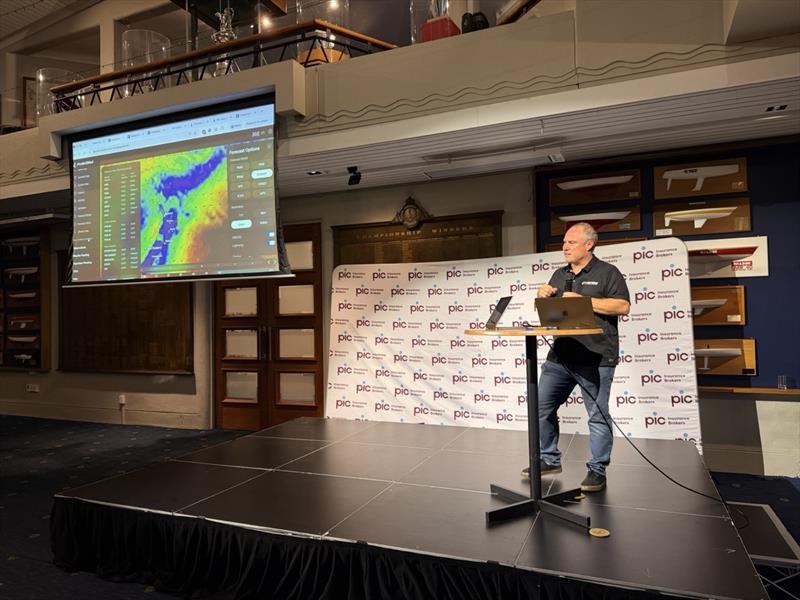
Nick Olson, PredictWind Weather Briefing - 2026 PIC Coastal Classic © Suellen Hurling / Live Sail Die
Fresh forecasts, coastal observations and careful management of the tide could prove more valuable than outright speed in this year's PIC Coastal Classic.
Nick Olson from PredictWind has warned competitors to prepare for a long, technically demanding race from Auckland to Russell, with light winds and several difficult transitions expected along the 119nm course.
A high over the Tasman Sea is producing a weak pressure gradient that is forecast to fade as the race unfolds. Although that should spare crews the strong westerlies Auckland has experienced repeatedly in recent months, it creates a different challenge: finding and staying connected to narrow areas of usable breeze.
"It's going to be a very technical race, and the weather is really going to play a big part in it," Olson told competitors during the final pre-race briefing.
A promising start, but complications farther north
Conditions at the start are expected to be relatively favourable.
"I actually think there will be a reasonable breeze at the start," Olson said. "I think it's going to be pretty nice."
That should give the fleet an encouraging opening to what may become a much slower contest. The picture grows less certain around Cape Rodney, where boats are expected to sail out of the initial southerly and into lighter, less stable conditions.
The transition could compress the fleet and create large differences between boats sailing only a short distance apart. Olson urged crews to watch the yachts ahead and resist making dramatic moves offshore without convincing evidence.
"This is where you're going to need to be right on top of it, looking at the boats in front of you and not doing crazy stuff, heading miles out to sea," he said.
Local sea-breeze effects could further complicate the northern portion of the course. Depending on how those breezes develop and cross the land, some boats may find new pressure while others are left drifting nearby.
"This is going to be tricky," Olson said. "There's no other way of putting it."
Conditions may improve again farther north before becoming lighter during the small hours. For many crews, the result is likely to be an overnight race requiring sustained concentration rather than a short sprint up the coast.
Keep updating the plan
Because the forecast is evolving, Olson said crews should pay close attention to the timing of new model runs.
Updates arriving between approximately 5am and 8am will allow teams to make their final strategic decisions before the start. The following evening's updates could be equally important, as much of the fleet may not yet have reached the halfway point when those forecasts arrive.
"When the models update, getting the new data and reassessing your strategy is going to be really important," Olson said.
Rather than treating their pre-start routing as a fixed plan, navigators should download the latest information and reconsider their strategy while racing.
Olson said the high-resolution PWG model was performing particularly well in recent Auckland validation results. He cautioned against relying exclusively on global models with grid resolutions of about 25 kilometres, which can smooth over the small-scale coastal effects most likely to decide a light-air race.
"If you're looking at the global models, you're not going to see those details," he said. "I would 100 per cent be looking at the tides, observations and high-resolution modelling."
Actual observations may be even more valuable than model output. Crews were advised to save several observation points along the coast and monitor them progressively as they sail north.
"The observations are going to be your friend," Olson said. "I would have a few locations set up along the coast so that you can move to those spots and look at the different observations as you go."
With boat speed falling in the lightest patches, tidal current will assume greater importance.
Tide could decide the close contests
At the start, the tide is expected to carry boats towards, and potentially across, the line. Crews will need to protect against an early-start penalty while still positioning themselves for a clean exit from the harbour.
Later, boats could encounter adverse current at the same time as the wind weakens. Olson noted that the tide begins turning along the edges before it changes in the middle of a channel, creating tactical opportunities for crews that understand the local flow.
If the wind disappears completely, anchoring may even become a sensible defensive move to prevent a boat from being carried backwards.
"Bring your best attitudes"
Despite the tactical uncertainty, Olson said there was nothing nasty in the forecast, apart from it being light. The greater challenge will be maintaining patience and focus through a long race filled with frustrating shifts and slow patches.
He repeated advice offered earlier in the week by veteran sailor Mike Sanderson: "Bring your best attitudes."
"I've thought about that all week," Olson said. "I think it's the best advice I've ever heard for yachting, because no one likes negativity."
In light air, frustration can spread quickly through a tired crew. The teams that continue trimming, observing and making measured decisions, even while their rivals appear to sail away, will give themselves the best chance.
This Coastal is all about patience. It is more likely to reward the crews that keep learning throughout the race: checking the latest models, reading the water, managing the tide and finding the next thread of wind.
The 2026 PIC Coastal Classic is scheduled to start from Auckland at 9:30am on Friday, 23 October.
Watch the tracker
PredictWind has quietly launched a new free mobile race tracker, and all boats in the race will feature (as long as they have downloaded the app, and selected the race!). Those following the race can view the tracker on the Coastal Classic website, or directly here: forecast.predictwind.com/tracking/race/nzmyc