
America's Cup: Emirates Team NZ hoists a new mainsail - and Trae gives his verdict
by Richard Gladwell/Sail-World.com/nz 15 Oct 01:58 PDT
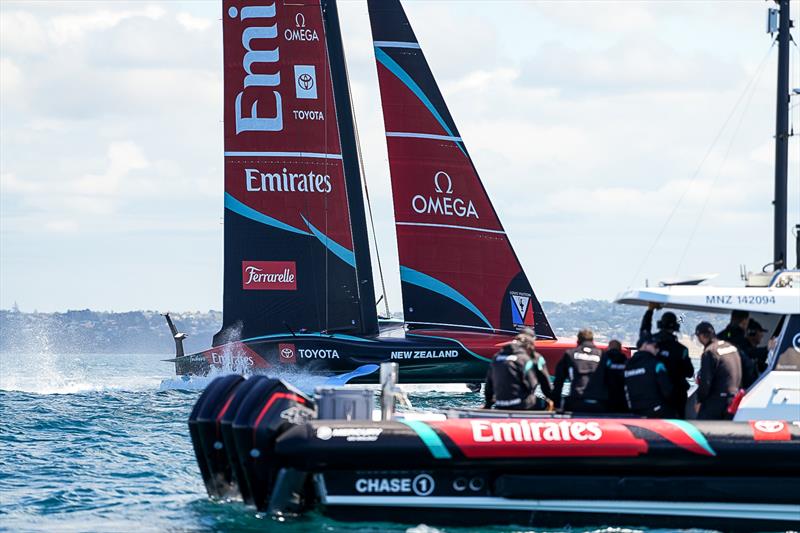
Emirates Team New Zealand - October 14, 2026 - Auckland © Sam Thom/America's Cup
A very experienced pair of eyes has tracked every movement on the water of New Zealand’s America’s Cup yachts for the past 40 years.
Even more significantly, when something goes wrong, as a trained Medic, he is one of the First Responders.
Tony Rae is more than just a safe pair of hands.
As a 23-year-old sailmaker, he was on the crew of Lion New Zealand in the 1985/86 Whitbread Race before moving across for the first New Zealand Challenge America’s Cup campaign in Fremantle to be mainsheet trimmer on KZ-7.
While “Trae” has sailed in other Round the World race teams, notably Steinlager 2 in the 1989/90 Whitbread, he has remained with the New Zealand America’s Cup team throughout its chequered history.
An outstanding seaman and top competitive sailor, it is hard to imagine a New Zealand America’s Cup team without “Trae”.
On Thursday, he was back on the front line aboard Chase One, as they followed Taihoro on her 26th day of on-the-water training/testing in the campaign to defend the 38th America’s Cup for the fourth successive time.
“My background with the team goes back to 1987. I've never been with another team. In some ways, it's a privilege to still be working with a team like this.
“We've had our ups and downs over the years. But touch wood, it's all going really well so far. I'm part of on-water operations, and sort of on the chase boat every day, helping with the bits and pieces on the yacht, jib changes, that sort of thing, and then also the on-water medic,” he said in the post-session Recon interview.
Today was significant for the testing of a new mainsail – a Code 2 – which was definitely below its expected range in the 6-8kt seabreeze that prevailed for the start of the session, just before midday, but became more viable later in the day when the breeze climbed to 8- 14 kt.
Today’s session probably had two functions. First, to check the new sail fitted, with the inevitable crew member trip to the top of the mast to fit wind gear and check that everything is as it should be, including the halyard locks and the top section of the highly stressed mainsail.
The second test would have been to see how the sail, and indeed the AC75, performed at the bottom end of the designed wind range or less. Trae explained that with any new sail on these boats it is about "loading them up, and commissioning it to make sure that it all looked how we thought it should look, it should all be loaded up - size-wise and everything- and getting the batten tensions right. All the things that come with a new sail. So far, so good,” he reported.
Questioned about how the sail set-up worked compared to the designers' visualisations, Trae made it clear that area was well above his pay grade.
“I hear all about it, but I don't really know where they're at. With these boats. There's so much going on through comms, about what's happening on the boat versus what's happening on the chase boat and back to the base. [Many of the chase boat crew are wired into a comms network between the race boat, the chase boat technicians and the shore-based designers watching the results of live testing.]
“A lot of it's discussed later on in meetings obviously – which I'm not a part of,” he added.
Questioned on the relevance of speed runs lately, when so little time is spent reaching during a race, Trae said he believed they were just for calibration.
“I think for a lot of them, it's just calibration, and just to look at different angles, really."
“That sort of thing is more just to do with the guys on the raceboat and what they're trying to do with compared to what they've been asked to look at.”
Naples revisited
The 2027 America’s Cup regatta will be the most significant sailing event held in Naples in 67 years – since the 1960 Olympics.
There, Trae’s father Murray represented New Zealand in the two-man Flying Dutchman class, along with skipper Ron Watson.
Serendipitously, the NZ Olympic Trials for the 1960 Olympic Regatta in Naples were held between Marétai and Waiheke Island, better known as "The Paddock", the favourite training area for Emirates Team NZ in the foiling era of the America's Cup.
Almost seven decades later, in May 2027, Murray and Tony will share a poignant moment as Emirates Team New Zealand foils across the start line of the first race in the 38th America’s Cup regatta in Naples.
Recon Report - October 14, 2026 - Sailing Day 26 - Hauraki Gulf, New Zealand
- AM: Overcast 6-8kts 045° (NE) PM: Sunny. Wind: 8-14kts 045° (NE)
- Sea State: Flat (AM & PM)
Sailing Stats:
- Dock Out: 1100hrs
- Dock In: 1550hrs
- Time sailed: 4hrs
- Foiling time: Not reported
- Tacks: No data. Gybes: No data
Crew List:
- Port Helm: Seb Menzies (NZL)
- Starboard Helm: Nathan Outteridge (AUS/NZL)
- Port Trimmer: Iain Jensen (AUS)
- Starboard Trimmer: Andy Maloney (NZL)
- P5: Jo Aleh (NZL)
- P6: Josh Armit (NZL)
Recon Unit Report – October 14, 2026
Key Points:
- New Mainsail.
- High volume of pre-start practices.
ETNZ rolled out of the shed at 0942, light NE and overcast. Splashing down at 1020, we noticed that during the craning off the cradle the boat was considerably more bow heavy than usual. One possible explanation is the mast seemed more raked forward. With a wide range in the forecast they had a full quiver of jibs loaded on the chase boat from J1 to J5. Put on board the boat was brand new M2-1 main. The crew consisted of Nathan Outteridge, Seb Menzies, Iain Jensen, Andy Malone, Josh Armit and Jo Aleh.
The boat left the dock at 1100 and was off the tow at 1120 at Narrow Neck Beach. The breeze was a light 4-6 knot NE that was quickly building. The J2-1 was hoisted and at 1150 ETNZ sailed onto the foil. At 1206 after just 15min of sailing ETNZ stopped to adjust the jib clew. Perhaps explained by a different rig setting due to the new main. The wind was now 9-11 knots and the sea state building a small chop in the strengthening outgoing tide. The session resumed at 1217 and consisted of long boards out into the harbour to dial in the new sail. The session ended at 1248 after a start and race.
Chase One then laid two yellow marks and at 1304 with their J3-1 now hoisted, ETNZ went through a series of rolling pre-starts. Several times coming out of a tack ETNZ would splash the nose down, seemingly out of its usual balance. Also during aggressive turns the stern would drop before straightening and regaining lift. The session ended at 1345.
The next session started at 1402 in 8-10 knots of breeze with a big upwind sail to Tiritiri Island, the breeze was a stronger 12-14 knots and the sea state larger up in the channel between the island and headland. The session ended at 1452 with a speed run across the wind and short downwind.
The final session started at 1508 and consisted of a long sail downwind to Narrow Neck Beach. Once in the flat, sheltered water of Rangitoto Island, ETNZ did several flybys and manoeuvres most likely for ETNZ personal media before ending their day at 1532 off of North Head.
Overall, a solid day of testing a new M2-1 main and racing practice with Chase One.
Additional Images: