
America's Cup: Emirates Team NZ - Day 25 - Kiwis look good on Miserable Monday
by Richard Gladwell/Sail-World.com/nz 13 Oct 02:54 PDT
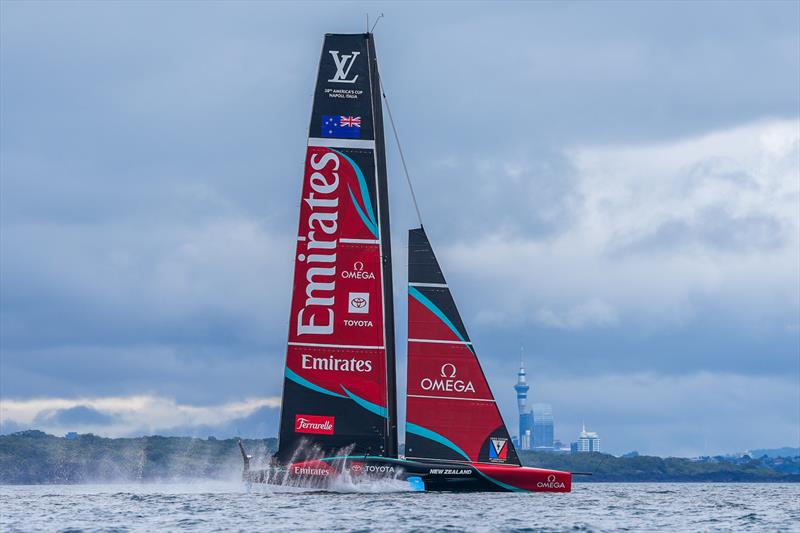
Emirates Team New Zealand - October 12, 2026 - Auckland © Sam Thom/America's Cup
On a miserable Monday, October 12, Emirates Team NZ turned in an interesting light-air performance. The America's Cup defenders delivered a very controlled light-air foiling performance, staying foil-borne in 4.5-7.5kt winds that, if measured accurately, were borderline for racing.
From the video, the Kiwis plugged away at their routines, rather than speedwork. Their concentration seemed to be on keeping flying, almost regardless of directional cost.
Even so, the deviation from their sailing line did not seem that significant overall, and touchdowns were rare. They also seemed to be able to go straight into a self-start and effect a lift-off on the occasions they got too low to the water.
Another feature of the Recon video is the low flight height in the conditions, with the Kiwis keeping a minimal distance from the surface and heeled to windward. It was an impressive piece of flight control and helm co-ordination - assuming the flight control was in manual mode. Interestingly, Josh Armit was in the starboard trim position normally occupied by Andy Maloney, with the three-time America's Cup winner observing from Pit 6 on the aft starboard side.
The impressive funky-breeze performance can also be attributed to changes to the AC75 class, with a substantial weight reduction from the first- and second-generation AC75s. Interestingly, the Kiwis got off their J2 and onto the smaller J3 jib in just 6.5kts of breeze, without any foiling maintenance issues. The minimum wind strength for foiling is 7.5kts.
For Kiwi fans looking through rose-tinted glasses, it could also signal that the Kiwi test program is paying dividends, and reducing their chances of a race-ending fall off their foils after hitting a soft spot in the breeze. That should keep the heart rates down in Naples in 220 days' time.
As always, the truth of the performance will only be truly revealed on the race course.
Recon Report - October 12, 2026 - Sailing Day 25 - Hauraki Gulf, New Zealand
Wind & Sea Conditions:
- AM: Overcast 4-8kts 270° PM: Overcast. Wind: 4-8kts 090° (E)
- Sea State: Flat (AM & PM)
Sailing Stats:
- Dock Out: 1100hrs
- Dock In: 1550hrs
- Time sailed: 4hrs 30mins
- Foiling time: Not reported
- Tacks: No data. Gybes: No data
Crew List:
- Port Helm: Seb Menzies (NZL)
- Starboard Helm: Nathan Outteridge (AUS/NZL)
- Port Trimmer: Iain Jensen (AUS)
- Starboard Trimmer: Josh Armit (NZL)
- P5: Jo Aleh (NZL)
- P6: Andy Maloney (NZL)
Recon Team Report – October 12, 2026
Key Points:
- Light, offshore conditions.
- Lots of boat on boat with Chase One practice.
- Crew standing up consistently to check settings.
ETNZ rolled out of the shed at 0945 under heavily overcast skies. The boat splashed at 1017, taking the J1-0, J2-1, J3-1, J4-0 and M2 mainsail out on the water. The crew consisted of Josh Armit (starboard trim), Nathan Outteridge (starboard helm), Seb Menzies (port helm), Iain Jensen (port trim) and Jo Aleh.
The boat left the dock at 1100 with a light offshore breeze. At 11:19, ETNZ was off the tow between St Heliers and Rangitoto, in 6–7 knots of breeze from 260°, blowing straight out of Auckland in very flat waters. The mast appeared to be raked quite far back, with a significant amount of mast rake visible. We noticed this when the sails weren’t up yet and we’re not quite sure if we have seen this before or not, but we will pay extra attention to it the upcoming days.
Session 1 began at 11:43 in approximately 4.5 knots of breeze, with the J2-1 jib and M2 mainsail. It took the team around two minutes to get up on the foils. Once foiling on a low reach, they began with a broad downwind run as a gust increased the breeze to 6–7 knots. At 12:16, we measured 7.5 knots of breeze. The wind was shifting significantly offshore, while the water remained very flat. The conditions appeared challenging for maintaining the correct flight angle on the foils. Sometimes the boat came quite far on top of them.
ETNZ spent most of the first session sailing between Eastern Beach and Waiheke Island. The breeze dropped back to around 6 knots towards the end of the session, settling into a more westerly direction. The team carried out numerous manoeuvres, both upwind and downwind, including 360s and bear-away manoeuvres. Every now and then, one of the crew members could be seen standing up. At the end of day we asked Josh Armit about it and he said that way it’s just easier to check some settings on the boat.
ETNZ had their first break at 12:27 and started their second season at 12:42. They started with some starting simulations followed by downwind gybes. The bow appeared to dip quite frequently during gybes. According to Josh this wasn’t on purpose. During one tack from starboard to port, the boat fell off the foils, with the breeze at that time measured at 4.5 knots. The team continued with multiple tacks and gybes before finishing the session with a broad reach on starboard tack, sailing towards the northwest of Waiheke Island.
At 13:17, ETNZ began a tow from the northwest of Waiheke towards the northwest of Motutapu Island. Once at the new location at 13:36, ETNZ swapped the J2-1 for the J3-1. At that time we measured the wind at 6.5 knots, still offshore and flat water.
Session 3 began at 13:55 in 7 knots of breeze from 230°. The team sailed upwind, with crew members again standing in the boat at times. This was followed by longer speed runs, including reaching, and several 360s. The team also carried out spontaneous pre-start manoeuvres before taking another break at 1433, with still 6–7 knots wind measured at that time.
Session 4 began at 1447 in 6–7 knots of breeze, with the water remaining very flat. ETNZ carried out further pre-start drills, focusing primarily on committee-boat starts and using some of the shipping-lane marks as reference points. They also used one of the marks as a gybe mark during the session.
Further boat-to-boat simulations was practiced, where Chase 1 made splits and simulated crossing or crash tack situation. They finished the session with another practise start and the session finished at 15:25 with the breeze at approximately 7–8 knots.
Overall, a light, overcast, offshore day with a high focus on manoeuvres.