
Antigua Racing Cup 2027 - Put it on your programme
by Antigua Racing Cup 8 Oct 14:01 PDT
March 17-21, 2027
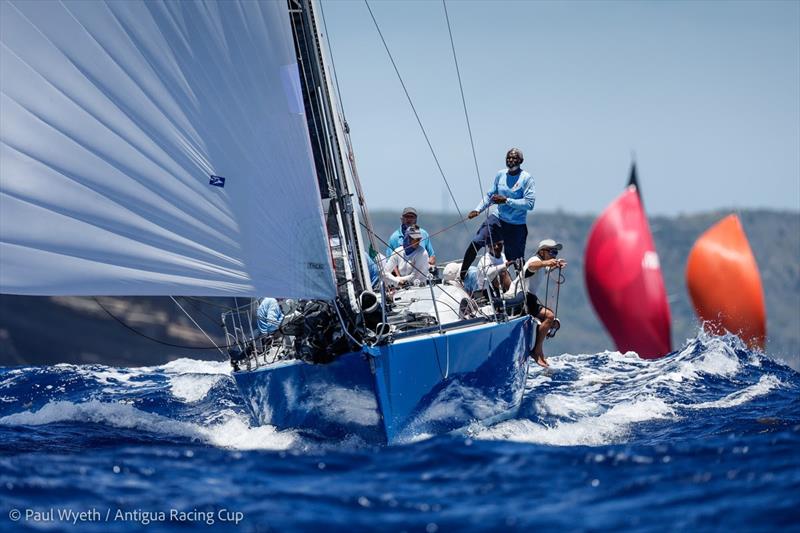
Poul Hoj-Jensen's Danish Blue (ANT) - Antigua Racing Cup 2026 © Paul Wyeth / Antigua Racing Cup
Trade winds, ocean swell, technical courses and proper competition. The second edition of the performance-focused regatta aims to become a regular stop for serious Caribbean campaigns.
Ask a racing sailor to describe the perfect regatta and it might sound like this. Trade winds in the high teens. Open-ocean swell rolling onto Antigua's south coast. Boats surfing downwind with warm water coming over the deck. Plenty of races on well-set courses. Then back to historic Nelson's Dockyard to argue over who nailed the start and who found the shift. And all of it in March, while much of the northern hemisphere is still de-icing the car.
That is the case Antigua Racing Cup is making as it returns for its second edition, 17-21 March 2027. The focus stays on the competition: technical courses, professional race management, racing suited to each type of boat, and the option to score under both CSA and IRC. The 2026 inaugural edition showed the idea works. The aim now is to make the event a regular choice for international owners, skippers and program managers deciding where to race in the Caribbean.
The South Coast Stadium
Antigua sits on the outer curve of the Leeward Islands, between the Caribbean Sea and the Atlantic with little between the racecourse and thousands of miles of open ocean. Nothing blocks the easterly trades, which regularly reach the high teens to twenties in March, or the one-to-two-meter swells. Upwind, the challenge is finding the fast mode through the waves. Downwind, boats accelerate onto the swells with real chances to surf.
It is Caribbean racing with an ocean edge, yet the course is only a short run from English Harbour. That means less time motoring and more time racing.
Racing Designed for the Boats
Instead of sending every boat around the same course, the Race Committee sets racing to suit each class. Smaller performance boats get tight windward/leeward courses where starts and crew work count the most. Larger yachts and offshore multihulls get longer courses with reaching legs and different wind angles. Virtual marks let the committee put the course wherever the best sailing is. The principle is simple: give boats the racing they were designed for.
In 2026, 21 boats put that to the test, and 11 of them dual-scored under CSA and IRC. They got nine races, strong trades and some very close results. In CSA 2, Steve Rigby's GS46 Belladonna and the Antiguan RP37 Warthog, skippered by Jules Mitchell, finished tied on points. Belladonna took the class on countback. American Bruce Chafee's Reichel/Pugh 42 Rikki placed third under CSA 2, while five race wins secured IRC 1.
Early 2027 Entries
The 2027 fleet is already taking shape. Martin Zonnenberg's J/111 Quickdraw, skippered by Scott MacGregor, has a proven record in both one-design and offshore racing, including the J/111 Championships and the Newport Bermuda Race. That should make it a strong contender in Antigua's downwind conditions. From the other side of the Atlantic, Ed Bell brings smoking-hot Kerr 46 for its Caribbean debut.
Ossie Stewart is a former RS Elite UK National Champion and an Olympic bronze medalist, with more than 30 championship titles. He has chosen the One-Design route and the first RS Elite One Design. With a significant number of Elite One Designs already based in Antigua, its the hope is that Aeolus will be the first of a growing one-design fleet where every start, shift and maneuver counts.
Don't Take Our Word for It
British sailor Josh Redgrave, part of the winning Belladonna team, put it simply: "This is high level racing in the Caribbean."
Bruce Chafee had already raced in Antigua earlier in the season. He was impressed by a race team that listened to competitors and delivered "proper windward/leewards and with some longer races with spicy reaching legs thrown in."
Antiguan Ashley Rhodes dominated CSA 4 with the Melges 24 Whiplash and wants to see more sportboats and performance yachts on the line in 2027. His invitation: "Bring it."
Part of the Campaign
The new dates fit Antigua Racing Cup into a natural Caribbean sequence:
- The RORC Caribbean 600 starts from Antigua in February.
- The St. Maarten Heineken Regatta follows in early March.
- Antigua Racing Cup runs 17-21 -March.
- The season then moves on to the BVI Spring Regatta.
For teams that have already paid to get a boat and crew to the Caribbean, the question is simple: why stop racing?
The new CSA Majors Trophy adds another reason to keep going. It links the RORC Nelson's Series, RORC Caribbean 600, St. Maarten Heineken Regatta, Antigua Racing Cup and BVI Spring Regatta into one Caribbean CSA championship. For European and North American programs, the earlier March dates allow more fun Caribbean racing before the northern season begins.
Race Hard. Then Talk About It.
The whole event is based in Historic Nelson's Dockyard. Soon after racing, happy hour starts, the grills fire up and crews replay the day: the start they nailed (or didn't), the sail call that worked, and the boat they just held off on corrected time. Daily prize-givings follow, with music across the Dockyard and race winners encouraged to enjoy their moment.
There are no losers in Caribbean regattas! Owners, professional crews, Corinthian teams and local sailors all share the same space, with the boats tied up just meters away.
Serious racing offshore, easy-going Antigua ashore. If that sounds close to a racing sailor's perfect regatta, that is the point.
For owners, skippers and team managers planning a 2027 Caribbean campaign: put 17-21 March on the program.
To find out more: www.antiguaracingcup.com
To check the entry list and enter: www.antiguaracingcup.nautical-cloud.com