
Transpac's ongoing review of F-TCF ratings: Handicapping for the best sailed, best prepared boats
by Alan Andrews / Transpacific Yacht Club 2 Sep 07:03 PDT
6 July 2027
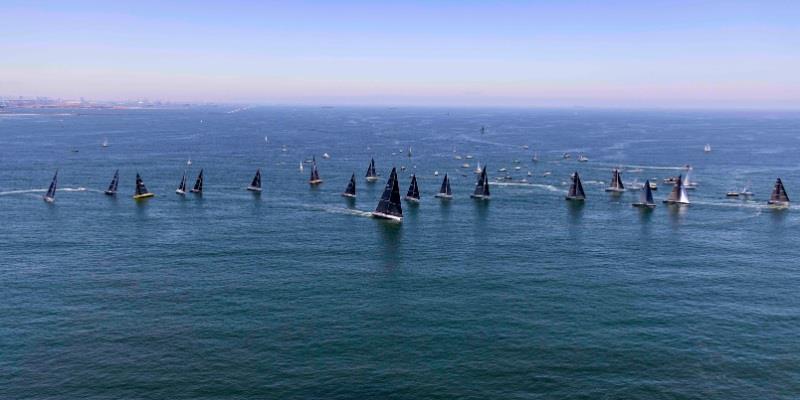
Handicapping for the best sailed, best prepared boats © Transpacific Yacht Club
Competitors in the Transpac Race have always ranged in boat size and inherent speed, with overall results calculated on "corrected time" by a handicapping system.
TPYC's history of developing custom handicaps for the race dates back over 50 years and continues Transpac's goal of fairness for the various boat types, sizes and speeds so the winners are the best sailed, best prepared boats. In 2025, this led Transpac to adopt Forecast Time Correction Factor (F-TCF) scoring to better incorporate the most likely weather for each race, as well as each boat's measured performance characteristics.
Decades ago, Transpac customized handicaps by modifying the IOR rule handicaps, which were based on buoys and all-points-of-sail coastal racing, to suit the largely downwind Transpac. Then, with the advent of Velocity Prediction Program (VPP) based rules, which calculate each boat's performance across the spectrum of wind speeds and wind angles, race organizers had to supply the other part of the rating—the wind speeds and directions the boats would likely encounter. Initially, the matrix was compiled from competitors' written logs and refined over time. With the advent of optimal routing software and historical digital weather files, a TPYC study "raced" nine representative boats through seven Transpac Races (and three start days per race) along their "optimal routes" to calculate an updated matrix of the fleet average miles at each wind speed and direction.
Of course, no race is average
Conditions near the start can vary from a strong WNW breeze that brings the fleet quickly out to the northerly synoptic wind, to a light SSE Catalina Eddy flow that takes boats two or three times longer to reach the synoptic breeze. Later in the race, the building and easing of the trades affect the fleet—and the different types of boats within that fleet—differently. Advances in optimal routing software and weather forecasting allow each boat's predicted elapsed time to be calculated on the morning of the start. That time, divided by the "scratch boat's" predicted elapsed time, is each boat's Forecast Time Correction Factor, or F-TCF. At the end of the race, each boat's corrected finish time is their actual elapsed time multiplied by this F-TCF.
F-TCF handicapping was adopted by the 2024 and 2026 Newport Bermuda Race, the 2025 Transpac and the 2026 Pacific Cup. The races saw improved agreement between the predicted elapsed times and their fleets' actual elapsed times, compared to previous wind matrix or Performance Curve Scoring (PCS) systems. This indicates F-TCF better represents actual race conditions with the potential for fairer scoring.
It isn't perfect though. Operational and software errors were identified in the Newport Bermuda Race this June, with remedies incorporated prior to the Pacific Cup in July. The specific weather files, routing software version, software settings and polars were published prior to Pacific Cup, which allowed competitors to duplicate F-TCF optimal elapsed time calculations. For the first time, polars with the performance enhancements of the Pacific Swell Factor were available to competitors following an ORR policy change to release this previously unpublished data.
Information sharing
In recent months, Pacific Cup, Newport Bermuda and Transpac race organizers, US Sailing Offshore Office and top navigators have been in contact, sharing what they've learned, what's gone right, and what needs improvement so that race handicapping can continue to evolve and improve. As we head into the 2027 race, Transpac's Technical Committee, chaired by Brad Wheeler, is working with other actively-racing TPYC Directors to review F-TCF with the goal of improved handicapping for our competitors.
Items in this review include:
- Which forecasts will lead to the most accurate handicapping (HRRR, HRRRX, RRFS, GFS, ECMWF, etc.) and what boundaries to switch (longitude, time).
- Consider calculating final predicted elapsed times from Zero Hour files when final F-TCF would only be available after finishing.
- What settings to include in the optimal routing software—time steps, minimum speed, wave effects in the router or from Pacific Swell Factor?
- Reviewing Transpac 2025 in light of what has been learned since: consider comparing actual boat performance and tracks with optimal routes predicted by Zero-Hour and other available GRIB files for the race.
- Testing and handicap production protocol—use representative test fleet and weather files to verify results when routing software is updated; review protocol for production and publication of handicaps.
Transpac's Technical Committee will have a busy few months before presenting their recommendations to the Board, but our goal is clear: improve handicapping to reward all competitors fairly for their preparation and fast sailing.