
RORC Round Britain and Ireland Race 2026 - The offshore marathon has begun
by Louay Habib / RORC 9 Aug 12:01 PDT
9 August 2026
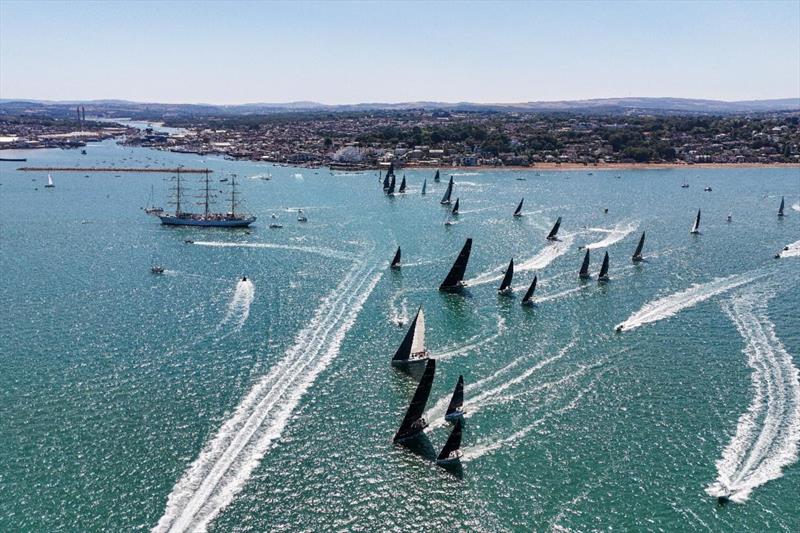
The RORC Round Britain and Ireland Race sets off from the RYS line in Cowes - 32 boats, 182 crew from 22 countries, 1,800nm, 1 great challenge © James Tomlinson / RORC
The 2026 RORC Round Britain and Ireland Race started with cannon fire from the Royal Yacht Squadron Line in Cowes, marking the start of one of offshore sailing's greatest challenges.
In bright sunshine, the 32 competing boats, crewed by 182 sailors from five continents, made a clean start, beating to windward in a light easterly breeze. The line was all clear and the fleet was soon racing east out of the Solent.
Ahead lies a 1,805-nautical-mile course around some of the most exposed waters in northern Europe, and undoubtedly plenty of twists and turns along the way. From the tidal headlands of the English Channel to the west coast of Ireland, St Kilda and the Shetland Islands, plus the complexity of the North Sea, this race will test boats and crews to their limits.
RORC Commodore Deb Fish knows the Round Britain and Ireland Race exceptionally well. She navigated Incisor of Wight to overall victory in 2000 and returned in 2022, racing double-handed with Rob Craigie on Bellino to finish second overall by just seven minutes after IRC time correction.
For 2026, Fish and Craigie are back on Bellino, this time racing four-handed with Griffin graduates Nicole Hemeryck and Joe Griffiths.
"The Round Britain and Ireland Race is the most challenging race in the RORC calendar, without a doubt. It is 1,800 miles of headlands, rocky shores, tidal races, traffic separation schemes, sandbanks, wind farms and everything else that this extraordinary coastline can throw at you.
"What makes it so important to the RORC is that it represents what offshore racing is really about. Logistically it is hard, physically it is hard and mentally it is hard. Offshore racing is full of highs and lows, but when you overcome difficult moments together, whether there are two of you or 20, it brings you together as a crew. This race does that more than any other.
"It is also fantastic to see so many young sailors in the fleet, including sailors who have come through the Griffin programme. That is enormously important for the future of the sport. Fifty years after the first race, the Round Britain and Ireland Race remains a very special challenge and a very important part of what the Royal Ocean Racing Club stands for."
After the Solent send-off the fleet will round the south of the Isle of Wight heading east. Conditions are expected to become more demanding tonight. A westerly gradient of around 10-15 knots is forecast to establish, setting up an upwind passage out of the English Channel before the breeze trends north-westerly.
With the tide reversing during the first evening, crews could face a short, uncomfortable sea as wind and current oppose each other. After a relatively gentle start, the opening night should provide the fleet with a much sharper introduction to the 1,805 miles ahead.
Two hours after the start, Johnny Vincent's Volvo 70 Pace was leading on the water, approaching Bembridge Ledge Buoy and exiting the Solent at over 10 knots of boat speed. Jens Kellinghusen's Ker 56 Varuna 6 was just a mile astern. The Class40 battle is close at the front with nothing between Pierre LeBoucher's Penfret and Greg Leonard's Swift.
Track the fleet in the RORC Round Britain and Ireland Race and witness life in the challenge via RORC media channels: roundbritainandireland.rorc.org