
From heartbreak to history: Nicholas Halliday's Olympic journey
by Ziyan Huang 17 Jul 19:06 PDT
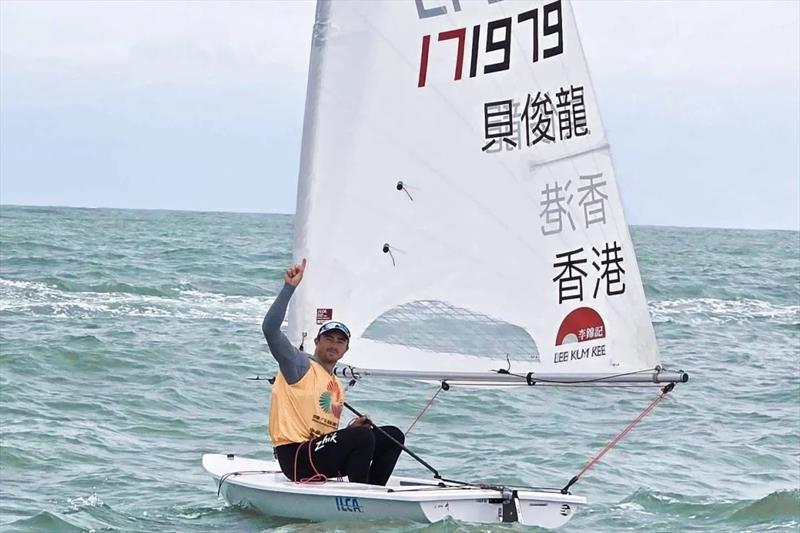
Nick takes gold at the 2025 National Games © Sailing Federation of Hong Kong, China
With two years until LA 2028, the clock is ticking. But for Hong Kong's Nicholas Halliday, the real race has already begun. This time, he's playing for keeps.
Just months ago, the ILCA 7 sailor was announced as one of six Hong Kong athletes awarded an LA28 Olympic Scholarship issued through the IOC's Olympic Solidarity initiative.
It's a reward that recognizes what Halliday has already proven and what he's capable of achieving next.
In 2025 alone, Halliday made history not once, but twice when he became Hong Kong's first-ever winner of a Sailing Grand Slam during French Olympic Week, and clinched Hong Kong's first sailing gold at the National Games. Earlier this month, Halliday also received the Chief Executive's Commendation for Community Service in recognition of his impact on the next generation of Hong Kong sailors.
Now, with the 2026 Asian Games in Nagoya on the horizon and the qualification for LA 2028 approaching, Halliday sits down with the Unstoppable podcast to reflect on the journey, the lessons learned from failure, and why he believes the best is yet to come.
You once said in a 2017 interview that your dream was to represent Hong Kong at the Olympics. Now you've done that in Paris, you've won a National Games gold, and you're already planning for LA 2028. Has your perspective on the Olympics changed since you were that teenager?
When I was younger, you looked at the Olympics and thought, "Wow, this is the biggest thing on the planet." Now that I've been doing this professionally since 2017, I kind of go into it like it's another regatta—give it your best, like any other regatta. It's a dream come true, but at the moment it's a bit weird because you just give it your best, like any other regatta. I think we're at an advantage because I've been to two Asian Games now, so you get used to those big regattas.
Has your motivation for sailing evolved over the years?
When I was younger, it was more about getting good results—results, results, results. Nowadays it's more about doing the best you can and improving as a sailor every day. The best regattas I've ever had were the ones where I improved every single day and learned from the lessons.
You've spoken about setbacks—missing Tokyo qualification by a few points, finishing fourth at the Asian Games. How did you handle those moments?
When I missed out on Tokyo, I was really bummed because I thought, "I'm one of the good ones here. I really thought I could do it." When I missed out at the Asian Games, I was having a chat with my coach and I told him, "I know I'm going to go to the Olympics one of these days. It might not be this year, but one day I'm going to go." That self-belief has come a long way since then. Sometimes setbacks last one regatta, sometimes up to six months or a year. Having the mentality that it's going to get better—there's always something to improve on—that perseverance is the most important thing.
Where does that self-belief come from?
The funny thing about sailing is you don't have to be the best to win a race. You can always get a lucky shift. You don't have to be the strongest—sometimes you can just be a little bit smarter than the others. When I was younger, I watched a lot of motivational videos of Michael Phelps and Kobe Bryant. They were my idols growing up, so maybe I learned a little bit from them.
You won the European Championships and bronze at the Youth World Championships as a junior. Then you moved to the senior fleet. What was that transition like?
When I moved to full-time in the Laser Standard in 2018, I thought, "Oh yeah, I'm so good now." But when you go into the senior fleet, it really humbles you. Those guys are 10 levels above you—they're professionals who've been doing it for 10-plus years. I got absolutely demolished, chewed up and spit out at the back of the fleet. It was really demoralizing. I thought, "I'm a good sailor, but I'm finishing so badly." You don't need to put that much pressure on yourself when you're transitioning from a youth fleet to a senior fleet. It's a whole different game.
What has sailing taught you that you wouldn't learn elsewhere?
Sailing is such a unique sport—six days of racing, one-hour races, two or three a day. Compared to a 100m race where you show up and race for 10 seconds, it teaches you to be very patient. You have to wait for the weather sometimes. You can't be in the zone all the time or you'll burn out. There are so many variables, and you just have to adapt and learn every day. That's the best part. The biggest takeaway is to try to do the best you can because there are so many uncertainties and variables you can't control. Just control the variables you can—like showing up on time, giving your best effort, and not being too hard on yourself if something goes wrong.
What are your goals for the Asian Games and beyond?
The next goal is the Asian Games in Nagoya. Then the Olympic qualifiers should start coming around, so I hope to qualify for LA 2028. I finished fourth at the 2023 Asian Games and 24th at Paris. This time I want to do better—not just participate, but perform. After that, who knows, maybe 2032 as well.