
What the Firefly means to me - Neil Banks
by Alex Baxter 6 Jul 07:33 PDT
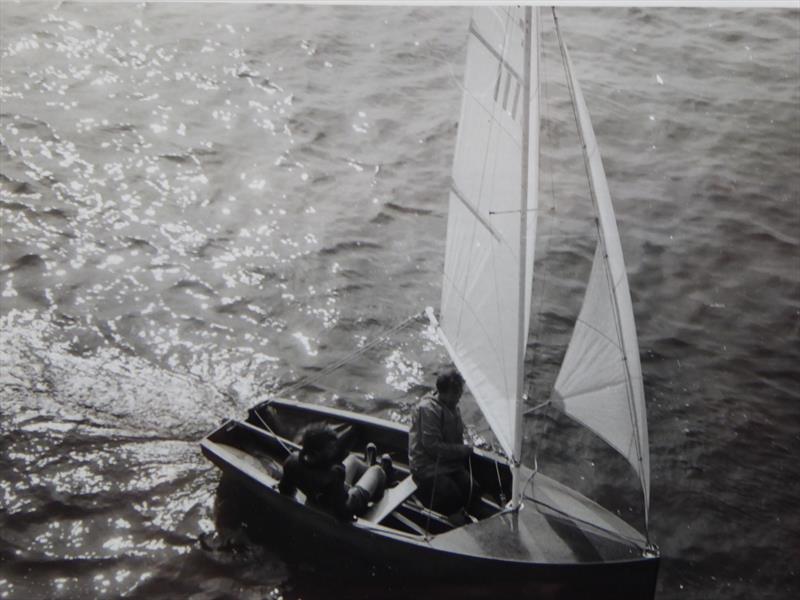
Neil Banks Firefly 3111 © Neil Banks collection
As the Firefly class celebrates its 80th anniversary, we are sitting down with some class legends to hear their reflections on the fleet, including why they keep coming back and what it means to them.
This time, I sat down with legend of the class Neil Banks. All I can say about Neil is I wish I'd met him 40 years ago. He is a seriously entertaining man, and getting to sit down with him and chat was both hilarious and a real privilege.
Peter Lanham on Neil:
Neil Banks and I first crossed tacks in the early 1970s, at an unspeakably cold and windy Championships week at Felixstowe Ferry, team racing, the RYA nationals, or perhaps the Association's own championships for the RNVR Trophy. Neil was a member of Felixstowe Ferry SC, then home to a large Firefly fleet with a busy calendar of open events, and I believe he had tinkered with a 505 on his way to the Firefly.
Our paths met again years later at Chipstead SC, both of us having moved to west Kent for work, and we have been crossing tacks on the charming but sometimes crowded waters of Chipstead Lake ever since - Neil almost always ahead of me. Just occasionally I crossed ahead of him, a major event indeed, and one savoured for a long time afterwards.
Neil gave a great deal back to the sport. He was an effective Class Captain at Chipstead and worked tirelessly to promote the Firefly class, both around the club and nationally. Coming from a professional financial background, he also served as auditor for the National Firefly Association - and, I suspect, as a considerable source of practical advice to the resident Hon Treasurer. As a one-time NFA Hon Treasurer and Membership Secretary myself, I can vouch that the Association's accounts (and Chipstead's!) were kept under a close and expert eye.
I rather fear that indifferent health and creaky, aching bones have now brought our Firefly sailing to a close, after goodness knows how many years of delight: open meetings, championships, team racing, and the very best fun of all, weekend club points racing with tea and cake afterwards. And far too many close friends and chums in the bonkers world of Firefly's, up and down the country, to count, but all remembered.
Neil Banks:
I saw a meme the other day. It asked: have I done too much sailing? The answer is no. It was Firefly's that did it for me.
My introduction to the class was entirely accidental. I was sailing a battered old 505 at Felixstowe Ferry when I got conned into crewing the committee boat for the 1966 Firefly Championships. I watched the fleet all week and liked what I saw, so when I could no longer afford the 505, I borrowed Firefly 3111 instead. That, really, was that.
My first boat of my own came along in about 1969, and it arrived in rather unusual circumstances. A friend of mine, a senior RAF officer, had been tasked with selling off the RAFSA surplus Firefly's, and he told me to come and take my pick at an RAF base in East Anglia. A friend and I drove straight in with no security checks whatsoever, were directed round the perimeter road to a bunker, and walked in to find Firefly's lined up on one side and racks of bombs on the other. I chose the one I liked, paid sixty-five pounds, and drove home with Firefly 2129.
I kept 2129 for four or five years, helming on the side for a friend who had a Hornet, the sliding-seat version, and for another fellow at Felixstowe who owned a Firefly but preferred not to helm it himself. After that, a group of us at Felixstowe clubbed together to buy a complete batch of new Firefly's straight from Fairey Marine. Pan White took 3330, Tony Weller 3331, Bill Goodacre 3332, Bradford University 3333, and I had 3334, which I named Scrubber. More boats followed. In 1983 came 3532, a fibreglass boat built by Omega Boats that had been the raffle prize at that year's Pwllheli nationals; the winner never claimed it, so I bought it at a reasonable price. Then I found 3007, Tip Top Too, Mimi Curry's old championship-winning boat, in fine condition down in Kent where I was living by then.
Before I settled on my longest-serving wooden boat, though, there was the Rondar chapter. I had been helping the far-sighted Richard Thompson take the prototype round a few clubs to gather feedback, which is why Rondar allocated me their yard number, 3600, making mine the first Rondar boat in the fleet. It was an exciting time for the class, because sales soon ballooned as schools and universities updated their fleets.
That Rondar boat, in fact, was the one that mattered most to the class as a whole, far more than any of mine. The class had been dying. Schools and universities had moved to Larks and 420s, and the wooden fleet was ageing. When Rondar developed their Firefly with Richard Thompson, it changed everything. It was deliberately built to be no faster than the wooden boats; they even had to retro-build it, adding weight after discovering they had made it too light. Once clubs saw how robust it was, they bought whole fleets. Wooden boats kept their appeal, often finishing in the top ten and still winning nationals, but Rondar was the turning point. There is no question about it.
Even so, I still missed having a wooden boat. An old friend had sold me 2166, Deuteron, some years earlier, but through the Rondar era she had been sitting in a garage. Her history was a tangle of coincidences. She had originally been built as a kit boat by John Powell, who, as it turned out, was the son of my very first headmistress at junior school in Felixstowe, so I already knew a little about him. He had sold her on to Richard Hopkins, a regular top-five finisher at the nationals in her day, before she eventually came to me. When I finally had her redecked, Knight and Pink rang me at the office to say they were having terrible trouble removing the old decks. John, it turned out, had been an atomic scientist who made his own epoxy glues, and they simply would not shift. Everything had to be sawn off and the deck beams reshaped before a new deck could go on. She is still with me today, in absolutely fine fettle, but due to ill health I am now looking for the right custodian. She deserves someone who appreciates her history and will love her as much as I do.
The boats are only half of it, though. What I really remember are the nationals. My first was 1967 at Torbay, my dad crewing for me, and I have the black-and-white pictures to prove it. Many existing and upcoming legends were racing, and the whole thing was an eye-opener. The event was sponsored by a well-known cigarette company who kept a gin palace moored there for the week, and somehow my mother talked her way aboard, leading the high life and taking yet more pictures.
The national that is burned into most people's memory from that era, though, is 1972 at Felixstowe Ferry. The Sunday followed weeks of southerly gales, and a big incoming swell punched into a full spring ebb tide, all wrapped in a force four to five. The bay is relatively shallow, so the seas stood up like brick walls with breaking tops. At one point I leaned out of my boat and touched the top of a friend's mast: he was in the trough while I was on the crest. Of around 113 boats that left the beach, about 21 managed to finish. The rest were washed up on the beach or limped home battered and bruised. I came eleventh that day, terrified that as backup pathfinder I might be promoted pathfinder the next morning, but I got lucky; the tenth-placed boat was made of stern stuff and did its duty. I was prouder of the eleventh place than of many a better finish, and anyone who was there still cannot get it out of their mind.
Another memory that stays with me is the opposite extreme: Felixstowe 1976, a heatwave year. A force three to four all week, a big clean swell and not a breaking wave in sight. On one reaching leg I surfed the face of four consecutive waves for the whole leg. It was just brilliant. Absolutely fantastic.
Then there were the 1985 Plymouth nationals. One day the Dutch Navy decided to enter the harbour, and a flotilla of six or eight warships steamed straight through the middle of the fleet. That same week I very nearly won my first-ever nationals' race, the Marlow Trophy. There was almost no wind and an adverse tide to the finish, and Mike Hudson and I were both roll-tacking our way to the line, legally of course. In the end his roll-tack was just better than mine, and he took first.
The evenings at nationals are a chapter in their own right. People got gloriously drunk, had a laugh, and nobody turned aggressive or got into trouble: that was, and still is, the Firefly way. On several occasions boats moved around overnight. At Felixstowe 2017, a number of them ended up in a pond on the golf course. The greenkeeper was furious, but the chairman of the golf club knew the fleet well enough to tell him to calm down, by which point the police had already been called. One of the boats was being carried back down to the sailing club when it passed a patrol car with its window open. The officers looked bored stiff. One of the girls carrying the boat looked over and said, perfectly seriously, "Don't worry, we are all athletes." A completely random thing to say, but it rather summed everything up.
The drinking, I should admit, sometimes ran in the family. Weymouth holds a particular memory. One of my younger daughters, then fourteen, was crewing for me. She had done a couple of nationals before, but this was Weymouth, and she joined the crews union party that evening. I was upstairs with my mates making steady progress through the local cider, and every half-hour or so one of the ladies would come up to reassure me: "It's all right, Neil. She's fine." Which, as any parent knows, is precisely what worries you. She got very drunk indeed, and I carried her back to the house we had rented. The next morning brought light winds, an oily swell and blazing sunshine, the kind of morning designed specifically to punish the night before. She climbed into the boat, we completed the race, and she did not have the good grace to feel ill. Not a trace of it. I went off her for a while after that. Mind you, at an earlier national at Castle Cove, her older sister, then fifteen, had ruined the wife of a good friend of mine by getting her totally pickled on White Lightning.
I joined Chipstead Sailing Club after moving to Surrey in 1983 or 1984; it was no longer fair to drag the family all the way to Felixstowe just so I could go sailing. I already knew Paul Dixon from the Firefly world, and he sailed at Chipstead with his famous 3161, Rage. Rage had a particularly colourful history of her own. She had been bought new by a couple of the chaps from Itchenor, when it was a big centre of Firefly sailing, who decided to try something called graph speed paint, a graphite-based coating applied to the outside of the hull. The theory was that water would flow more freely over it, reducing friction. They sailed her at the Torquay nationals, and within two races both they and their sails had turned grey as the graphite washed straight off the hull and onto them. It made not the slightest difference to their speed. Paul bought the boat from them at a knockdown price, stripped her down, repainted her properly, and sailed her from Chipstead ever after. Paul's wife Judy declined to crew for him, so she crewed for me instead, and we had a wonderful time at quite a few nationals together. Paul would always beat me on the lake, and I would always beat him at sea. It was a beautiful arrangement. I have never left Chipstead. I can relax there; I have won the club championship more times than I can count, and I have had a thoroughly fine time. Which is, in the end, the point.
I gave something back to the Association too, not on the committee but as its Honorary Auditor. I am not a practising accountant, though I am qualified, and in my career, I was well used to working from what are politely known as incomplete records. The Firefly Association accounts have always qualified handsomely for that description.
It has not all been gin palaces and surfing, of course. I have had my share of disasters along the way. At Felixstowe, one spring when the water was still cold, I fell in and could not right the boat. I had all the right gear on but still ended up with bad hypothermia. Lesson learned.
Worse still was Mounts Bay, during the first nationals we ever held there. A strong wind was blowing offshore, but you could not feel a breath of it on the beach. As soon as the boats sailed past St Michael's Mount, the full force of it hit them, and most of the fleet was flattened on the spot. Only ten of us made it to the start line before the race was abandoned. We sailed back in, and my late wife, who was crewing for me that day, has never forgotten the sight: sandwiches, food and bottles of water floating all over the sea, washed out of the capsized boats of the rest of the fleet. Those are the kinds of memories that stay with you forever.
What kept me coming back, year after year? Above all, the strict one-design rule: you were racing the sailor, not the chequebook. In the early days, a number of Olympic sailors kept a Firefly as a second boat purely for that reason: they could race hard all week, get absolutely trolleyed in the evenings, and not give a moment's thought to what the next day on the water might bring. The mix of sailors helped too. When I surveyed the national records during Covid, I found that in most championships for which I could get crew names, about half the sailors were women. The women caused just as much trouble as the men, but the whole environment was the better for it, and the social side far nicer.
And then there were my daughters. Across twenty-six years of Firefly sailing, I had two of my three girls crewing for me at one time or another. Of all the prizes I have won, and I have won a few, that is the one I value the most.
So, when people ask what the Firefly means to me, the honest answer is that it has been the thread running through my whole life. It is a great boat for parent and child and a fine single-hander too, as Paul Elvstrom proved on his way to gold in 1948, and it has a social life ashore to match anything afloat. But what it really gave me was the rest of it: the mental break from high-pressure work, lifelong friends at Felixstowe and Chipstead, the rivals I beat at sea and lost to on the lake, my dad in the boat at Torbay, and twenty-six years on the water with my daughters. The boats come and go, and the bodies wear out, but the memories don't. Was it all worth it? After sixty years, the answer is very simple. I would not change a single day of it.
The 80th Anniversary Year
As part of the Firefly Class's 80th anniversary celebrations, the fleet will come together for a landmark season of racing and events, including the Tideway 80th Anniversary National Championships at Tenby Sailing Club, kindly sponsored by Tideway Wealth Management, a full calendar of Open Meetings across the country, and the 80th Anniversary Dinner on Saturday 21 November 2026 at the Royal Thames Yacht Club.
The 2026 anniversary raffle prize is a race-ready Firefly (F4444), generously provided by Ovington Boats - complete with Selden Mast, Hyde Sails, covers, and a launch trolley from Sailboat Trailers.
Next up: Tenby and the 80th Anniversary Nationals
Next on the calendar is the big one. The 80th Anniversary Tideway Firefly National Championships run at Tenby Sailing Club from 8 to 14 August, and with only a few places left.
Please remember the last day to enter/pay is 10th July, after which the late entry fee applies. If you have been thinking about it, now is the moment to commit before the door closes.