
New report highlights global efforts to reduce vessel strike risk
by Marine Mammal Advisory Group 5 Jun 02:40 PDT
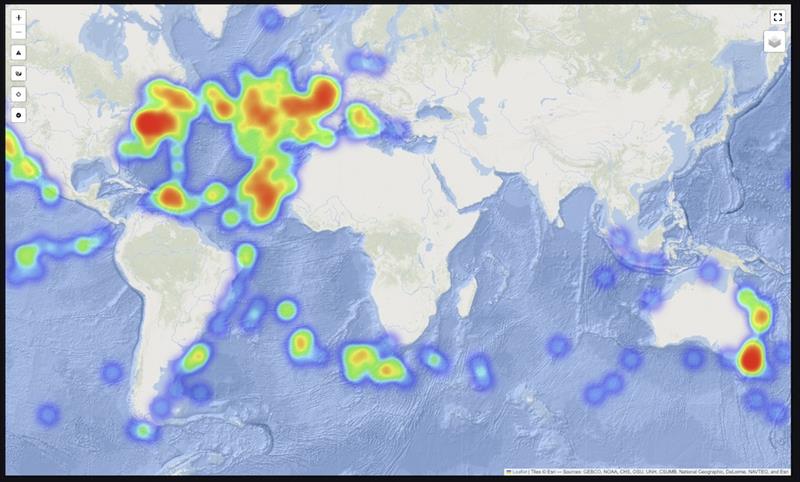
Heat map of whale strike density, according to Marine Strike Log data © Marine Mammal Advisory Group Marine Strike Log
Key Highlights:
- International experts convened at the European Cetacean Society Conference to address vessel strike mitigation.
- The workshop featured 40 presentations spanning science, policy, technology, and maritime operations.
- Participants explored future directions for a Global Risk Assessment Framework to support safer navigation.
- Vessel speed reduction and routing adjustments remain the most effective mitigation measures.
- Emerging technologies are improving real-time detection and monitoring capabilities to complement, but not substitute, operational measures.
- Participants emphasized the need for education to mariners and stronger multi-stakeholder collaboration, improved data integration, and practical implementation across sectors.
- Read the full report here.
- The next workshop on risk assessment and mitigating marine megafauna collisions with marine traffic will be held at SMM2026 - the 26th Biennial Conference on the Biology of Marine Mammals, taking place October 2026 in San Juan, Puerto Rico.
Maritime traffic represents a significant and growing threat to cetaceans worldwide. The risk of vessel strikes is exacerbated by the continuous increase in global shipping activity, particularly in regions where high-speed vessels and major shipping routes overlap with migratory corridors and critical habitats of cetaceans and other marine megafauna. Reducing vessel strikes requires genuine commitment from both governmental bodies and the private sector, grounded in scientific data.
On 21 April 2026, a special workshop at the European Cetacean Society Conference was co-hosted by fellow leaders and collaborators in the industry: Alice Bouchard - International Whaling Commission, Damian Foxall - Marine Mammal Advisory Group, and Natacha Aguilar de Soto - Oceanographic Centre of the Canary Islands (IEO/CSIC) to address mitigation of collision risk for marine traffic and marine life. A new comprehensive report has been released by collaborators, compiling the shared findings from the workshop and current best practice examples in strike risk mitigation; read more here.
The workshop and report feature 40 expert presentations from scientists and organizations from around the world, providing a structured overview of the current state of knowledge and practice across five main areas: risk assessment methodologies, mitigation measures based on operational strategies, technological developments to improve early cetacean detection, advances in education to mariners and industry perspectives.
Advances and challenges in risk assessment and mitigation
Together the group explored advances in risk assessment: current methodologies, recent International Whaling Commission (IWC) guidelines, and future directions for the development of a Global Risk Assessment framework aimed at providing a credible and accessible resource to inform safer navigation practices.
Risk assessment has enabled the identification of some of the existing high-risk areas worldwide through the integration of collision records, species distribution and spatial planning tools. Limitations remain due to data gaps, inconsistencies in reporting, and a lack of standardization and interoperability across methodologies and platforms. However, in some areas, risk assessment has supported the application of realistic conservation measures (rerouting, speed limits, exclusion zones) with practical tools for real time mitigation with less possible disturbance to navigation.
"The Marine Mammal Advisory Group's (MMAG) mission is to reduce vessel strike risk in the sailing and recreational boating sector. Through MMAG's six-pillar mitigation strategy - (1) sharing information, (2) risk assessment, (3) live reporting, (4) technical solutions, (5) education, and (6) collaboration - our community can garner shared learnings, insights, data and solutions to lower risk and strike incidents globally," said Damian Foxall, co-founder of the Marine Mammal Advisory Group.
Discussions on mitigation measures emphasized that no single approach is sufficient. Operational measures - particularly vessel speed reduction and routing adjustments - remain the most consistently effective tools, but their implementation varies across regions and sectors. At the same time, regulatory frameworks, incentive-based schemes, and voluntary initiatives were recognized as important mechanisms to support uptake.
Contributors concluded that mitigation measures must be adapted to specific ecological, operational, and socio-economic contexts, reinforcing the need for flexible, context-dependent strategies that must achieve realistic and tangible reductions in ship strike risks.
"Vessel strikes are one of the IWC's priority conservation concerns, affecting all species and all ocean basins. Effective response requires coordinated, global, and multi-disciplinary action. The IWC and its Expert Panel on Vessel Strikes bring together marine scientists, shipping experts and policymakers, most recently developing guidelines for standardising vessel strike risk assessments. These guidelines will be publicly available later this year and represent an important step towards the more coordinated, evidence-based global approach that this issue urgently needs." said Alice Bouchard, Vessel Strikes and Strandings Data Manager, International Whaling Commission
Technology and implementation challenges
Technological developments were presented as rapidly evolving and increasingly relevant components of vessel strike mitigation. Tools such as passive acoustic monitoring, thermal and visual detection systems, and decision-support platforms are enhancing the capacity for real-time detection, monitoring, and risk management.
Nevertheless, contributors stressed that these technologies are most effective when used in combination with operational measures, rather than as standalone solutions, and that further validation, standardization, and integration into operational workflows are needed. Most importantly, appropriate use of technology does not replace the primary objective of separating vessels from cetaceans, which must be the first consideration in any safe passage plan. When spatial separation is not possible, speed limits have been proven to achieve reductions in ship strikes in several parts of the world.
A key cross-cutting theme was the persistent gap between scientific knowledge and operational implementation. While significant advances have been made in understanding collision risk and developing analytical and technological tools, their translation into consistent practice within the maritime sector remains limited.
Addressing this gap requires genuine commitment from governmental agencies and the shipping and sailing sectors, as well as improved access to global data on marine megafauna and collision hotspots, communication frameworks, targeted training for maritime professionals, and the development of clear, practical guidance that aligns conservation objectives with operational and economic constraints.
Moving towards coordinated global action
Overall, vessel strike risk was recognized as a systemic, global, and transboundary issue requiring coordinated action. Participants emphasized the importance of applying precautionary and adaptive management approaches in the face of uncertainty, while strengthening collaboration among researchers, policymakers, industry stakeholders, non-governmental organizations, and technology developers.
Future efforts should focus on improving standardization and data integration, increasing the uptake of effective mitigation measures, and ensuring that scientific knowledge is made accessible and translated into practical, scalable solutions across different regions and sectors.
The report covers case studies from global initiatives to local scenarios, including an in-depth look at ship strikes in the Canary Islands, where high cetacean diversity coincides with dense international shipping and intensive inter-island fast-ferry traffic. The case study reviewed two regional Traffic Separation Schemes (TSS), each less than 120 km in length, and suggested speed reduction as a significant collision mitigation solution. The proposed speed reduction to 10 kts would add less than 3 hours to a typical cargo ship's journey, which represents a modest operational cost relative to the conservation benefit.
"The Spanish government and local ferry companies are making an effort to advance towards mitigation. This workshop provides examples of amazing initiatives worldwide, including speed limits, incentives to mariners and others, that can reinforce the process so that whales in the archipelago are safer, "said Natacha Aguilar, of the Oceanographic Centre of the Canary Islands (IEO/CSIC).
Read the full report compiled by Alicia Rodríguez-Juncá, Alice Bouchard, Carla Rubio, Damian Foxall and Natacha Aguilar de Soto here to learn more.
The next workshop focused on risk assessment and mitigating marine megafauna collisions with marine traffic will be held at SMM2026 - the 26th Biennial Conference on the Biology of Marine Mammals, taking place October 2026 in San Juan, Puerto Rico. Register here.