
The Ocean Race Auckland: Where's the Kiwi boat?
by Richard Gladwell/Sail-World.com/nz 4 May 20:34 PDT
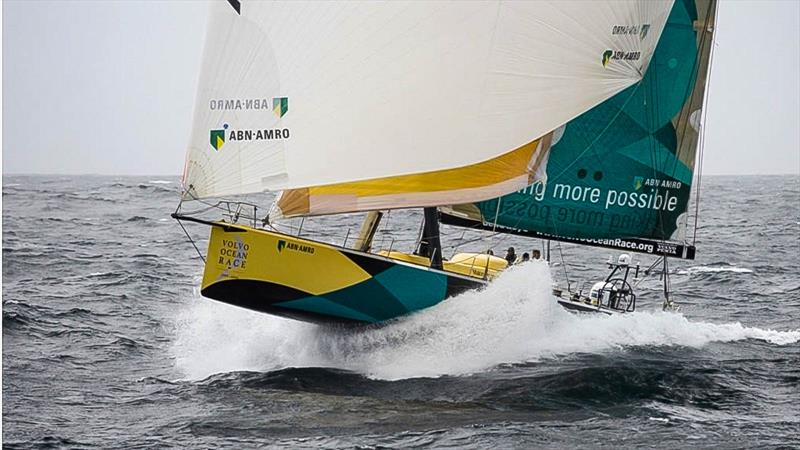
The signature shot of ABN AMRO 1 skippered by Mike Sanderson, as she passes Lizard Pt on the way to winning the 2005-06 Volvo Ocean race © Oskar Kihlborg
Monday's formal announcement of the Auckland stopover for the 2027 edition of The Ocean Race underscored the diminishing presence of New Zealand sailors in a race that has long been part of the Kiwi sailing culture.
It was last here in 2018, in the one-design Volvo 65s, which had been repurposed for a second lap of the planet. Several Kiwis were on the crew, but that event underlined that the last Kiwi skippered entry was 15 years ago, in the 2005-06 season, with Mike Sanderson skippering ABN Amro One to a race win. Sanderson remains the youngest skipper to have won the race and now heads up Doyle Sails, one of the two dominant sailmakers on the global scene.
You have to go back over 20years to find the last time a New Zealand-flagged entry competed in the race. Camper with Emirates Team New Zealand, from the design board of Marcellino Botin, grabbed second overall after finding form in the last European legs of the then Volvo Ocean Race. Camper was skippered by top Australian Chris Nicholson.
The last boats in the New Zealand tradition of the race, begun with Peter Blake and Ceramco, in the second Round the World race, were Grant Dalton's New Zealand Endeavour, which won Overall honours and the Maxi division in the 1993-94 race. Ross Field skippered the NZ/Japan-flagged entry, Yamaha, to win the Whitbread 60 division that year. That set the pattern for Kiwi skippered international entries, but after the 2011 event, that too faded away.
That's not to forget the courageous efforts of Bianca Cook and Tony Rae in 2019, when they launched NZ Ocean Racing with a view to competing in the 2022-23 edition of The Ocean Race. Cook purchased the former Turn the Tide on Plastic, on which she had crewed in the previous edition of the race under skipper Dee Caffari (UK). The campaign became a victim of the COVID pandemic, which led to a marked decline in enthusiasm for commercial sponsorship. They were hit with a double whammy when the traditional race course was altered to bypass New Zealand, and the VO65 division was cut back to just sailing three Atlantic legs in the seven-leg race.
Since 1994 the race devolved into one with some veteran Kiwi Round the World sailors becoming key crew members aboard international entries, But that too faded after the 2018 race, when the Volvo Ocean Race transitioned to the current ownership and the decision was made to transition away from the specialist Whitbread/Volvo Class Rules, to the IMOCA class, which is very popular in trans-oceanic race circuits of Europe, and the French based Vendee Blobe Race, the premier singlehanded around the world race.
The upshot of this litany was very apparent in Auckland yesterday, with the announcement of the NZ Govt-backed Auckland stopover at the end of a monster 14,000nm leg from the start in Alicante, Spain - permanent headquarters of the race organisation.
In the 1989-1994 period, Richard Brisius competed in two Whitbread Round the World Races that included Auckland stopovers. He then moved into successful management roles with three Volvo Ocean Race teams, before taking ownership as one of the co-founders of The Ocean Race. He made a flying visit to Auckland on Monday for the stopover.
The obvious question was "what's happening with New Zealand entries for the race?"
"That's the right question to ask," Brisius replied. "I think New Zealand is a diminishing breed of races around the world, which used to be dominated by Kiwis.
"Kiwis were the kings of the ocean, and right now, I don't see enough movement.
"We need leadership in New Zealand to start to drive towards new great participation in the race. The values are still the same. People have the right ground-up attitude that's needed in this race."
Back in his competitive era in the race, there was much more opportunity to crack into a Whitbread/Volvo Ocean Race team. Crews were much larger with Lion New Zealand sailing with 21 crew in the 1985-86 Whitbread.
Now, with smaller 60ft-long race boats, there are just five crew on board, including a non-sailing on-board reporter. The days of crew sailing on deck are gone, with the boats now helmed by autopilots and the crew largely sailing from below-deck enclosed structures, including grinding pedestals.
The shift to the IMOCA60 has underscored the Eurocentric nature of sailing at all levels. The Ocean Race is not just a race around the world every three years, but is now a series of Atlantic and Mediterranean-based events. The 3,000nm The Ocean Race Atlantic gets underway on September 1, and has attracted six entries to date with maybe a seventh pending. They are all strong teams, arguably the best in this aspect of the sport.
One of those is New Zealand's Conrad Colman, now based in France, who was announced as the latest confirmed entry to his MSIG Europe team two weeks ago. Colman says he’s keen to give opportunities to sailors like himself who are inspired to compete at the highest levels offshore.
“I originally came to Lorient so I could have an opportunity to race around the world solo, and I've now done two of those successfully,” he said. “But it was the Whitbread, the Volvo, and now The Ocean Race that really inspired me to become a sailor. So this marks the start of something new for us, an opportunity to get more New Zealand sailors in the IMOCA space, starting with this race.”
He's also keen to be a New Zealand-flagged entry in The Ocean Race, but needs more sponsorship. Colman told Sail-World in an interview to be published later this week that he had a boat and a recommittment from his Vendee Globe sponsor for The Ocean Race Atlantic. He has an option on a top boat, but needs more sponsor support to make it happen.
Brisius admits that the severely reduced crew sizes from the Glory Days of fully crewed around-the-world racing, coupled with its Eurocentricity, make it hard for New Zealand to return to its former prominence.
"It's much harder to get a slot. So that's something. Most of us wouldn't have got a chance if [bigger crews] weren't the case.
"That's also a trend I would like to see shift, with more people back on the boats."
The Kiwi Renaissance "starts with someone with a big dream, who really wants to be the leader, to pull this through."
"Just like now we talk a lot about the past, which is something to learn from.
"We're with the IMOCAs, and it's a fantastic boat. What we like about them is that they are very suitable. They can race around the world with no problem. They are the world's fastest moohull. They set the 24-hour monohull distance record.
"And as a sailor now, you are more challenged, actually, because each of these four people is sailing it. So you have to be a very complete sailor to get a spot on these boats.
"But you can also see that because the boats are so taxing, they're changing crew quite often. It's hard. You can barely do the whole race, because they are so hard to sail. So that gives more opportunities for more crew."
For the full interview, click on the YouTube thumbnail above.