
2026 RORC Caribbean 600 - IRC Zero Report
by Louay Habib / RORC 26 Feb 10:05 PST
26 February 2026
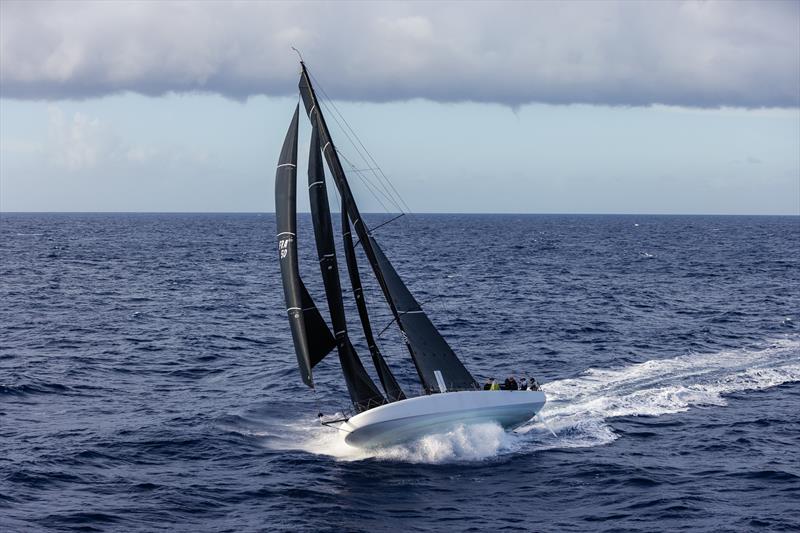
Mach 50 Palanad 4 – E.Leclerc (FRA), skippered by Antoine Magre win IRC Zero in the RORC Caribbean 600 © Arthur Daniel / RORC
Mach 50 Palanad 4 - E.Leclerc (FRA), skippered by Antoine Magre, took victory in IRC Zero, finished the race to take class line honours in an elapsed time of 2d 10:32:31 and posting the best IRC corrected time to secure the class win.
James Neville's Carkeek 45 Ino Noir took a bold but calculated gamble on the very last leg to finish second on IRC corrected time by a slim margin. Niklas Zennstrom's 's Rán completed the podium.
The IRC Zero contest featured a sustained battle between Palanad 4, James Neville's Ino Noir (GBR), Niklas Zennström's Rán (SWE) and the Frederic Puzin's Daguet 5 (FRA). The margins remained tight throughout, with the outcome decided only on the final beat to Antigua.
A race defined by VMG
This year's race unfolded differently to many recent editions. The trades were more south-easterly than typical, producing significantly more upwind and tight-reaching sailing across the course.
Palanad's navigator Will Harris identified the pattern early. "Probably about 60 percent of the race was upwind or tight reaching," Harris said. "That changes the way you approach the course entirely."
For the Mach 50 Palanad 4, renowned for its reaching performance, that meant discipline rather than domination. "Intense," said skipper Antoine Magre. "There were constant manoeuvres, constant sail changes. We never really got into a normal watch rhythm."
Palanad 4 also suffered an early setback when a halyard issue dropped their J1 shortly after the start. "It wasn't the best beginning," Magre admitted. "We lost over a mile." The French team responded calmly, grinding back through precise execution across the northern islands.
Guadeloupe: Ino Noir's key move
The lee of Guadeloupe proved pivotal in reshaping the class standings. At night, with land effects disrupting pressure and breeze patterns, Ino Noir elected to sail a slightly more offshore lane than their rivals.
"We could see the boats ahead on the tracker and how slow they were going," explained Ino Noir's navigator Juan Vila. "So we made a plan."
The plan was to position one to two miles further offshore, seeking a different pressure band. "In Guadeloupe you have to make your call and cross your fingers," Vila added and the decision paid off.
Ino Noir made a significant gain through the transition, compressing the fleet and bringing the podium positions back into contention.
Speed and setbacks downwind
From La Désirade toward Barbuda, Ino Noir found strong downwind pace. "We were flying 18 to 20 knots," Neville said. "However, the breeze eased more than forecast and we got tangled in fishing gear near Barbuda costing time."
Despite this, Ino Noir remained firmly in the contest heading towards the final leg. At Redonda, with approximately 35 miles remaining to Antigua, Ino Noir's path turned substantially to the north, away from the rhumb line.
"We weren't planning to go that far north," Vila explained. "But there was a big squall on our line. We had to decide whether to go long south or try to go around to the north. We thought going north of the cloud was better. We had a strong shift from the south for a while, so we continued pushing north until we got the shift back to the east."
The move required sailing additional distance but preserved pressure and avoided the light air behind the squall. For a period, the corrected time calculations tightened significantly. IRC Zero appeared potentially within reach for Ino Noir. Neville was proud of the effort. "Very pleased," he said. "It was a bit of a battle of the Carkeeks."
Ultimately, however, the gains were not quite sufficient to overturn Palanad 4's advantage.
Where Palanad 4 secured the victory
While Ino Noir made bold tactical calls, Palanad 4's race was defined by sustained performance across the full range of conditions.
"About 120 degrees true wind angle in 20 knots - that's where we are very strong," Harris said. On those reaching legs, the Mach 50 delivered decisive speed. "That was sublime," Magre confirmed. Crucially, Palanad 4 also performed well on the stronger upwind sections late in the race. "The windier it gets, the better we go upwind," Magre said.
Across 600 miles, Palanad 4 maintained a high level of execution. "We didn't sail perfect," Magre acknowledged. "But we were on point most of the time." That consistency proved decisive.
A meaningful win for Palanad 4
For Antoine Magre, skipper of Palanad 4, the class victory carried personal significance. "My father couldn't race with us this time," he said. "As we lost my uncle last week. The IRC Zero win was dedicated to him."
To follow the RORC Caribbean 600 and for more information, visit: