
Globe40 sailor Rupert Holmes gives a personal report from Jangada after Leg 4
by Rupert Holmes 25 Feb 12:16 PST
17 February 2026
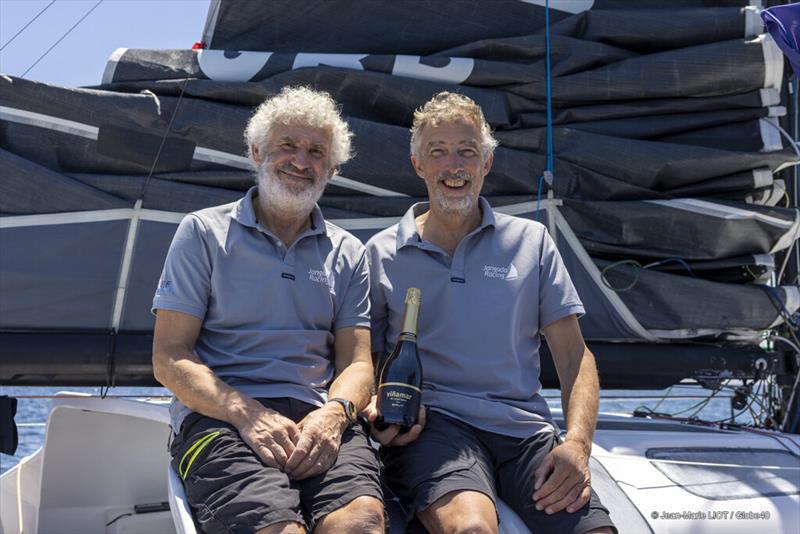
Rupert Holmes and Richard Palmer in Jangada finish Leg 4 of the Globe40 in Valparaiso © Jean-Marie Liot / Globe40
A closely fought trans-Pacific leg from Sydney to Valparaiso - and looking ahead to rounding Cape Horn
I'm alone on deck, on a pitch dark night, less than 100 miles from the finish and Jangada 40 sailing at a consistent 11-14 knots, with frequent surges to 16 or 17 knots. Arch rivals Lisa Berger and Jade Edwards Leaney on Wilson have popped up barely more than two miles ahead on our starboard bow.
It's incredibly close competition after almost 7,000 miles of intense racing and 27 days at sea. Yet Wilson isn't the only boat we're concerned about. Ten miles back off our port quarter are Melodie Schaffer and Colin Campbell on Whiskey Jack. And the three of us are set to compress further in lighter winds close to the coast.
Right now we're sailing at a hot angle with the big A2 spinnaker in 18-22 knots of wind and a building sea state. Over the next few hours gusts are forecast to build to 26-27 knots, which will make it challenging to hold this sail, but if we can it will be our fastest option.
We know that Melodie, winner of the 2023 Rolex Canadian Sailor of the Year in recognition of her performance in the first Globe40, will be pushing as hard as possible to get past us.
In the overall rankings we are only 0.5 points ahead of Whiskey Jack, so if we can finish ahead of Wilson that will be a big bonus, even if we now have no hope of catching the leading boat in the sharp bow division for pre-2017/8 Class40s, José Guilherme Caldas and Luiz Bolina on Barco Brasil, who are 58 miles in front.
Incredibly, the race among the new scow bow designs for the overall leg win was even closer. Credit Mutuel (Antoine Carpentier and Alan Roberts) and Belgium Ocean Racing - Curium (Djemila Tassin and Benoit Hantzperg) stuck close together at a breakneck pace almost throughout, averaging 13.3 knots over the ground for the entire leg, representing an average daily run of 320 miles.
The Belgians again broke the world record 24-hour run (subject to World Speed Sailing Council verification), surpassing the record Hantzperg and Renaud Dehareng set in Leg 2, notching up 459.78 miles, an average of 19.19 knots.
After 23 days at sea they held a narrow lead on the approach to the virtual finish line, but sailed into a patch of very light airs in the lee of the headland to the south of Valparaiso, allowing the French boat to catch them in the final minutes. The result was so close that even after analysis of the Adrena data logs from each boat the race committee had no option other than to call it a tie, with the two teams declared joint winners.
There are no losers in this edition of the Globe 40, but some teams have had less luck than others. Thibaut Lefevere and Nicolas Guibal on Free Dom, for instance, hit a floating object east of the Bass Strait, severely bending one of the rudder stocks and piercing the hull's outer skin.
Fortunately they were able to return to Sydney unaided for repairs, before restarting a fortnight behind the fleet. But were then struck by lightning on the first night back at sea, necessitating another return to Sydney, although this time it was a quick turnaround.
When I went to report on the finish of the inaugural edition of the Globe40, a striking aspect that made me want to compete in this edition was the strong sense of camaraderie among the teams. The same is equally evident in this edition and the professional shore teams of Credit Mutuel and Belgium Ocean Racing cut short their intended holiday in south Australia to return to Sydney and help with repairs and logistics.
Equally, this leg was missing the young German team of Lennart Burke and Melwin Fink on Next Generation Boating, who had to return to Reunion on Leg 3 after breaking a spreader bracket and shroud that threatened the integrity of the mast. They are now en route directly to Recife, where they will rejoin us for the final leg back to Lorient.
Back to Jangada 40's final night at sea: As the breeze increases boat speed builds to a crescendo, topping 19 knots. We've already survived a 27.5 knot gust, but with the sea state continuing to build it's increasingly difficult to maintain control, even with the first reef in the big square top mainsail and there's at least three more hours of this.
We've already seen Wilson slow on AIS, presumably for a sail change and now it's our turn. Nevertheless it's a frustration and we will lose ground when bare-headed. Two-thirds of the way through Whiskey Jack appears on AIS, still doing 17 knots.
Luckily, it's not long before we have the FR0 (fractional code 0) flying and, now able to come back up on course, are regularly hitting 15 knots plus, even under the smaller and more manageable sail plan. Five minutes later Whiskey Jack bears away downwind and slows to 6-7 knots, before disappearing at a range of seven miles.
Managing the succession of low pressure systems and associated fronts - that can sometimes extend for thousands of miles - is key to navigation and routing in the south. We led the sharp bow fleet for the initial six days of this leg, and even when we later crossed the International Date Line the first four boats were only an hour apart.
But next we had to negotiate a full-on Southern Ocean storm. On day 12 a low pressure of 967mb was forecast to pass to the south of us before deepening to 952mb as it sped further east-southeast. As well as the possibility of 60 knot gusts, a chaotic sea state with significant wave height of 7.2m (23ft) was forecast for our track along the ice limit at50 degrees south.
I've sailed these waters before, albeit many years ago, and know at first hand just how real the potential for danger is. My last steed was an 80ft ex IOR Maxi originally designed for the 1980/81 Whitbread Round the World Race and weighing 10 times more than a Class 40's meagre 4500kg.
Nevertheless, a key advantage of a Class40's speed is the ability to route around weather and we bailed out towards the north at an early stage, losing ground on the tracker until Whiskey Jack and Wilson joined us a day later. The latter then had their own rigging scare, when the leeward D3 shroud became disconnected. Faced with worsening weather Jade went aloft in the dark, successfully effecting a repair.
As the breeze increased we set a new speed record of our own at 26.1 knots, while reaching at a 110 degree true wind angle with only the J1 jib and triple reefed mainsail. However, Barco Brasil remained in the south, where they had to sail under a conservative sail plan with the wind averaging 40 knots and with occasional gusts to 50.
A very different scene greeting us when we eventually closed the finish line. In the final two miles the mist cleared, the sun came out and we were able to see the Chilean coast and Valparaiso for the first time. Wilson had finished 35 minutes in front and Whiskey Jack followed 19 minutes later.
At 22 days this will be by far our longest stopover. It's a time to rest and recuperate, take a short break to explore elsewhere in Chile, and prepare the boat for what may be the toughest leg of all.
Leg five takes us 1,700 miles south around Cape Horn and then almost 3,000 miles north through the major semi permanent cold front in the South Atlantic and on to the Brazilian city of Recife.
As I write this we are at 45 degrees south, more than halfway down the long haul from Valparaiso to Cape Horn.
Leg 5 started in offshore winds of 4-34 knots in the shelter of Valparaiso's deeply indented bay, followed by a three-day beat in winds predominantly 25-33 knots and a brutal sea state.
Unsurprisingly this took a toll across the fleet, with damage ranging from Whiskey Jack's Starlink terminal that flew off its mount to a broken J1 headsail halyard and exploded mainsheet traveller car for the Belgians.
The latter forced a pit stop on the Chilean coast, which the shore team completed quickly, but overall the excursion will cost them a couple of days.
We're currently in a high pressure ridge that will clear away later today, giving us a clear run towards Cape Horn, around 900 miles away.
While that's a big landmark, it by no means represents the end of the challenges the fleet faces.
The ascent of the south Atlantic represents one of the most technically difficult parts of this circumnavigation, with the potential for vigorous low pressure systems to form at short notice in the lee of the Andes mountain range and the notorious semi permanent cold front off Cape Frio, near Rio, before we finally reach the next stopover in Rio, almost on the equator, in about three weeks time.
The final 4,600 mile leg to Lorient in south Brittany, starts on March 29.
Track the Globe40 fleet