
2026 Ice and Snow Sailing World Championships in Västerås, Sweden - Day 2
by Marina Psychogyiou 18 Feb 09:50 PST
16-21 February 2026
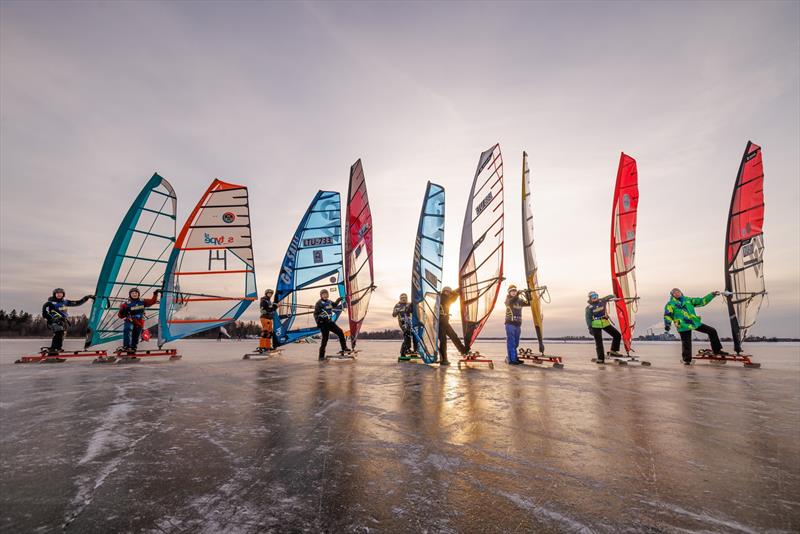
2026 Ice and Snow Sailing World Championships in Västerås, Sweden - Day 2 © Richard Ström
Four Decades of Sailing Carved in Ice
With the wind refusing to cooperate on Lake Mälaren today, racing at the 2026 Ice and Snow Sailing World Championships remained on hold. But a quiet racecourse doesn't mean a quiet community. Days like this offer something different — time to reflect on the history of WISSA, the evolution of the equipment, and the people who have shaped this unique sport for more than four decades.
A Legacy on Hard Water
WISSA President Will Tuthill (USA) has been part of this story since the 1980s. He still marvels at the unlikely fact that the world's longest running international competition for windsurfing, wings, and kites takes place not on water, but on ice. "It sounds incredible but it's true: the longest running international competition in the history of all three of our disciplines is actually on 'hard' water," Tuthill says. "It started in 1980 with windsurfing sails. Wings became an official class in 1991 in Estonia, and in 1993 in Poland we adopted kites."
The first official WISSA event was held in 1980, and by 1984 the championship had already made its way to Västerås — the same city hosting this year's edition. Tuthill's own first event was in 1986.
In 1987, poor conditions in Germany left competitors with plenty of time to talk and plan. That year, they formed the first official association. Over time, the administrative load proved heavy, and WISSA returned to a more informal structure, a model that has carried the sport from the 1990s to today.
Now, there is renewed discussion about forming a more formal international body to support growth, visibility, and development. But Tuthill is clear about one thing: "We are proud of the WISSA spirit and the inclusivity of our community. Whatever we build for the future, we need to make sure that spirit is preserved."
A Family, a Community, and a Lifetime of Ice
Few people embody that spirit more than Feodor Gurvits (Finland), competing this year alongside his wife Anna and their sons Eemil and Ossi. This is Feodor's 15th WISSA event, and his journey is as remarkable as it is humble.
His first WISSA was in 2007 — and he finished last. A decade later, in 2017, he won. In 2025, he took home three medals.
But for Feodor, the challenge has evolved. "Competing by yourself is one thing," he explains. "But if you are moving a bigger team of people and trying to make competition for everyone lean and efficient, that's more of an effort."
He speaks with pride about the WISSA ethos — a culture built on mutual support, shared knowledge, and collective problem solving. "We help each other with equipment and with logistics. We're a very open community. If somebody makes it to the competition, we make sure they are able to compete."
Feodor's own path into the sport began almost by accident. After moving from Germany to Finland with a car full of windsurfing gear — in February — he needed a way to sail in winter. So he built a sled. The first broke after three meters. The second after 300. The third finally worked. So he organized a competition. There were four participants.
The next year, he went to WISSA — and finished last. But he kept going.
Coaching the Next Generation
In 2016, Feodor began coaching juniors. By 2018, they had already earned two medals. Since then, his team has medaled every year.
He now coaches not only Finnish sailors but also members of the Estonian windsurfing team, and even a Finnish sailor who once aimed for the Olympics before the complexities of Olympic windsurfing — especially the transition to foiling — became overwhelming.
The family's involvement runs deep. Feodor laughs when he talks about how he introduced Anna to the sport:
"On our second or third date I dragged her to the ice. She didn't give up then, and she's still not giving up on me."
Anna adds her own memory:
"I was tricked into organizing the WISSA event in 2011 while I was this pregnant — and it was an experience. I really appreciate what the Swedes are doing here."
Their son Eemil is competing for the first time this year.
"Losing to your son is a very pleasant competition to lose," Feodor says. "He already beat me in chess, so now we're waiting for the sailing part. But he needs to practice a little bit — he's not there yet."
Eemil, meanwhile, is taking it all in stride:
"This is my first competition, but I did it at home — wing with skis. Here I'm doing wing with skates for STS, and maybe I'll do wing with skis for the course racing."
Equipment, Evolution, and the Art of Adjustment
Ice and snow sailing is a sport where equipment choices can make or break a race — and where conditions change by the hour. "You would think ice is ice," Feodor says, "but there are so many different types of surface, and you need to adjust your equipment accordingly."
From bumpy hard ice to smooth black ice to thin snow cover, every surface favors a different sled configuration. Feodor prepares multiple setups — skis, skates, different angles, different sharpening — and stays ready to switch mid event. "Sometimes you even retire from a race, take the discard, and make sure you have the most suitable equipment for the next one."
The sport has seen major equipment revolutions. Narrow ski sleds dominated decades ago. Then in 2011, Russian sailors arrived with large white sleds that "wiped the table." "Some sleds work everywhere and anyone can drive them," Feodor explains. "Some are more sophisticated — maximum performance, but only in certain conditions. I'm more of a 'Paris-Dakar' style. Whatever I build has to work in any conditions." Much of the innovation happens in the community itself — through shared testing, building, and discussion. "We have a very active Facebook group where information is shared. We borrow equipment, test, build for each other. That is the engine for development."
Looking Ahead
With no racing today, the standings remain unchanged. Organizers remain hopeful that the coming days will bring the wind needed to continue the championship. But even without racing, the day offered something valuable: a reminder of what makes WISSA special. A sport built on ice, powered by wind, and sustained by a community that shows up for each other — year after year, generation after generation.
Racing continues through Saturday, concluding with the iconic Marathon across Lake Mälaren.
Find out more at www.isswc.com