
Flying Fifteens at the RYA Dinghy & Watersports Show 2026
by UK Flying Fifteen Association 17 Feb 10:51 PST
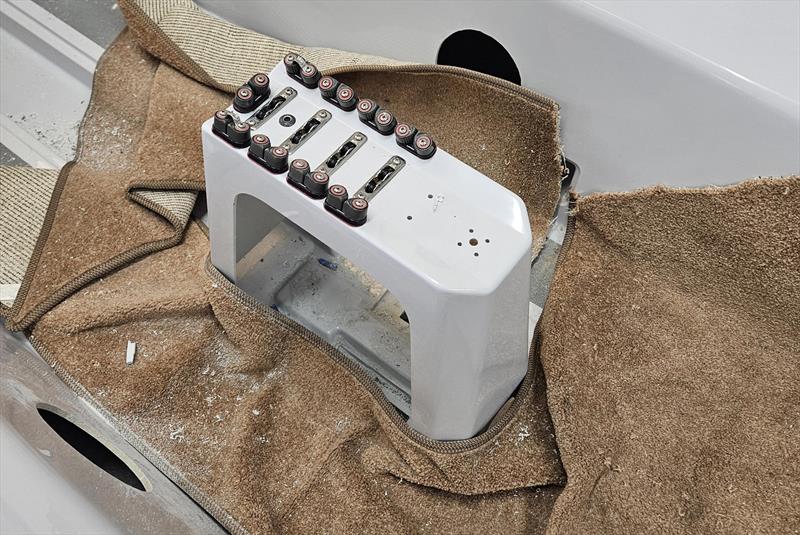
GBR4148 - The fit-out starts: positioning the first fittings © Simon Patterson
The Flying Fifteen class has always been one the stalwarts of the RYA Dinghy & Watersports Show, and we'll be there again this weekend with a brand-new boat on display on stand B30.
As always we look forward to catching-up with any existing class members who might drop-by the stand for a natter and to see the latest developments, but of course we especially love chatting to potential new sailors of our wonderful boats - so if you've always been curious about the Flying Fifteen and can perhaps see one in your future please do come and find us!
The Flying Fifteen itself has been around for over seventy years and, depending upon their ambitions, newcomers to the class can choose anything from an old Classic-fleet boat worth a few hundred pounds, right up to a shiny new fully-finished and race-ready craft costing somewhat more.
Another way into a new boat, and at considerably lower cost, is to buy a bare hull and fit it out yourself. One long-standing class member who favours this route is Simon Patterson who, as many do, worked his way up through a series of second-hand boats before making the leap to a new Ovington 10 fitted-out by himself in 2016. That boat was GBR 4044, followed in due course by GBR 4080 and now his latest creation, GBR 4148, shown in the photos here and finished in time for last year's World Championship.
As can be seen Simon is lucky enough to have a well-equipped workshop at his disposal, but that's by no means essential and plenty of Flying Fifteens have been fitted-out on driveways and in domestic garages. And Simon is at pains to point-out that the work itself is quite straight-forward.
"Anyone with decent DIY skill and tools can fit a hull out. The class rules are very generous in terms of what you can do, and it's really just a matter of drilling holes and bolting stuff down. The trickiest part is actually getting everything symmetrical side-to-side because there aren't many straight edges on the hull to measure things from!"
As Simon says the Flying Fifteen rules place little restriction on fit-out, but of course layouts have tended to become standardised and indeed Pinnell & Bax, for example, will supply all the fittings in a single discounted package, which Simon recommends: "It makes things very easy, and they're very flexible too - for example, if you decide to change something you can send the bits you don't need back for a credit and they'll swap them for something else."
With GBR 4148 Simon went the extra step of fitting the keel himself, although on his two previous boats he'd bought the hull with it pre-fitted. "Paying a bit more to have the keel fitted at the factory is probably a better option for most - but that's mostly because of the amount of labour involved in turning a raw keel casting into a faired-and-painted keel. It's a big job!"
And finally, how much money can you actually save by fitting a new hull out yourself? Simon says the biggest factor for him is how much more affordable it makes moving from one boat to the next.
"Flying Fifteens hold their value really well, and if you're doing the work yourself you can find that selling your previous boat will mostly pay for the next one. For example, we sailed GBR 4044 on the circuit for four years before ordering another new hull from Ovington, That became GBR 4080, which was a brand-new boat for the net cost of around £3000 plus a suit of sails."
Many thanks to Simon Patterson for the photos and these insights into one possible route into Flying Fifteen ownership. If you're interested in learning more about this or any other aspect of the class we'd love to see you at the show this weekend!