
SailGP faces the reality of being F1 on the water.
by Richard Gladwell/Sail-World.com/nz 17 Feb 06:08 PST
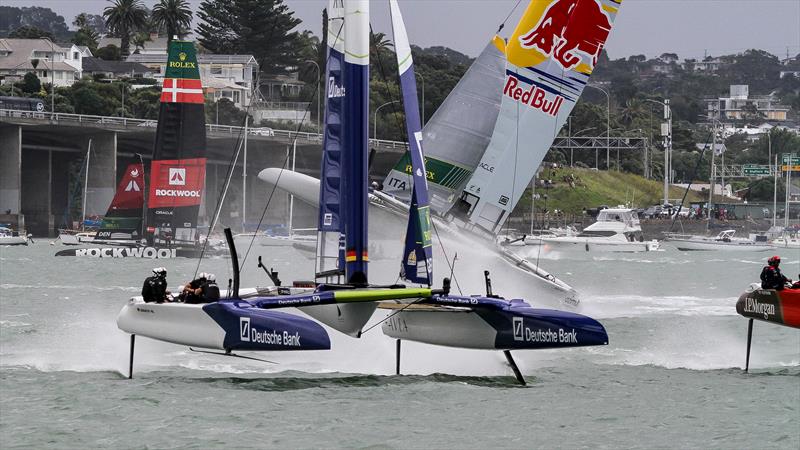
Red Bull Italy lifts off on Day 2 of ITM NZ SailGP - Auckland - February 15, 2026 © Richard Gladwell - Sail-World.com/nz
The SailGP League will face major challenges over the coming months in the aftermath of two serious collisions at the first two events of Season 6.
While the latest event is shocking, both in what did happen and what could have happened, it is but one of a series of incidents involving the foiling of catamarans and monohulls, dating back to 2011.
So far, there has thankfully been only one death - that of Andrew "Bart" Simpson in one of two major incidents ahead of the 2013 America's Cup when Artemis Racing suffered a structural failure in their final sail in their prototype AC72 wingsailed catamaran in top-end conditions in San Francisco.
Following that incident, Race Director Iain Murray took the initiative to compile a list of changes to improve racing safety, and these measures serve as the foundation for subsequent events in the America's Cup and SailGP.
A noted designer, Murray was also one of 16 crew members who had to leap for their lives from One Australia when the 80ft IACC yacht sank in two and a half minutes, after suffering a hull fracture when racing off San Diego in 1995.
Both SailGP and the America's Cup are fortunate to have Iain Murray as Race Director, and the environment in both events has changed to prioritise safety and take safety training seriously. The events of the weekend underline the need for a safety culture within the sailing and support teams and the need to take safety seriously. That is happening, and the safety processes have worked.
It is a well-known truism of disaster planning that "the disaster you plan for, never happens".
The response to that is to have the right people and equipment in place, and with proper safety training. From there, quick, accurate decisions have to be made without mistakes.
The weekend's collision involved a crew member being cut free from the F50. Breathing gear was available and used to buy some time for Louis Sinclair, while he was cut free of the F50.
From what has been revealed/uncovered so far, the SailGP safety processes in place worked.
It was a similar story in the 2021 America's Cup Challenger series, also in Auckland, when American Magic skipper Terry Hutchinson was caught underwater in a sinking AC75, and had to be cut free by a fellow crew member.
The sight of an AC75 flying overhead (we had to look up to see it) was unforgettable. It was surprising that the entire crew survived.
Black Foils skipper Peter Burling was on hand that day, coming out from the Team NZ base with a bunch of safety gear, and assisting with the salvage of the barely floating AC75.
He was also on the helm of Emirates Team NZ's AC50 (forerunner to the F50) when the wingsailed foiling catamaran spectacularly nosedived and capsized during the Semi-Finals of the 2017 America's Cup in Bermuda. The crew also fell from the boat that day, after clinging to the trampoline deck netting for a time.
And before all of them, in June 2011, SailGP CEO Russell nose-dived an AC45 when again crew were hurled or high dived from the upper hull of the wingsailed catamaran in front of the US media during an exhibition sail in San Francisco. The event made the front page of the Wall Street Journal, creating the F1 image of this new aspect of sailing.
Coutts was also CEO of Oracle Racing when the Jimmy Spithill skippered AC72 nosedived and capsized in San Francisco during its last training sail. The platform and wingsail broke up, drifted out through the Golden Gate, and the bits were retrieved during the night.
Spithill is now the CEO of Red Bull Italy and is still listed as a reserve skipper for the team.
The point is that there is plenty of first-hand experience in these mishaps at all senior levels of the sailing fraternity in SailGP.
Looking back at the several thousand or so frames I shot during the racing and recovery, it is clear that the safety processes worked well, and the right people were there very quickly, with the right gear.
Going forward, there should be the experience within SailGP to make the right calls without a lot of external review or help.
However, there are several obvious areas to consider.
The first is semi-implemented: reducing congestion on the SailGP course. That was done on Sunday, with the teams sailing two further Group races, and the top three on points going through to the Final.
It does change the nature of the racing from being congested, and with plenty of rig turbulence in light and more moderate winds, with few passing lanes.
It also takes the emphasis off being first to Mark 1 at the end of the Sprint leg, and means that the position of the boats at Mark 2 - a gate mark rather than a congested rounding mark is more important. It also means that the lead boat can't just go off and sail its own race in clear air, leaving the poleton to cope with its congestion and self-created turbulence.
However, the devil is in the detail. How the boats are split/seeded into the Heats, and whether this is fair when there is an uneven number of teams.
The split fleet racing from a fan's perspective is obviously less spectacular.
The concept was tried in Auckland in 2025 during Practice racing.
When asked in the Mixed Zone after the racing, as to which style they preferred. It was split 50/50 on whether they preferred the smaller, less congested racing in a group of six teams or the single fleet (12 teams). A point of discussion will be whether racing in one fleet or two should be implemented for the whole weekend for consistency, or if the format should be flip-flopped.
Another point is what happens if a boat, or often two, drop out because of gear/system failure. If they come out of the same Heat, the racing becomes very unbalanced. In the single fleet, dropouts are less of an issue.
What has to happen is that a set of rules is laid down, and competitors and fans accept that is the way the game is to be played.
SailGP is generally very good about this, thanks largely to the candid explanations of the Chief Umpire, Craig Mitchell.
The second point is understanding why F50s can suddenly lose control and spin out at the top end of the wind range.
While the Black Foils incident was the most notable over the weekend, on Sunday, the Red Bull Italy team executed a similar right-hand turn at high speed as their fleet was hit by a squall just after the start.
Fortunately, there were no other boats around, and the Italians - who had some very experienced crew on board - avoided a repeat of Saturday.
"We had a big slide in the first reach of the first race, it was just windy, the boat's really loaded, and you're on the edge of control," explained skipper Phil Robertson. "We just went over the limit a bit, and it's really hard to get the boat back under control. So there's a little bit to review in that area."
"Once you spin out, it's pretty hard to keep it under control, and the boat takes over from there."
Robertson says that sailing foiling boats in these squally conditions is quite different from monohulls.
"You want to be fast, and you've just got to stay fast. The danger is actually just getting slow, because the apparent wind starts to go aft, and then it's difficult to get it forward again. It's quite a big change in terms of load through the rig and the foil.
"They're definitely very, very difficult. You can't just bear away, as you would in a normal boat. When you get a puff, especially on a race track like this with 12 other boats around, you don't always have that option. So you've got to preempt the increase and stay ahead of it. But sometimes you just can't, and you just get hit by a big one - then you've just got to hold on.
"You've got to choose which way you're going to go out if you start to get more heel than you want. The idea is to keep these boats as flat as possible. And as soon as you start to get a bit of leeward heel, it's pretty difficult to get it back under control.
"And with these little (18mtr) wings, once you start easing, the sheet quickly goes slack, as the wings get too much pressure behind the wing to actually ease it anymore."
"The only way out of it is to turn up or bear away. And if there are boats around you, that's not an option."
The third point is the new high-speed T-Foils.
In Auckland, on the first day, Robertson said they were at 50 kts on the first sprint leg and sat on that speed.
50 kts is also the speed at which cavitation seems to become an issue in foiling classes, and one of the issues will be to check whether it occurs on the main T-Foil or the rudder T-Foil. Many claimed that the port rudder washed out on the Kiwi boat, resulting in a loss of control, as the boat heeled and the starboard rudder began to come clear of the water.
However, as Robertson noted, once the F50 starts to heel, it becomes very hard to regain control.
The review is expected to take place between the CEOs of the individual teams and the SailGP League management.
It is a big ask for the DS Automobiles (FRA) to be repaired and ready for the next event in Sydney, starting on February 28. The next event is in Rio de Janeiro in mid-April. Then the Circuit of the Americas starts, as the event moves through several locations in North and South America.
The next option is SailGP Portsmouth in mid-July. That comes into play if the repair task is so extreme that the boats have to be completely rebuilt.
However, the fortunate side of the weekend's damage is that it occurred in Auckland, which has substantial carbon-composite construction capability - arguably the world's epicentre. One of the issues the League has to address is establishing partnerships around the world capable of undertaking repairs and rebuilds using duplicated tooling, as done by the former Core Builders Composites, which supplied tooling to other builders of the AC50s used in the 2017 America's Cup.
The recent stern repair to the Kiwi F50 after Fremantle, carried out at C-Tech in Auckland and SailGP Technologies in Southampton, went well. The League also has a relationship with the American Magic facility in Pensacola.
There is no escaping the fact that serious damage is part and parcel of the high-octane SailGP circuit. The League likes to compare itself to F1 - but as we saw in the weekend, and in Fremantle, there is no Punch without Judy.