
Crossing the Drake: Picomole Reaches Antarctica
by Rapido Trimarans 14 Feb 12:39 PST
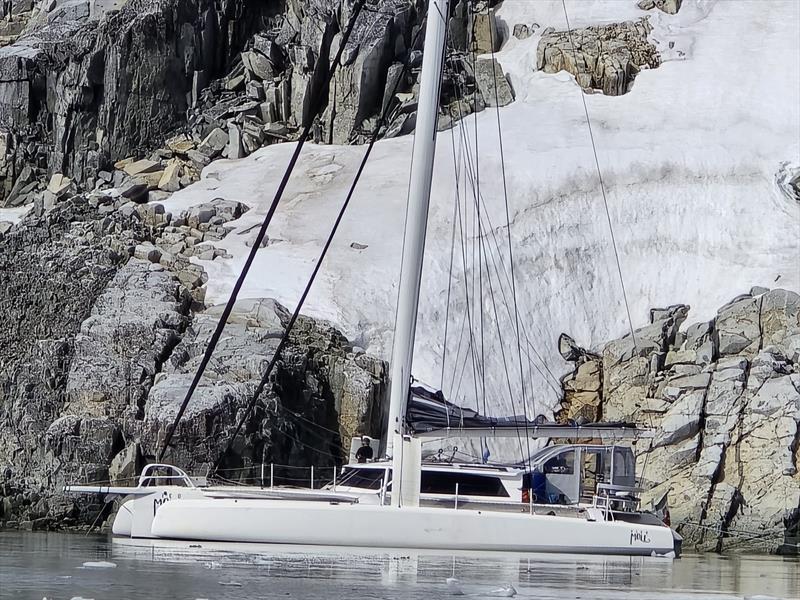
Rapido 53XS, Picomole, in Antarctica, February 2026 © Picomole
Through a small number of photos and short video clips received in recent days (we will post a video separately), we can see that Aldo Fumagalli and the crew of the Rapido 53XS Picomole have crossed the Drake Passage and reached the Antarctic Peninsula.
The images place them between Anvers Island and Brabant Island — among glaciers, drifting ice, and a landscape more commonly associated with steel expedition yachts than performance trimarans.
At this stage, we have no voyage report, no logs, and no direct account from the crew. Aldo and the crew are rightly focused on sailing and safety. What we are witnessing is simply what the camera shows: a Rapido trimaran in Antarctica.
Only two months ago, this same crew was sailing Picomole in the warmth of the Caribbean, taking Line Honours in the Multihull Division of ARC 2025 and placing 2nd Overall. To move from tropical trade winds to the hostile cold of the Southern Ocean in a single season speaks to ambition, preparation, and serious seamanship.
The Reality of the Drake Passage
The Drake Passage is widely regarded as one of the most demanding stretches of ocean on Earth. It's the body of water between Cape Horn in Chile at the southern extreme of the South American mainland and the South Shetland Islands of Antarctica. It lies in the path of uninterrupted westerly wind systems (the "Roaring Forties" and "Furious Fifties") where low-pressure systems regularly generate gale-force winds and large, confused seas. These conditions are reinforced by the Antarctic Circumpolar Current, the most powerful ocean current on the planet, which keeps the sea state active even when winds temporarily ease.
For sailors, crossings here are not forced; they are carefully timed. Success depends on reading weather systems, selecting the right window, and moving efficiently through it before the next system arrives.
In this environment, the combination of skilled crew and a fast, highly responsive boat like the Rapido 53XS becomes significant. The ability to sail quickly, adjust course decisively, and stay within a favourable weather window is a practical advantage in these waters.
Ice and Vigilance Near the Peninsula
While wind and sea state define the Drake Passage, the nature of the hazards changes as a vessel approaches Antarctica.
Closer to the Peninsula, drifting ice, growlers and icebergs require constant lookout and disciplined navigation. Radar, visibility, and human vigilance are essential. The images we have received show Picomole operating in precisely this environment.
A Rare Sight in Polar Waters
The Antarctic Peninsula has traditionally been visited by heavy displacement monohulls and purpose-built expedition vessels. Seeing a performance cruising trimaran here is unusual not because it is impossible, but because it demands preparation, judgement, and confidence from those on board.
Whether this ultimately proves to be the first time a production cruising trimaran has reached shore in Antarctica will be confirmed in time. What is already clear is that Aldo and his crew have taken their boat far beyond typical cruising grounds.
A Fast Return Trip
The team are now back from the ice after a very fast return crossing of Drake's Passage from the Arctic Peninsula to the latitute of Cape Horn in 42 hours, 39 minutes.
Footnote: First Catamaran to reach Antarctica built by Rapido's co founder, Paul Koch
In January-February 1999, Robin Chamberlin and Terry Travers sailed the catamaran API Mersey Pharmacy (Excess) to Antarctica, becoming the first multihull yacht to venture that far south, as noted by World Sailing. Excess was built at Ostac from Parallax 11 hulls when Paul Koch owned the yard. Today, Paul is co-founder of Rapido Trimarans, builder of the Rapido 53XS Picomole which is possibly the first production trimaran to reach Antarctica. The connection is a quiet thread linking two pioneering multihulls, decades apart.