
International One Metre World Championships in Gladstone, Australia - Reflections on a Masterpiece
by Nigel Barrow 28 Jan 09:40 PST
20-28 October 2024
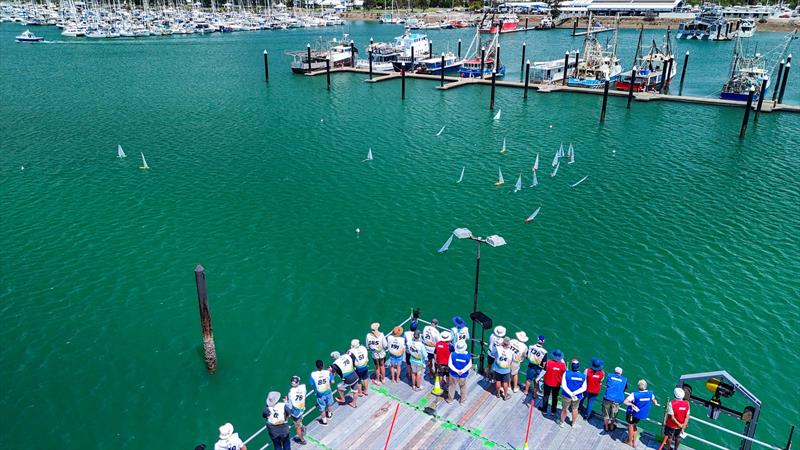
Day 5 of the International One Metre World Championships in Gladstone, Australia © Lacey Blake - CINOVA
Reflections on an Australian Masterpiece
When a club of just eleven members in a remote corner of Queensland announced it would host the IOM World Championship 2024, few could have predicted the scale of what was to come. Fewer still could imagine that this small, tight knit community would deliver one of the most professionally executed world championships the class has ever seen — complete with global livestreaming, stadium style viewing, and a level of organisation that rivalled major international sporting events.
This is the story of that remarkable achievement, seen through the eyes of a competitor who travelled halfway around the world to witness it.
A Journey to the Edge of Australia
Planning the trip to Queensland came with its own anxieties. The region's reputation for dangerous wildlife — from box jellyfish and saltwater crocodiles to tiger sharks, blue ringed octopus and stonefish — was enough to make any visitor cautious. Five weeks in the area produced only a single giant lizard sighting, but the fear was real enough to keep swimming strictly off the agenda.
The long journey was softened by an upgrade to Emirates' A380 business class — a decision that proved worth every penny. After a smooth hop to Dubai, complete with a sprawling terminal wide lounge and a restorative shower, the onward flight to Brisbane delivered a reminder that even the largest aircraft can be tossed around like toys when turbulence strikes.
Arrival in Australia brought its own drama. A minor security incident involving a tiny screwdriver set and a backpack full of batteries triggered a race against the clock to retrieve and re check luggage. Thanks to an Apple AirTag and a helpful Qantas representative, the crisis was averted — though not without a spike in adrenaline.
Gladstone: Industry, Warmth, and Generous Hospitality
Gladstone, the host city, sits 517 kilometres north of Brisbane. Known as the "engine room of Queensland," it is a powerhouse of industry: alumina refineries, LNG export facilities, one of Australia's busiest coal ports, and the country's largest cement plant. Towering conveyor belts feed ships with up to 6,000 tonnes of coal per hour, while neighbouring terminals handle grain, fuel, chemicals, and thousands of containers annually.
A warm, welcoming community is at the heart of all this vigorous industry. Conversations with locals — from a retired train driver to a passer by offering a lift — revealed a town proud of its region and eager to share it.
The Gladstone Radio Sailing Club itself was modest: a car park, a public toilet, a long fishing wharf, and a gravel ramp into the water. The wildlife warnings were real — sharks, jellyfish, and even a tiger snake that appeared near the control area during the Worlds — but so too was the beauty of the venue. With steady easterlies blowing across the harbour, it was a sailor's paradise.
The Eleven Who Delivered the Impossible
At the heart of the event was Grant Cooper, the driving force behind the championship. His roles were too many to list: organising chair, infrastructure wrangler, commentator, YouTube summariser, radio promoter, master of ceremonies, and host of the nightly "Jag the Joker" entertainment. Supported by his company's professional livestreaming capabilities and a dedicated team of volunteers, he set a standard for event presentation that will be difficult to match.
Sponsorship flowed generously — much of it in kind — thanks to the close knit nature of the Gladstone community and the prestige of hosting a global event. The port authority played a pivotal role, even clearing fishing boats from nearby jetties to create an unobstructed racecourse.
A Venue Transformed
Three days before the championship, the waterfront was quiet. Then, almost overnight, an army of volunteers descended. Artificial grass rolled out across the tarmac. Sunshades and security fencing appeared. A vast open air cinema rose beside the water. Electronic heat boards, scoring screens, and a towering 20 foot control platform were installed along the length of the wharf. Cameras, scaffolding, food trucks, and a coffee kiosk completed the transformation.
It was a masterclass in planning and execution.
Measurement and registration took place in the air conditioned Marine Rescue building, where each competitor was processed with remarkable efficiency. The rigging area — shaded by branded canopies destined for charity after the event — offered welcome relief from the 30 degree heat.
An Aboriginal Welcome
At the opening ceremony competitors were welcomed with an Aboriginal smoking ceremony. An ancient Australian custom, spanning over 60,000 years, involving the burning of native plants to produce smoke for cleansing, healing, and welcoming people to country. Performed by Indigenous elders or community members, the smoke purifies, wards off bad spirits, and promotes well-being. In addition a wildlife team brought several Joeys and it was fascinating to see grown men melt as they cuddled these adorable creatures.
Speeches done, equipment inspections complete, the main event could begin
Racing Begins — Eventually
Practice racing delivered perfect conditions: sun, wind, and waves. But on the morning of the opening ceremony, the wind gods turned mischievous. After a week of reliable easterlies, the breeze swung 180 degrees, making it impossible to lay a course. A four hour delay followed, and similar disruptions plagued the next two days.
Once racing finally settled, competitors lined up on the elevated control platform, nearly 40 feet above the water, offering panoramic views of the course. Six races were completed in the first three days despite the delays.
Shore side communication was exemplary. Heat results appeared instantly on electronic boards, and the turnaround between races was impressively tight. A switch from a traditional windward mark to an out to in gate reduced collisions — though not without introducing its own tactical quirks.
The competition was fierce. Shifting winds created heroes and victims in equal measure, and the distant windward marks tested even the sharpest eyes. The A heat duels between Zvonko Jelicek (Croatia) and Ian Vickers (New Zealand) captivated spectators, who packed the outdoor cinema to watch the battles unfold in high definition. Ian Vickers closed the gap in the final races, finishing just one point shy of the world title.
In lieu of the traditional celebratory dunking — too risky in crocodile country — Zvonko received a drenching from one of the giant boat rinsing buckets instead.
A Championship to Remember
The outdoor cinema revealed every mark rounding and every collision in forensic detail, though umpires on the platform often struggled to see incidents clearly from such distance. Commentators quickly learned to tread carefully when interpreting contact.
After a final evening of celebration at Auckland House, the site was dismantled with the same efficiency with which it had been built. Within a day, the waterfront returned to normal — but the memories remained.
The Gladstone team delivered not just a world championship, but a benchmark for what a small, passionate community can achieve with vision, determination, and unity. Their legacy lives on in the comprehensive video archive, the vibrant social media coverage, and the admiration of sailors around the world.
Thank you, Australia — and thank you, Gladstone Radio Sailing Club, for an unforgettable world championship.
If you missed the previous articles in this series, they are: