
RORC Transatlantic Race - Inside the navigator's mind
by Louay Habib / RORC 9 Jan 09:32 PST
11 January 2026
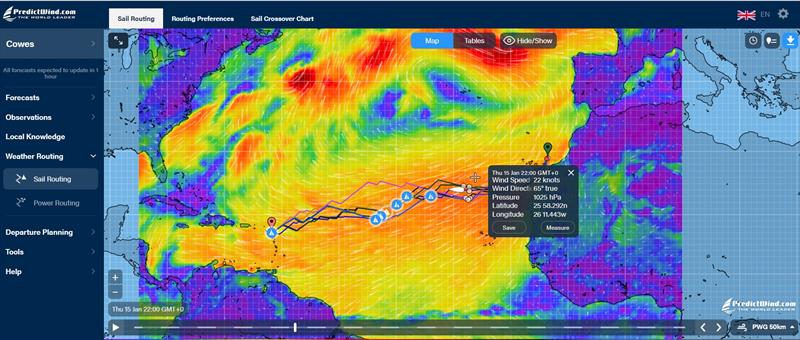
RORC Transatlantic Race © PredictWind
RORC Race Officer Chris Jackson sets the scene for the weather outlook, setting the strategic backdrop for the 2026 RORC Transatlantic Race.
"On current forecasts the weather outlook for the RORC Transatlantic Race this year is looking good," commented Chris Jackson who has raced across the Atlantic eight times.
"The trade winds look well established so we would be hopeful for a good fast race for the fleet. The start on Sunday 11 January looks like there will hopefully be around 10 knots of breeze, maybe increasing through the afternoon slightly. The fleet will have all options open for their course after rounding the laid mark off Puerto Calero Marina, but they should expect a lighter-wind exit from the Canary Islands, transitioning into steadier trade-wind conditions once clear.
"The forecasts are showing the potential for some isolated squall activity; this will obviously need to be monitored by the fleet. The course is looking like a VMG run most of the time, this could mean that a lot of the fleet will stick closer to the rhumb line rather than diving a long way south towards the Cape Verde Islands."
In the RORC Transatlantic Race, raw speed matters, but navigation decides outcomes. Over three thousand nautical miles, success is shaped by decisions made long before the start gun fires and refined hour by hour as the fleet transitions from the Canary Islands into the trade winds and into the wide blue yonder. For the 2026 edition, some of the most experienced navigators in offshore sailing will be plotting those decisions aboard radically different platforms, each with its own strengths, limitations and opportunities.
Juan Vila on Carkeek 45 Ino Noir, Will Oxley aboard the Botin designed Baltic 111 Raven, and Miles Seddon navigating the MOD70 Zoulou all bring world class credentials. Yet their approaches reflect not only personal experience but the very nature of the boats they are sailing.
<<<553310>>>
Juan Vila and the art of positioning?
Juan Vila's career spans victory in the America's Cup, the Jules Verne Trophy and the Volvo Ocean Race. For the 2026 RORC Transatlantic Race he will navigate James Neville's Carkeek 45 Ino Noir, a high performance monohull racing in a fiercely competitive IRC environment. Vila was navigator on Maxi Lucky, setting the monohull race record for the Lanzarote to Grenada record last year.
"For a navigator, the biggest difference is speed," Vila explains. "Ino Noir is not as fast as the big maxis I've worked on, and that changes everything. On a fast boat you sail from one weather system to the next. On a smaller boat you wait for the weather to come to you, so positioning becomes far more important."
That difference shapes strategy from the outset. Rather than chasing distant wind systems, Vila is focused on medium range forecasts, currents and the evolving shape of the trade winds. Ino Noir's versatility helps. With strong VMG downwind and efficient reaching modes, the boat offers multiple strategic options.
"That flexibility is huge," says Vila. "Early in the race, if you are pushing south to reach the trades, VMG sailing can matter a lot. Later on, when you are aiming for a shift or threading through cloud systems, the reaching speed becomes very valuable."
Competition under IRC adds another layer. With rivals such as Palanad 4 and NeoJivaro close on rating, Vila balances boldness with caution. "When the models align, you sail your strategy and forget the competition. When the forecasts are uncertain, you watch your rivals more closely and avoid ending up in a dead end."
Despite the technology available, Vila insists instinct still rules close quarters sailing. "In the short term, experience takes over. When you are in island shadows or playing squalls, you trust what you see. For the bigger picture, you rely on historical data, hindsight and the confidence you have in the forecast range."
For Vila, success is not defined solely by corrected time. "This fleet is diverse and weather will always favour some boats. Success is sailing Ino Noir to her full potential and making the best decisions with the information available."
Will Oxley and managing extreme performance?
If Vila's race on Ino Noir is about patience and positioning, Will Oxley's world aboard Raven is defined by sustained speed. Oxley has navigated everything from Ultims to IMOCA 60s and was on board Comanche when she set the monohull elapsed time record in the 2022 RORC Transatlantic Race. Raven presents a different challenge again.
"The fundamentals of routing don't change," Oxley says. "Every boat has a polar and you run routings against that. What took longer with Raven was building an accurate polar, because there is nothing quite like her."
Raven's ability to sustain 25 to 27 knots for long periods shifts the emphasis toward sea state and risk management. "The faster you go, the more the waves matter. We actively route to avoid rough water, even if that means sailing further."
Despite Raven's superyacht interior, Oxley is clear that comfort does not change the tactical approach. "We eat freeze dried food like everyone else. Weight matters and this is a full on race program."
Data remains central, but Oxley stresses interpretation over volume. "High resolution weather models are vital, but you must understand why they are showing what they show. You can use them with time or space corrections if you know where they are weak."
New tools are also coming into play. "We are now using AI based weather models that extend reliable pattern recognition beyond the traditional 10 day limit. They do not replace physics models, but they give valuable context."
For Oxley, Raven's first competitive Atlantic crossing is about execution. "We have spent a long time learning the boat and building reliability. Success is sailing at full potential for the whole race and finishing with a healthy crew and yacht, and a transatlantic time that stands up against recent benchmark runs."
Miles Seddon and the MOD70 match race?
On Zoulou, Miles Seddon's role blends navigation, boat handling and head-to-head racing. Having raced MOD70s for more than a decade, including earlier editions of the RORC Transatlantic Race, Seddon knows that this contest often becomes a hybrid of drag race and match race.
"With two boats like Argo and Zoulou, you are racing each other as much as the weather," he says. "Gybing away on a fifty-fifty forecast would be foolish. The goal is to cross the line first."
Foiling has made MOD70s faster and more stable, but not fundamentally different to route. "The boats are quicker in the right conditions, but the strategy is similar. Flat water and sustained downwind pressure are still the dream."
This year Seddon expects a more direct hunt for the trades. "It looks like getting into the trade winds quickly and avoiding a ridge of high pressure north of the thumb line will be key. If you find 18 to 20 knots and flat water, the boat is fully powered and the miles just disappear."
Decision making at speed demands simplicity. "Everything happens fast. We set clear limits on wind strength and direction before manoeuvres. With only six crew, communication is constant and plans need to be clear."
Despite the technology, Seddon believes discipline matters most. "Small risks are possible because speeds are high and you can recover quickly. But if you stop paying attention, you can get a very long way off course."
Three Boats, three minds, one Atlantic Ocean?
What hitches these navigators together is not just experience, but respect for the Atlantic. Whether waiting for the weather to arrive, bending the course to protect a high speed machine, or shadowing a direct rival at 30 knots, the decisions made will ripple across days and thousands of miles.
As the fleet departs Lanzarote for Antigua, the race will unfold very differently for each boat. But for Vila, Oxley and Seddon, the challenge remains the same: turn data into judgement, judgement into speed, and speed into a safe and successful RORC Atlantic Race.