
The Famous Project CIC Jules Verne Trophy record attempt - Day 13
by Agence TB Press 12 Dec 2025 02:55 PST
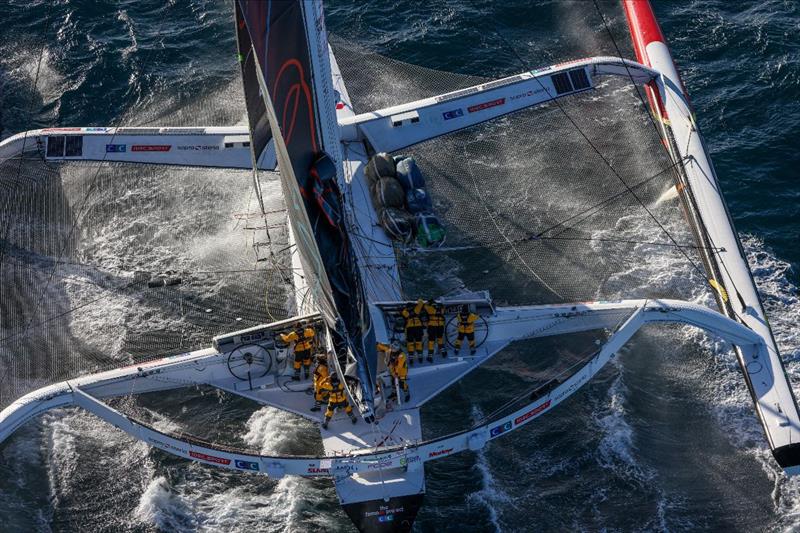
The Famous Project CIC © The Famous Project CIC
A cautious learning process. On the shoulders of giants. Sunday at the Cape of Good Hope?
Router, meteorologist, strategist, Christian Dumard is above all a sailing enthusiast. Weather advisor on more than a dozen round the world record attempts, in addition to advising organizers of no less than three Vendée Globes, three Ocean Races, and two Golden Globes, he is, for the girls of The Famous Project CIC, the voice from land that helps Alexia (Barrier), Dee (Caffari), Annemieke (Bes), Rebecca (Gmür Hornell), Deborah (Blair), Molly (LaPointe), Támara (Echegoyen), and Stacey (Jackson) decipher and figure out the best route to sail around the globe aboard a Maxi Trimaran ocean racing boat.
As The Famous Project CIC approaches the highly symbolic end of the first Atlantic phase of its Jules Verne Trophy voyage in excellent conditions, Christian sees his respect and admiration for this all-female crew grow with every mile. Given the immensity of the challenge, their humble and cautious approach is proving to be the only way to achieve the ambition of "completing the loop" and becoming the first all-female crew to finish the Jules Verne Trophy with the best possible time.
A reasoned introduction
As Alexia, Dee, and their ladies finish their second week at sea, several truths become apparent to the observer, giving this extraordinary adventure all its flavor and spice. Never before has this newly assembled crew sailed together for so long aboard IDEC SPORT. Only three of these women have experience in the southern oceans, and none of them on board a maxi multihull. Very few women have ever sailed in a multihull race around the world, and Tracy Edwards and her "girls" on the Royal and Sun Alliance catamaran, which was forced to abandon the race halfway through, naturally come to mind. Dona Bertarelli on Spindrift and Dame Ellen McArthur on the trimaran B&Q Castorama can boast of having completed a round-the-world trip on a multihull.
"Entering this Jules Verne Trophy cautiously is simply a matter of common sense at sea," emphasizes Christian Dumard. "All these women are showing great professionalism and measured caution, which is entirely justified given their limited experience on this type of exceptional boat, the venerable age of this trimaran launched in 2006, and their ambition to finish this race. I greatly admire their ability to strike the right balance and their incredible serenity. This is a round the world race characterized by kindness, a desire to do well, and sharing, in a calm and cheerful atmosphere. They are taking the time to get into their race and to fully appreciate this incredible boat that few sailors have been able to master. They are improving every day, every mile a little more, and are becoming bolder without panicking or overdoing it. They are taking full measure of the boat's potential, its specific characteristics, and its limits, and are gradually, at their own pace, pushing it further every day. This is a very intelligent approach, which preserves both the crew and the equipment."
At the table of the greats...
Alexia repeats it over and over again: she and her seven women have invited themselves to the table of the greats, on a Jules Verne Trophy that has only seen immense sailors dare to attempt to claim it, such as Peter Blake, Steve Fossett, Olivier de Kersauzon, Bruno Peyron, Franck Cammas, Thomas Coville, and Francis Joyon...
"We are sailing on the shoulders of giants," Alexia Barrier murmured humbly. Their gradual rise to prominence is the result of careful calculation and thoughtful reflection. "The start was slow," admits Dumard, "but justified by the rough sea conditions, with 4-5 meter waves in which the girls didn't want to take any risks. They were right to do so, and they were then able to benefit from a calm trade wind, perfect for continuing their introduction to the race. Admittedly, the doldrums widened as they passed through, causing them to slow down for a whole day. The southeast trade winds were very moderate, allowing the girls to continue learning about the boat and life in a long-term community, and to prepare themselves for the first major challenge of their round the world trip: entering the turbulent waters of the southern hemisphere. A very favorable sequence of events is presenting itself to them as they head for the southern tip of Africa, to be reached in the night between Sunday and Monday, around 16 days after leaving Ouessant."
Entering the Southern Ocean
This is already a reality for the girls of The Famous Project at the end of their second week, as they enter the southern latitudes, the "land of shadows" from which they will only emerge when they round Cape Horn in three to four weeks' time. The immediate weather pattern shows signs of divergence, suggesting that the wind will fluctuate in strength. A line of clouds visible on satellite images lies directly in the boat's path. The gusts under these clouds are described as "not nasty," but still stronger than the established wind, prompting the utmost vigilance. The approach to the Cape of Good Hope immediately presents a very clear choice of route, between a "normal" route to the south and a "conservative" route to the north. The crew and routers agree to stay north for the next 24 to 48 hours to avoid the "very strong" winds and gusts of over 60 knots further south. The southern option is faster but considered too extreme for a first encounter with a southern depression. The conservative route to the north is preferred in order to avoid high seas, allowing the crew to gradually adjust to these new conditions. It should be noted that the Agulhas Current* must be closely monitored. Situations where the wind is contrary to the current, which would cause dangerous seas, should be avoided.
Quick Links:
*The Agulhas Current is a marine current in the Indian Ocean. It takes its name from the South African Cape Agulhas. It flows along the east coast of South Africa, towards the southwest, and is measured at over 4 knots in some places.