
Dinghy and Keelboat racing beyond your budget? Don't lose the racing passion, go radio sailing
by Nigel Barrow 12 Dec 03:07 PST
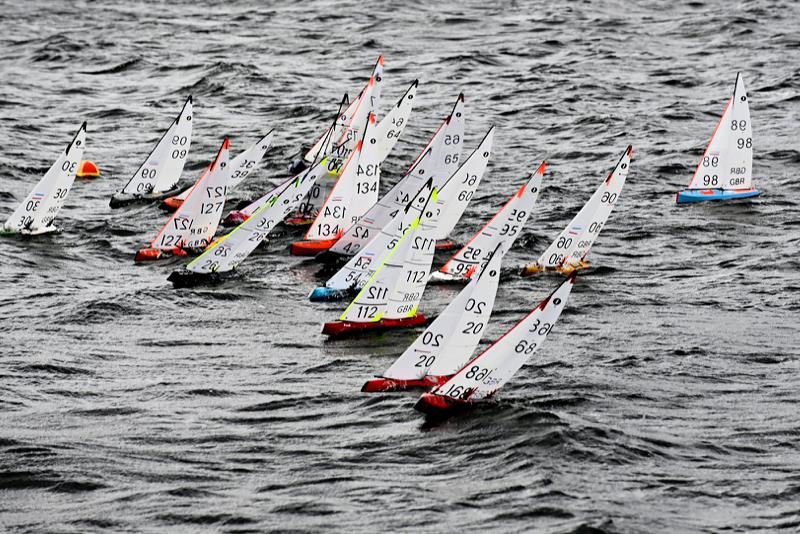
Crowded starts - IOM Ranking round 3 and 4 at Datchet © David Adam
Falling participation in full sized sailing
In a recent post by the Royal Yachting Association introducing their "reflections on the water survey", they started by saying and I quote, "Sailing and boating in the UK are at a crossroads - participation is in decline". Maybe this is true in other countries as well. But not every aspect of participation is falling. Radio sailing is thriving and attracting Olympians, dinghy and keelboat international champions and even some of the most recognisable sailing stars in the world regularly participate in this exciting sport.
The exploding cost of racing
When I first started dinghy racing, we bought boats between £120-£300. They were mainly second hand or home built. My cadet which had a clean sweep of all events in the UK and Internationally in the period 1972/73 was built by a schoolteacher and cost me £130. Club sailing was fun, mainly with second hand boats and many club members travelled as a group to open meetings across the country. The emphasis was on families, fun, support for each other, sail fair with a strict adherence to the rules and of course we all wanted to win. Above all the sport was affordable.
Then I transferred to 470 sailing and cost increased dramatically. I had to travel further, often into Europe. The hull had to be relatively new as they would go soft or break if sailed hard and often. A new jib was needed every other regatta, A mainsail every few regattas and so on. Add to that accommodation and travel and the costs rise exponentially.
Over time, the addition to the sailing game of exotic materials, coaching costs, squad training, international travel, made the price of competitive sailing prohibitive to most people's budgets. I heard from one coach that if you want to campaign a Laser for the Olympics, the cost is upwards of £120k.
Is it a surprise that there are signs of reduced participation. Sailing is becoming too expensive for many.
The Solution to stretched budgets - Radio Yacht Racing
How do you start
If your passion lies in racing boats and you don't want to miss the thrill of matching your skills against fellow competitors, downscale and go radio sailing. More fun, more races, more venues, develop more skills, tiny bills, and if you are ambitious, racing opportunities all over the world. Our sport is thriving, and our clubs are strong and healthy.
Getting into the sport is easy. Find a club near you, go visit and see what they sail and buy one of the classes they race. Wherever you are in the world, you will find a friendly welcome. Radio boat designs come in a variety of shapes and sizes, but the most popular ones are raced all over the world.
The boats are technical marvels
The hulls are made of either carbon fibre, glass epoxy, 3D printed or blow moulded. The fins and rudders are made of carbon. The fittings are micro versions of those used on bigger sister boats. The rigs and sails are highly sophisticated. Fractional or masthead rigs can be made of Aluminium tubes or carbon rods depending on the class rules. Sails are seamed or moulded. Tuning is a skill that takes time to understand. Like a dinghy there can be up to 21 variables on a rig to manage. Thankfully most designers provide a guide to give a baseline set up but millimetre tweaks of adjustment on say the backstay or jib topping lift can be the difference between winning boat speed or just average. It takes time and experience to unravel the rig's mysteries.
Skills you must learn
Once you have understood all of that. You must learn how to sail a boat remotely:
- On the one hand you can see the wind on the course and the position of your boat compared to your competitors.
- On the other hand, you have to learn how to sail the boat remotely. It is difficult but highly satisfying to master, can take a lot of practice to get to the stage where no sooner, for instance, do you sense the need to tack than this is translated through your fingers on the transmitter controls and out to a manoeuvre of the boat on the water - in many ways your consciousness is extended out onto the water.
- Similarly, the challenge of efficiently rounding a mark which can be several dozen yards/metres from where you're standing, rather than a couple of feet abeam.
The excitement of up to about 20 boats vying for position on the start line, the same rewards and punishments depending on whether you get it right or wrong. And the same scope for breath-held tactics in the latter stage of each race... plus you get to do it eight or more times in one session.
Radio sailors are passionate about their sport. They start with one boat but quickly they buy another class and before they know it, they have a small fleet. They are supportive, out to have fun and of course they want to win and there is nothing better than to gather after racing over a tea or something stronger to discuss the days stories, what might have been, the current designs and the latest rumours.
Silencing the doubters
I have encountered many a sailor who looks down on our radio sport saying it is not like the real thing but those who make the transition wish they had moved sooner because they learn so much in a short space of time. Where else can you experience thirty 10-15 minute highly competitive races in a weekend in a sport where, as a skipper you have to manage everything from logistics, boat preparation, weather, tactics, rules and much more. The learning curve is exponential but so rewarding.
If you want to get started in radio sailing, visit the Model Yachting Association web site or alternatively click here for endless information on getting into the sport.
To finish, I quote a couple of recent comments made to me which sum up the main point of this article.
I asked a new radio sailing club member why he bought two brand new top designs instead of initially going for the cheaper second hand option. The answer was "These two boats are less than the price of a headsail for my previous yacht and they will last for years rather than a season".
This second quote popped up in Facebook as a comment to a recent article on YachtsandYachting.com.
"After taking up radio sailing 5 years ago, I recently returned to racing my Laser dinghy after over 30 years. I have learnt so much more about dinghy sailing doing radio sailing. This included sail setting, trimming, starting, and race tactics. I just wish I had started radio sailing sooner."
Come and join us
What are you waiting for. Find a club, go visit, buy a radio boat and go racing. You will find you clubmates helpful, the racing rewarding and the experience invaluable. Your passion for the sport will live on.
Want to see the best in the world in action? Take a look at the last IOM world championships in Australia:
If you need help to get started wherever you are in the world, don't hesitate to contact the MYA Racing officer (i.e. the author) at .
Whatever you race, have fun on and off the water.