
IOM Worlds 2026 at Datchet - Dinghy and Keelboat sailors could learn a lot from radio sailing
by Nigel Barrow 30 Oct 2025 11:30 PDT
15-22 May 2026
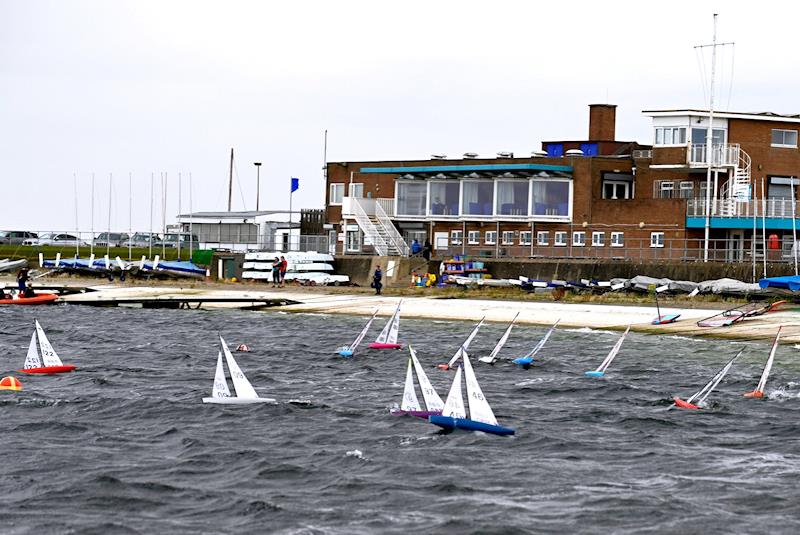
Beating away for the clubhouse - IOM Ranking round 3 and 4 at Datchet © David Adam
Datchet Radio Sailing are hosting the biggest event of the radio sailing world in May next year, the IOM World championships. Competitors from 20 plus countries will participate and the spectacle of the best in the world racing is not to be missed. This is the first of a series of articles that provides background on the sport in the build-up to the event.
There are some in sailing who regard radio sailing as sailing toy boats. The ones who try it learn that the subtleties of design, rig setup, tactics and sharpness of manoeuvring takes a lot of practice to master. There are exceptions to the rule. We have all heard about Ken Read, one weekend sailing in the US radio sailing class DF95 Nationals, coming second to his brother Brad, and in the next week he is doing tactics on a hundred-foot maxi. Ken is a regular in the radio sailing sport and has done a brilliant DF95 tuning guide on Youtube.
What can radio sailing offer the dingy and keelboat sailor?
A radio sailing regatta usually involves a minimum of 8 races and sometimes can deliver up to 20 races in a day. Large fleets (80+) are split into heats with a maximum of 24 boats although the author has sailed in competitive fleets of 30+.
In dinghy and yacht racing there may only be one race a day. Imagine the acceleration of your tactical knowledge you gain with so many starts and races.
Whatever your role on your larger boat, sailing a radio yacht will teach you so much. If you are a crew or deck hand, you will be forced to understand tactics, rig setup and everything outside your scope of activity on the boat. If you are a skipper, radio yacht racing will sharpen your skills so quickly. Many times I hear the comment from bigger boat skippers and crew, I wish I had discovered this earlier. It has taught me so much.
Radio yachts are highly technical, and it is not surprising that some of our top sailors are designers and have decades of experience. If you have never looked at a radio yacht, let me explain how they work.
There are one design classes which are the best to start with as they all have the same gear examples being the DF65 and DF 95. These are boats in a box and quickly assembled with a tube of superglue. Other classes have some freedom in design meaning, one needs to make a choice and live with that decision. Nearly all designs have sweet spots and not so sweet spots.
The radio gear is relatively simple. You have a transmitter which has two control sticks. The left-hand stick is used for the sheeting which controls the main and jib, the right hand stick is for the rudder. There are things you can do with the transmitter to help you round the race-course faster but we won't go into that here.
The trickiest bit is setting up the rig, how much rake, mast bend, sail twist, shroud tension, angle of booms from the centre, what angle to sheet the booms, how much depth on the loose footed main and jib. In fact at the last count on one class of radio yacht I think there were 21 possible variables. The aim is to get the boat to sail upwind and be completely balanced sailing as fast as possible. Easier said than done. Go to any radio sailing club and look at the variety of set ups, some fast, some slow. If you are lucky, your boat will have a setup guide to give you a great starting point.
Once you have all that together you then need to learn to sail it. Dinghy sailors will find it easier than keelboat sailors because things happen very quickly. I have heard a radio yacht manouvres 12 times faster than a yacht because of the scaling effect. Anticipation is key and decisions need to be made quickly.
Aside from the technical and sailing skills, radio sailing is fun and you will experience great camaraderie at any club. The sport is perceived as being for hobbyist, the retired or kids, but as many experienced sailors are learning, radio sailing rapidly develops skill and knowledge that you cannot get just from sailing your dinghy or yacht. Find a club near you and give it a try. You will not be disappointed.
Want to find out more? Contact Nigel Barrow, email